
N-Stereo, Nathaniel Wing’s new stereo-processing plug-in, is currently listed at $0 instead of $29 for Windows, macOS, and Linux users. The offer is live on the developer’s own product page as of August 5, but it has no published end date, no stated redemption limit, and no explicit statement about whether an activation obtained during the promotion remains valid after the price returns.
Bedroom Producers Blog first flagged the giveaway on August 5, describing it as part of a launch promotion for Wing’s new plug-in line. A check of Nathaniel Wing’s product page confirms the free price and the regular $29 price, along with the requirement to enter a real email address to receive an activation code. That makes this a free licensed download rather than an unrestricted portable effect: users will need to retain the activation email and installer.
For Windows music-production users, the meaningful part is that N-Stereo is a native 64-bit VST3 plug-in with a stated minimum of Windows 10 version 1607. It is aimed less at the familiar “make everything wider” one-knob effect and more at direct control over the time and phase relationship between left and right channels—controls that can produce useful spatial movement, but can also cause a mix to fall apart when played in mono.
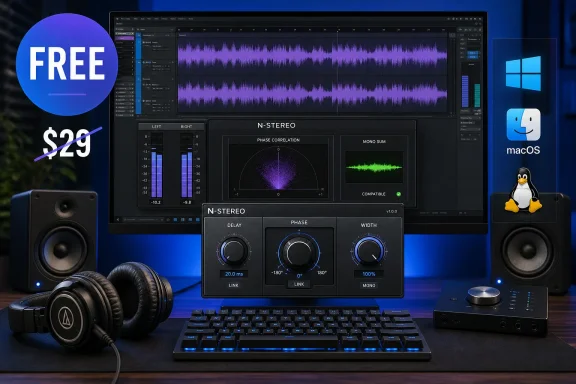
Nathaniel Wing’s product listing displays “FREE” beside the crossed-out $29 price and presents a “Get” button. The page also lists four other plug-ins—Stereo Stabilizer, Tone Equalizer, De-Esser, and 4D Delay—at discounted launch prices, with the five-product bundle shown at $179 rather than $515.
That corroborates the basic promotion reported by Bedroom Producers Blog. The important omission is timing: neither the developer’s N-Stereo page nor the article states when the $0 price expires. “Limited time” is therefore accurate, but it is not actionable as a calendar deadline. Users who want the plug-in should treat the current listing as a short-notice promotion rather than assume it will remain available through a particular week or month.
There is also no published statement on the product page about the long-term status of promotional activations. The vendor asks for an email because it sends an activation code, but does not spell out whether the code is perpetual, tied to a machine, transferable, or subject to a future account system. That does not make the offer suspicious; it simply means the license terms are less clear than the price.
The practical takeaway is straightforward: download the installer and archive the activation email, rather than relying on the product page to remain unchanged.
Those details describe a more deliberate processor than the usual stereo enhancer. Tiny timing offsets between channels can make a mono source feel wider. Phase rotation can change the perceived placement and depth of pads, percussion, backing vocals, doubled guitars, and ambient textures. A channel-polarity reversal can create exaggerated width or a hollow, diffuse character.
The trade-off is mono compatibility. Stereo width created through inter-channel delay or polarity differences can partially cancel when a recording is played through a mono Bluetooth speaker, a club’s summed system, a phone, or a smart speaker. N-Stereo’s mono-summing function and its phase display are therefore not decorative extras; they are the controls users should reach for before committing the effect to a mix.
The plug-in’s inclusion of time and phase analyzers gives it a potentially useful role as a diagnostic utility. A producer can use it to see and hear what a delay or phase change is doing, then check the mono sum before deciding whether the result is a creative effect or a translation problem. That is a more defensible use than inserting it blindly across a master bus.
Stereo processing is especially easy to misjudge on headphones. A sound can seem bigger and more exciting in a wide headphone image while losing center information, punch, or tonal balance in mono. Users should audition N-Stereo on a key stem or a send return first, then compare stereo and mono at matched output level. A wider sound is not automatically a better mix.
The supported format is VST3, with AU also listed for the macOS build. That should make N-Stereo straightforward to load in Windows DAWs with VST3 support, including REAPER, Cubase, Studio One, Ableton Live, FL Studio, Cakewalk Sonar, and Adobe Audition. The developer also lists Pro Tools, but adds a material limitation: it works only through a VST3 patcher. Pro Tools users should not read the compatibility badge as native AAX support.
Linux support is the standout claim here because commercial plug-ins often stop at Windows and macOS. But it is also narrowly framed. The vendor specifies Ubuntu LTS releases, not a universal Linux build across every distribution and desktop configuration. Users on Fedora, Arch, Debian, Mint, or immutable distributions should not assume support merely because the plug-in is called “Linux compatible.”
The macOS requirements contain a genuine documentation error. The technical-specification block says “macOS: 10.11 Catalina or higher.” macOS 10.11 is El Capitan; Catalina is macOS 10.15. Those are four major OS releases apart. Bedroom Producers Blog repeated the 10.11-or-later version claim, but the developer page does not resolve whether N-Stereo actually supports El Capitan, Catalina, or a later baseline.
That inconsistency matters more than it may seem. A plug-in that supports both Intel Macs and Apple Silicon almost certainly has a more modern toolchain than a literal macOS 10.11 baseline suggests, but that is an inference—not a published compatibility promise. Mac users should verify the installer’s actual requirements before treating the product-page line as authoritative.
That is a normal launch strategy, but the distinction matters for anyone building a stable production setup. N-Stereo may be worth collecting as a no-cost phase and delay tool, yet there is not enough independent reporting or long-term user feedback available today to judge update cadence, support responsiveness, installer maintenance, or how the plug-in behaves across a broad range of hosts. The product line is new enough that those operational details remain unproven.
The vendor’s page promises high-resolution processing, CPU optimization, preset management, resizeable HiDPI interface support, undo and redo, and keyboard shortcuts. Those are welcome quality-of-life claims, but they are vendor claims, not independent test results. The same restraint applies to the page’s broad “compatible with any DAW” language: host format support is the real gatekeeper, and Pro Tools already requires an additional compatibility layer.
For Windows users, the sensible use case is narrow and practical: install N-Stereo as a VST3 utility, test it on a duplicate track or return bus, and make mono checking part of the workflow. The free price makes that experimentation easy. The absence of a published expiry date means waiting for a more convenient time carries the only obvious cost.
For Windows music-production users, the meaningful part is that N-Stereo is a native 64-bit VST3 plug-in with a stated minimum of Windows 10 version 1607. It is aimed less at the familiar “make everything wider” one-knob effect and more at direct control over the time and phase relationship between left and right channels—controls that can produce useful spatial movement, but can also cause a mix to fall apart when played in mono.
The promotion is real, but the deadline is missing
Nathaniel Wing’s product listing displays “FREE” beside the crossed-out $29 price and presents a “Get” button. The page also lists four other plug-ins—Stereo Stabilizer, Tone Equalizer, De-Esser, and 4D Delay—at discounted launch prices, with the five-product bundle shown at $179 rather than $515.That corroborates the basic promotion reported by Bedroom Producers Blog. The important omission is timing: neither the developer’s N-Stereo page nor the article states when the $0 price expires. “Limited time” is therefore accurate, but it is not actionable as a calendar deadline. Users who want the plug-in should treat the current listing as a short-notice promotion rather than assume it will remain available through a particular week or month.
There is also no published statement on the product page about the long-term status of promotional activations. The vendor asks for an email because it sends an activation code, but does not spell out whether the code is perpetual, tied to a machine, transferable, or subject to a future account system. That does not make the offer suspicious; it simply means the license terms are less clear than the price.
The practical takeaway is straightforward: download the installer and archive the activation email, rather than relying on the product page to remain unchanged.
N-Stereo is a phase-and-delay tool, not a safe default widener
Wing describes N-Stereo as a tool to control phase and delay between the left and right channels. Its advertised feature set includes independent channel delay control, phase control, time and phase analyzers, second-order all-pass processing, mono summing, presets, and the ability to specify delay in milliseconds, seconds, samples, meters, or feet.Those details describe a more deliberate processor than the usual stereo enhancer. Tiny timing offsets between channels can make a mono source feel wider. Phase rotation can change the perceived placement and depth of pads, percussion, backing vocals, doubled guitars, and ambient textures. A channel-polarity reversal can create exaggerated width or a hollow, diffuse character.
The trade-off is mono compatibility. Stereo width created through inter-channel delay or polarity differences can partially cancel when a recording is played through a mono Bluetooth speaker, a club’s summed system, a phone, or a smart speaker. N-Stereo’s mono-summing function and its phase display are therefore not decorative extras; they are the controls users should reach for before committing the effect to a mix.
The plug-in’s inclusion of time and phase analyzers gives it a potentially useful role as a diagnostic utility. A producer can use it to see and hear what a delay or phase change is doing, then check the mono sum before deciding whether the result is a creative effect or a translation problem. That is a more defensible use than inserting it blindly across a master bus.
Stereo processing is especially easy to misjudge on headphones. A sound can seem bigger and more exciting in a wide headphone image while losing center information, punch, or tonal balance in mono. Users should audition N-Stereo on a key stem or a send return first, then compare stereo and mono at matched output level. A wider sound is not automatically a better mix.
Windows support is specific; macOS support is not
The developer lists N-Stereo for 64-bit Windows, macOS on both Apple Silicon and Intel, and 64-bit Linux. On Windows, the stated floor is Windows 10 version 1607 or later. On Linux, the supported range is specifically Ubuntu 22.04 through 24.04 LTS.The supported format is VST3, with AU also listed for the macOS build. That should make N-Stereo straightforward to load in Windows DAWs with VST3 support, including REAPER, Cubase, Studio One, Ableton Live, FL Studio, Cakewalk Sonar, and Adobe Audition. The developer also lists Pro Tools, but adds a material limitation: it works only through a VST3 patcher. Pro Tools users should not read the compatibility badge as native AAX support.
Linux support is the standout claim here because commercial plug-ins often stop at Windows and macOS. But it is also narrowly framed. The vendor specifies Ubuntu LTS releases, not a universal Linux build across every distribution and desktop configuration. Users on Fedora, Arch, Debian, Mint, or immutable distributions should not assume support merely because the plug-in is called “Linux compatible.”
The macOS requirements contain a genuine documentation error. The technical-specification block says “macOS: 10.11 Catalina or higher.” macOS 10.11 is El Capitan; Catalina is macOS 10.15. Those are four major OS releases apart. Bedroom Producers Blog repeated the 10.11-or-later version claim, but the developer page does not resolve whether N-Stereo actually supports El Capitan, Catalina, or a later baseline.
That inconsistency matters more than it may seem. A plug-in that supports both Intel Macs and Apple Silicon almost certainly has a more modern toolchain than a literal macOS 10.11 baseline suggests, but that is an inference—not a published compatibility promise. Mac users should verify the installer’s actual requirements before treating the product-page line as authoritative.
The free plug-in is also the entry point to a new product range
Wing’s site frames N-Stereo as one of five audio plug-ins, alongside a stereo stabilization processor, equalizer, de-esser, and delay effect. The wider pricing structure shows what the free offer is doing: it puts a focused utility in front of users while the surrounding commercial range is discounted.That is a normal launch strategy, but the distinction matters for anyone building a stable production setup. N-Stereo may be worth collecting as a no-cost phase and delay tool, yet there is not enough independent reporting or long-term user feedback available today to judge update cadence, support responsiveness, installer maintenance, or how the plug-in behaves across a broad range of hosts. The product line is new enough that those operational details remain unproven.
The vendor’s page promises high-resolution processing, CPU optimization, preset management, resizeable HiDPI interface support, undo and redo, and keyboard shortcuts. Those are welcome quality-of-life claims, but they are vendor claims, not independent test results. The same restraint applies to the page’s broad “compatible with any DAW” language: host format support is the real gatekeeper, and Pro Tools already requires an additional compatibility layer.
For Windows users, the sensible use case is narrow and practical: install N-Stereo as a VST3 utility, test it on a duplicate track or return bus, and make mono checking part of the workflow. The free price makes that experimentation easy. The absence of a published expiry date means waiting for a more convenient time carries the only obvious cost.
References
- Primary source: Bedroom Producers Blog
Published: 2026-08-05T15:04:32+00:00
Nathaniel Wing’s N-Stereo for macOS, Windows, and Linux is FREE for a limited time - Bedroom Producers Blog
Developer Nathaniel Wing’s N-Stereo for macOS, Windows, and Linux is now available for free for a limited time. Stereo enhancers and effects plugins have been relatively popular in 2026, with multiple freebies coming just in the last few months. In July, we had a couple of stereo-widening...bedroomproducersblog.com - Related coverage: mlb.com
Summer Concert Series Free Ticket Offer | Washington Nationals
Catch a free Nationals game and postgame concert! Harris Teeter, Coca-Cola and the Nationals are teaming up this summer to offer you a chance to see a Nationals game AND a postgame concert for FREE!www.mlb.com - Related coverage: thevelvetshadow.com
100+ Free Effect VST Plugins - The Velvet Shadow
A list of 100+ free effect vst plugins to download. Features delays, compressors, glitch, flangers, distortion, drum achines, phasers & chorus plugins.thevelvetshadow.com - Related coverage: thebeatcommunity.com
Marek Dendes Releases AudioPipeline - A FREE Download - The Beat Community
Marek Dendes has released AudioPipeline, available as a FREE download. The first app on the App Store with a true RECEIVER plugin for Ableton Link Audio, AudioPipeline is set of three AUv3 plugins – Seno audio effect) and Receive (instrument/effect) – that stream live audio between AUv3 hosts...thebeatcommunity.com - Related coverage: barnesandnoble.com
Summer Reading Free Book Giveaway | Barnes & Noble®
Barnes & Noble’s online bookstore for books, NOOK ebooks & magazines. Shop music, movies, toys & games, too. Receive free shipping with your Barnes & Noble Membership.www.barnesandnoble.com - Related coverage: audioz.download
Download Nasko N-STEREO+ [LIVE 11]-FANTASTiC » AudioZ
FANTASTiC | 08 April 2024 | 14 KB This ableton live rack lets you create your own mono-compatible, complex parallel stereoization effects with ease. N-STEREO+ turns stereo effects parallel withoutaudioz.download
- Related coverage: worldradiohistory.com