
The immediate objective is commercial: install propulsion “jetpacks” on satellites whose communications payloads still work but whose onboard propellant has become too limited for routine station-keeping. But the mission also places a highly dexterous U.S.-developed robotic system into the same crowded geostationary environment that hosts strategically vital communications, weather, intelligence, and military spacecraft. A vehicle capable of approaching, examining, gripping, relocating, and modifying another satellite is inherently a dual-use space technology—useful for sustainability and resilience, but potentially relevant to orbital conflict.
That does not make MRV a weapon. Its first mission is explicitly a servicing demonstration and commercial life-extension effort. Yet it does mean the United States has launched a platform that embodies the difficult engineering foundations of close-proximity operations: autonomous navigation, relative motion control, visual inspection, robotic manipulation, and safe operations near satellites that were never designed to be serviced.
For Windows and technology enthusiasts, the story is also a striking example of what happens when advanced robotics, autonomy, high-reliability computing, machine vision, and government-backed research leave the laboratory. MRV is effectively a robotic maintenance platform operating 22,000 miles above Earth, where a software error, a navigation fault, or an unexpected movement cannot be resolved with a service truck and a spare part.
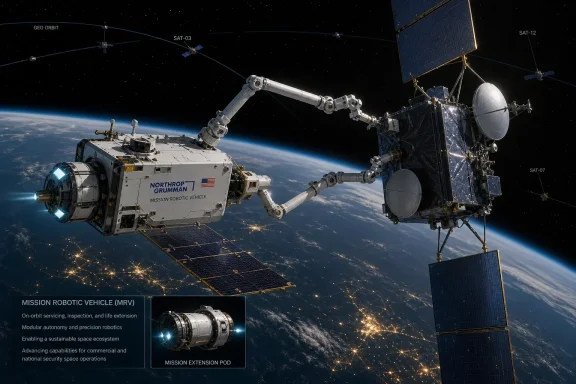 The Mission Robotic Vehicle’s Immediate Job: Extending Satellite Life
The MRV mission is built around a simple but expensive problem: many geostationary satellites remain capable of delivering television, broadband, data, or government communications after they approach the end of their designed fuel reserves. Their communications equipment may still be productive, but without enough propellant for station-keeping and maneuvering, operators eventually have to retire the spacecraft.
Northrop Grumman’s answer is the Mission Extension Pod, a compact propulsion module that can be attached to a client satellite. Rather than attempting a full internal refueling operation, the MEP acts as an external propulsion package, effectively taking over a portion of the satellite’s orbital mobility responsibilities. Northrop characterizes the MEP concept as a “jet pack” intended to extend a client satellite’s mission.
This distinction matters. Reports sometimes group satellite servicing, repairs, relocation, refueling, and life extension together, but these are technically different services. MRV’s initial MEP installations are about adding propulsion capability, not pumping propellant directly into an aging spacecraft’s existing tanks. Northrop Grumman is pursuing on-orbit refueling through a separate effort known as Elixir, which is intended to demonstrate refueling technology with a client satellite. The company has described Elixir as a future refueling payload development and demonstration program.
The vehicle will take considerable time to reach operational altitude. The Falcon 9 launch placed the mission on a route toward geostationary orbit, approximately 36,000 kilometers above Earth, where the MRV and its payloads are expected to spend roughly 14 months reaching the right orbit and configuration for servicing work. Aerospace America reported that the spacecraft and its three pods would need about 14 months to reach GEO.
Once there, the cargo-van-sized service vehicle is expected to retrieve and install the MEPs one at a time using its robotic arms. The arms are approximately three meters long, a scale that illustrates the precision involved: the MRV must maneuver near a multi-ton satellite moving at orbital velocity, synchronize its movements with the target, and conduct an installation without causing a collision, damaging antennas, or disturbing the host vehicle’s attitude control. The planned operation and arm length were outlined by Aerospace America ahead of launch.
The Commercial Value Proposition
The most immediate commercial appeal is straightforward: satellite operators may be able to defer the enormous cost and schedule risk of replacing an otherwise functional spacecraft. In geostationary orbit, a satellite can represent years of development, launch procurement, insurance, spectrum planning, ground-system integration, and regulatory work.
The MEP approach also aims to make life extension more flexible than Northrop’s earlier Mission Extension Vehicle (MEV) architecture. The MEV physically docked with a client satellite and then remained attached as the satellite’s propulsion and attitude-control partner. By contrast, an MEP is intended to be installed as an independent enhancement, potentially allowing the MRV to move on to another client after completing the task.
Northrop Grumman has already demonstrated that commercial satellite life extension is more than a concept. Its earlier MEV spacecraft extended the operational life of two commercial Intelsat communications satellites, giving the company a flight heritage that reduces some of the uncertainty around the business case. Northrop says its MEV program made it the first company to extend the life of commercial satellites running low on fuel.
The three MEPs launched with MRV are not simply generic hardware awaiting an unknown assignment. Pre-launch reporting indicated that two were intended for commercial satellites associated with SES of Luxembourg and Optus of Australia, while the plans for the third pod were not publicly detailed. Aerospace America reported the intended SES and Optus assignments, and noted that Northrop did not disclose the third pod’s plan.
That reserved third pod is a reminder that satellite servicing is not a consumer-style product category with a predictable installation schedule. Each operation depends on orbital geometry, spacecraft configuration, customer contracts, insurance, satellite health, licensing, and operational safety reviews. The technology may be repeatable, but every target satellite is its own engineering case.
A DARPA Robotics Program Reaches Orbit
MRV did not emerge solely from a commercial product roadmap. Its robotic payload is rooted in the Pentagon’s long-running Robotic Servicing of Geosynchronous Satellites (RSGS) program, a public-private effort led by the Defense Advanced Research Projects Agency.
DARPA’s central objective was ambitious from the start: develop technologies for inspection and servicing of satellites in geosynchronous orbit, including spacecraft that were not designed with servicing ports, standardized robotic interfaces, or repair access in mind. DARPA’s RSGS program identifies cooperative inspection and servicing in GEO as its core purpose.
In 2020, DARPA partnered with Northrop Grumman subsidiary SpaceLogistics. The partnership placed the company in charge of the spacecraft bus, launch, and operations, while DARPA funded the advanced robotic servicing capability developed with the U.S. Naval Research Laboratory. DARPA described the arrangement as a government-commercial partnership that would allow commercial use of the robotic payload after its on-orbit demonstration.
The result is more sophisticated than a remotely controlled claw. DARPA’s described payload includes:
- Two robotic arms for dexterous manipulation.
- Multiple tools and equipment stowage locations.
- Cameras and illumination for target inspection.
- On-orbit calibration and checkout equipment.
- Robotics-control avionics and advanced flight software.
- The ability to operate around satellites that may be old, non-cooperative, and never intended to receive a visitor. DARPA detailed these payload elements during the program’s pre-launch test phase.
The long path to launch says something important about the maturity threshold for orbital robotics. RSGS was not a quick prototype project. It required vacuum testing, thermal testing, component validation, integration of robotic hardware with a spacecraft bus, and a mission architecture capable of safely handling proximity operations in GEO. The Naval Research Laboratory completed cryogenic thermal-vacuum testing of the RSGS payload before the mission’s flight phase.
Why the Arms Matter
The MRV’s robotic arms are the defining difference between a spacecraft that can merely dock and a platform that can perform work. Docking systems are designed around specific target interfaces and carefully choreographed approaches. Robotics creates a much broader set of possible actions: surveying a satellite’s exterior, positioning a tool, grasping a fixture, installing external hardware, or supporting a future repair operation.
That flexibility is why the technology has so much potential for both commercial and national-security customers. A robotic servicing vehicle could eventually support tasks such as:
- Inspecting spacecraft after an anomaly or debris encounter.
- Installing propulsion or power-related hardware.
- Repositioning cooperative satellites.
- Supporting modular upgrades in orbit.
- Removing or relocating selected debris objects.
- Assisting with the retirement of obsolete spacecraft.
- Helping operators maintain critical services after a satellite’s original fuel budget has been exhausted.
The capability is especially significant in GEO, where satellites remain over fixed regions of Earth and where the loss of a communications platform can affect broadcasters, governments, airlines, enterprise networks, and military users. A successful servicing model could transform GEO from a “launch it and hope it lasts” environment into one where hardware can be maintained, augmented, or repositioned during its operational life.
The Important Caveat: Servicing Hardware Is Also Proximity Hardware
The phrase dual-use technology is often overused, but it fits orbital servicing unusually well. The same systems that let MRV safely approach and manipulate a cooperative commercial satellite could, at least in principle, support more coercive missions if a government developed separate policy, payload, authorization, and operational frameworks around them.
That does not mean a commercial MEP installation mission should be conflated with an anti-satellite operation. The distinction is critical. An object designed to install a propulsion pod on a consenting customer’s satellite is not equivalent to a dedicated counterspace weapon.
Still, the underlying capabilities overlap. To inspect, repair, or relocate a satellite, a servicer must master:
- Rendezvous — reaching a target spacecraft’s orbit.
- Relative navigation — understanding position, speed, orientation, and movement at close range.
- Proximity operations — maneuvering safely around antennas, solar arrays, sensors, and propulsion systems.
- Robotic manipulation — contacting, gripping, or installing equipment without inducing damaging forces.
- Autonomous fault handling — responding to communication delays, unexpected target motion, or sensor uncertainty.
- Mission assurance — avoiding debris creation or unintended damage in a highly valuable orbital region.
Those are also the components needed for a spacecraft to interfere with, inspect, shadow, move, or potentially disable another satellite. In other words, the dual-use concern is based on the physics and control problem, not on speculative descriptions of MRV’s announced mission.
Northrop Grumman CEO Kathy Warden captured the policy divide in comments reported after the launch. Asked about possible military applications, she said that determining how such a capability might fulfill U.S. government objectives would be up to the government, while the company’s role was to provide technology options. Warden’s comments were reported by TechRadar in coverage of MRV’s potential counterspace relevance.
That answer is appropriately cautious. Technology providers can build maneuverable spacecraft, robotic arms, sensing systems, and autonomous control stacks. Governments set doctrine, rules of engagement, acquisition priorities, classification boundaries, and legal policy for national-security employment.
Orbital Warfare Is No Longer an Abstract Planning Exercise
The strategic backdrop is not theoretical. The U.S. Space Force now openly describes orbital warfare as a formal mission area, including the development of operational concepts, tactics, techniques, procedures, on-orbit demonstrations, and training for space forces. Mission Delta 9’s official fact sheet says the unit develops orbital engagement concepts and conducts live on-orbit experiments and demonstrations.
That institutional reality changes how systems like MRV will be perceived internationally. In earlier decades, a robotic maintenance spacecraft might have been viewed almost exclusively as an engineering breakthrough. Today, any satellite able to move deliberately near another high-value orbital asset attracts attention from defense analysts, tracking organizations, and rival governments.
The Space Force has warned that other nations possess or are developing on-orbit capabilities relevant to satellite interference. A spokesperson cited China’s Shi Jian 21 satellite, which has a grappling arm, as an example of an acknowledged capability relevant to the discussion of space-based interceptors. The Space Force comment was reported by The War Zone in its examination of MRV’s dual-use implications.
The central issue is not whether every satellite with a robotic arm is offensive. It plainly is not. The concern is that activities such as inspection, towing, debris removal, servicing, refueling, and repair rely on close-proximity operations—and close-proximity operations can be difficult for outside observers to interpret in real time.
A servicing spacecraft approaching a cooperative client may be conducting a legitimate commercial mission. A similar vehicle approaching an adversary’s spacecraft without consent could be viewed as surveillance, interference, pre-attack positioning, or a direct threat. Intent may be invisible from the ground; capability and trajectory are easier to observe, but do not always explain purpose.
The Risk of Misinterpretation
This ambiguity creates one of the major risks around the expansion of orbital servicing. The more countries and companies field maneuverable robotic spacecraft, the more routine close approaches may become. That is beneficial for a space economy built around maintenance and reuse, but it also increases the potential for misunderstanding.
A few principles will become increasingly important:
- Advance notification of commercial servicing operations where possible.
- Clear licensing and registration of servicer spacecraft.
- Publicly communicated safety practices for approach and docking.
- Shared norms around no-contact or no-interference zones.
- Better space-domain awareness data for commercial and government operators.
- Robust channels for deconfliction during unexpected close approaches.
The alternative is an orbital environment in which legitimate maintenance activity and suspected hostile action are difficult to tell apart until the encounter is already underway. That uncertainty could encourage worst-case assumptions, especially during a geopolitical crisis.
The Benefits Are Bigger Than a Single Satellite Repair
Despite the strategic complications, MRV represents an important advance in the push toward a more sustainable space economy. Satellites have historically been expensive, specialized systems with limited opportunities for repair after launch. Their end-of-life often follows the depletion of a consumable resource rather than the failure of their most valuable instruments.
Life extension changes the economics. If a satellite can keep delivering services for additional years through an attached propulsion module, the operator may preserve revenue, maintain customer continuity, and defer a replacement launch. The Associated Press characterized the mission as part of a growing effort to keep working satellites in service longer and avoid replacement costs.
The technology could also improve resilience. A satellite operator with access to servicing vehicles may have more options after a minor failure, an unexpected fuel shortage, or a need to reposition capacity. Governments could see similar value in maintaining critical communications and sensing infrastructure without relying solely on launching replacement spacecraft.
In the longer term, robotic servicing could support a more modular model for space hardware. Rather than building every satellite as a sealed, all-or-nothing system, manufacturers could increasingly consider replaceable components, service-friendly fixtures, standardized interfaces, and in-orbit upgrade pathways.
That would be a major shift for the industry. It could encourage spacecraft designs that anticipate maintenance from day one, much as enterprise technology vendors plan for firmware updates, component replacement, diagnostics, and lifecycle management.
A New Market Needs Standards
However, satellite servicing will not become routine merely because MRV succeeds technically. The business will need common standards.
A viable on-orbit servicing ecosystem requires progress in areas including:
- Mechanical interfaces that robotic arms can safely grasp.
- Standardized refueling and power connectors.
- Machine-readable digital models of client spacecraft.
- Shared navigation and inspection protocols.
- Insurance structures tailored to proximity operations.
- Regulatory clarity across national licensing systems.
- Cybersecurity controls for commands, telemetry, robotic software, and mission planning.
The cybersecurity issue deserves particular emphasis. A robotic satellite servicer is an unusually consequential connected system. Ground controllers need secure access to spacecraft operations, but any compromise of command authority, navigation data, imaging feeds, or robotic control logic could be catastrophic.
The future of satellite servicing will therefore depend not only on arm mechanics and propulsion. It will depend on zero-trust mission operations, hardened command links, high-integrity software updates, telemetry anomaly detection, and strict separation between customer systems. In orbital robotics, cyber resilience is a physical safety requirement.
What MRV Does—and Does Not—Signal
The MRV launch does not mean the United States has suddenly deployed an operational satellite-fighting robot. It means a U.S. company and government research partners have placed a sophisticated robotic servicing platform on the path to GEO, where it is expected to demonstrate commercial life-extension work.
That accomplishment alone is substantial. The technical hurdles involved in operating robotic arms near aging, non-cooperative satellite designs are immense. The ability to inspect and modify such spacecraft could make orbital infrastructure more durable, more flexible, and less wasteful.
At the same time, it would be naive to ignore the security context. The U.S. Space Force is investing in orbital warfare organizations and concepts, while the service is also building a Space-Based Interceptor program intended to demonstrate integration into the proposed Golden Dome architecture by 2028. Space Systems Command says the interceptor program is being developed in support of Golden Dome and will incorporate space-based tracking, advanced interceptors, and artificial intelligence.
MRV belongs to a different category from a missile-defense interceptor. Yet both developments point in the same broad direction: space is becoming more operationally active, more maneuverable, more automated, and more strategically contested.
The strongest case for MRV is not military. It is economic and practical. Satellites cost too much, take too long to build, and provide too many essential services to discard simply because they need propulsion support or external maintenance. A successful robotic servicing industry could create a more durable orbital infrastructure and reduce the pressure to replace functional systems prematurely.
Its greatest risk is not that servicing itself is inherently destabilizing. The risk is that, without transparent norms and clear distinctions between cooperative servicing and coercive proximity operations, the same technologies that make space more sustainable could make orbital intentions harder to read.
Northrop Grumman’s MRV is therefore more than a robotic satellite mechanic. It is an early, tangible example of a new class of spacecraft: one that can preserve valuable infrastructure, expand the economics of satellite operations, and force policymakers to confront the reality that in orbit, the tools of repair and the tools of interference can sometimes be built on the same technological foundation.
