
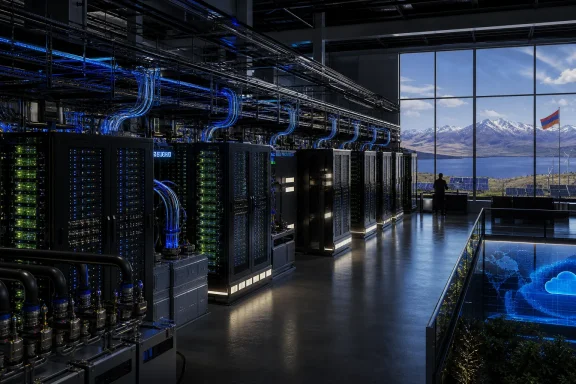
Prime Minister Nikol Pashinyan has visited Eleveight AI’s data center in Gagarin, Gegharkunik Province, putting political weight behind Armenia’s attempt to turn high-performance AI computing into national infrastructure rather than a collection of isolated startup projects. The facility, described by Armenpress and the Prime Minister’s Office as Armenia’s and the South Caucasus’ first AI factory powered by NVIDIA Blackwell B300 technology, is already moving from launch-stage symbolism to a capacity-and-power expansion challenge.
During the visit, Pashinyan was briefed on the site’s technical capabilities, the status of its build-out and planned projects. The immediate commercial signal is striking: according to the government readout carried by Armenpress, available initial capacity was fully reserved within a month of launch, with demand coming from Armenian and overseas customers.
That does not make Gagarin a hyperscale rival to Microsoft Azure, AWS or Google Cloud. It does, however, make it a consequential regional deployment of current-generation NVIDIA accelerators at a moment when access to advanced compute is increasingly shaped by export controls, energy availability and data-sovereignty requirements.
“AI factory” is the industry term for a data center designed primarily to generate AI output: training models, tuning them for specialised work, running inference at scale, and delivering GPU resources as a cloud service. The critical asset is not merely the presence of B300 GPUs. It is the complete system around them: high-bandwidth networking, storage, redundant power, cooling, orchestration software and physical security.
For Windows-focused organisations, that distinction matters. A company may run its business on Windows Server, Active Directory, SQL Server, Power BI, Windows 11 endpoints and .NET applications, while using a remotely hosted Linux-based GPU cluster for model training and inference. The useful outcome is not an Armenian desktop operating system or a Windows-specific AI stack; it is access to regional accelerated compute that can sit behind APIs, private links, containers and conventional enterprise identity controls.
Eleveight’s original launch materials described the Gagarin site as built to NVIDIA Reference Architecture standards and aimed at generative-model training along with public- and private-sector digital services. Armenia’s Ministry of High-Tech Industry also said the center would support large-scale AI workloads and let international customers deploy projects without major technical-integration work.
That is the practical proposition facing regional buyers: rather than buying, housing and operating a scarce GPU fleet themselves, they can rent compute capacity. For a bank developing fraud-detection models, a university working on Armenian-language models, or an engineering company processing imagery and simulation data, that can turn a capital-intensive hardware program into an operating expense.
The downside is familiar to every infrastructure team that has watched a cloud pilot become production critical. Once a workflow depends on a particular GPU provider, the questions become contractual and operational: where is data stored, how is it isolated, which identity systems connect to it, what happens during a network failure, and how portable are models and datasets if pricing or capacity changes?
The August 1 government account frames the first phase as a 5 MW facility with an eventual expansion to 40 MW, alongside a $150 million first-phase investment program and roughly $70 million already invested. Earlier company and ministry announcements had described up to $120 million in first-phase investment, while the Ministry of High-Tech Industry’s June opening announcement referred to $70 million invested initially and a further $50 million planned by year-end.
Those differences should not be treated as a minor accounting footnote. They show a project whose public capacity and spending figures are being revised as construction, equipment deliveries and commercial commitments develop. The firm’s claim that capacity was reserved shortly after launch is corroborated by NEWS.am Tech, but its report refers specifically to the 1.5 MW live deployment rather than the full 5 MW target now discussed by the Prime Minister’s Office.
For IT decision-makers, the distinction is important. A data center can have a 40 MW roadmap while offering a much smaller amount of usable GPU capacity today. “Reserved” capacity can also mean different things: signed long-term commitments, customer pre-bookings, internal allocations, or hardware already accessible through a production service. Prospective customers will want defined availability commitments, not only ambitious power figures.
The government has already treated that connection as strategic. In June, Pashinyan chaired a consultation on the separate Firebird Artificial Intelligence Data Center project, where officials discussed current activity and future programs. Armenia’s High-Tech Ministry has promoted a broader “AI Factory Park” ambition, framing high-performance computing, models, research laboratories and technology companies as parts of one ecosystem.
Eleveight has said its Gagarin operation uses natural-cooling approaches, a closed-loop cooling system and renewable-energy support, although those are company and ministry descriptions rather than independently audited environmental metrics. The claims are nevertheless aimed at the central constraint of AI infrastructure: delivering large quantities of electricity economically while avoiding water and cooling bottlenecks.
The power question is especially relevant because a GPU cluster is not an appliance that can safely operate like an office server room. Training runs can occupy hundreds of accelerators for days or weeks. A sustained power disruption, cooling failure or network partition can interrupt expensive jobs, damage service-level commitments and force customers to redesign workloads around checkpointing and recovery.
That means the next phase will be judged less by headline GPU counts than by mundane but essential measures: grid redundancy, backup generation, power-purchase arrangements, fiber diversity, latency to customer markets, DDoS protection, staffing and the ability to replace failed components. These are the same operational basics that determine whether an enterprise cloud platform is dependable after the launch event is over.
According to the August 1 Prime Minister’s Office readout, that partnership resulted in authorisation to export NVIDIA Blackwell B300 processors to Armenia. Previous reporting by Armenia’s High-Tech Ministry similarly said Eleveight’s project became possible because of a U.S. export license for advanced GPUs.
That is a major differentiator. NVIDIA’s highest-end accelerators are not commodities that can be purchased, shipped and resold without oversight. Advanced AI chips sit within a closely controlled global supply chain, and access can depend on end-use assurances, location, customer screening and future policy decisions.
For Armenia, the opportunity is to offer sovereign compute—capacity located in the country and governed under local commercial and legal arrangements—while maintaining access to leading U.S. technology. For customers, that can be attractive where data residency, lower regional latency or geopolitical risk make a distant public cloud less appealing.
But sovereignty is not absolute independence. The chips, firmware, software ecosystem, supply chain and export permissions remain deeply linked to foreign vendors and governments. Any organisation placing sensitive workloads in the facility should evaluate that dependency as carefully as it would evaluate a U.S. or European cloud provider’s regional footprint.
Those commitments point to the only durable way a facility like Gagarin can matter locally. GPU capacity alone does not create a national AI sector. It has to be paired with engineers who can run distributed workloads, researchers who can build useful models, legal frameworks for sensitive data, businesses willing to pay for deployment, and a talent pipeline that remains in the country after gaining scarce skills.
For Windows administrators and IT leaders, the local ecosystem matters because enterprise adoption is rarely limited by the GPU. The work is usually integration: connecting line-of-business data, implementing least-privilege access, retaining audit logs, securing endpoints, governing model output and making services manageable through familiar systems such as Microsoft Entra ID, Defender, SIEM platforms and endpoint management tools.
Pashinyan’s visit therefore marks a more meaningful stage than a ceremonial opening. Eleveight AI has hardware on site, customers are reportedly booking the early capacity, and the government is openly tying the deployment to broader industrial policy. The test now is whether the expansion from an operational 1.5 MW deployment toward 5 MW—and eventually 40 MW—can deliver reliable, secure, competitively priced compute rather than only a prominent national technology headline.
That does not make Gagarin a hyperscale rival to Microsoft Azure, AWS or Google Cloud. It does, however, make it a consequential regional deployment of current-generation NVIDIA accelerators at a moment when access to advanced compute is increasingly shaped by export controls, energy availability and data-sovereignty requirements.
 The factory is selling compute, not just hardware
“AI factory” is the industry term for a data center designed primarily to generate AI output: training models, tuning them for specialised work, running inference at scale, and delivering GPU resources as a cloud service. The critical asset is not merely the presence of B300 GPUs. It is the complete system around them: high-bandwidth networking, storage, redundant power, cooling, orchestration software and physical security.For Windows-focused organisations, that distinction matters. A company may run its business on Windows Server, Active Directory, SQL Server, Power BI, Windows 11 endpoints and .NET applications, while using a remotely hosted Linux-based GPU cluster for model training and inference. The useful outcome is not an Armenian desktop operating system or a Windows-specific AI stack; it is access to regional accelerated compute that can sit behind APIs, private links, containers and conventional enterprise identity controls.
Eleveight’s original launch materials described the Gagarin site as built to NVIDIA Reference Architecture standards and aimed at generative-model training along with public- and private-sector digital services. Armenia’s Ministry of High-Tech Industry also said the center would support large-scale AI workloads and let international customers deploy projects without major technical-integration work.
That is the practical proposition facing regional buyers: rather than buying, housing and operating a scarce GPU fleet themselves, they can rent compute capacity. For a bank developing fraud-detection models, a university working on Armenian-language models, or an engineering company processing imagery and simulation data, that can turn a capital-intensive hardware program into an operating expense.
The downside is familiar to every infrastructure team that has watched a cloud pilot become production critical. Once a workflow depends on a particular GPU provider, the questions become contractual and operational: where is data stored, how is it isolated, which identity systems connect to it, what happens during a network failure, and how portable are models and datasets if pricing or capacity changes?
Demand has arrived before the larger build-out
The numbers attached to Eleveight’s project have evolved as the facility has expanded. In July, NEWS.am Tech reported that the operating site had 1.5 MW of capacity, that it was fully utilised, and that the next step would take it to 5 MW before a later phase targeted 40 MW. It also reported that the initial deployment included 512 Blackwell B300 GPUs.The August 1 government account frames the first phase as a 5 MW facility with an eventual expansion to 40 MW, alongside a $150 million first-phase investment program and roughly $70 million already invested. Earlier company and ministry announcements had described up to $120 million in first-phase investment, while the Ministry of High-Tech Industry’s June opening announcement referred to $70 million invested initially and a further $50 million planned by year-end.
Those differences should not be treated as a minor accounting footnote. They show a project whose public capacity and spending figures are being revised as construction, equipment deliveries and commercial commitments develop. The firm’s claim that capacity was reserved shortly after launch is corroborated by NEWS.am Tech, but its report refers specifically to the 1.5 MW live deployment rather than the full 5 MW target now discussed by the Prime Minister’s Office.
For IT decision-makers, the distinction is important. A data center can have a 40 MW roadmap while offering a much smaller amount of usable GPU capacity today. “Reserved” capacity can also mean different things: signed long-term commitments, customer pre-bookings, internal allocations, or hardware already accessible through a production service. Prospective customers will want defined availability commitments, not only ambitious power figures.
Power, cooling and network resilience will decide the next phase
A 40 MW AI facility is not simply a larger server room. Modern GPU clusters concentrate extraordinary power density into racks that also require continuous cooling, backup power, specialised network fabric and careful physical design. The expansion therefore puts the focus on Armenia’s energy and connectivity infrastructure as much as on NVIDIA silicon.The government has already treated that connection as strategic. In June, Pashinyan chaired a consultation on the separate Firebird Artificial Intelligence Data Center project, where officials discussed current activity and future programs. Armenia’s High-Tech Ministry has promoted a broader “AI Factory Park” ambition, framing high-performance computing, models, research laboratories and technology companies as parts of one ecosystem.
Eleveight has said its Gagarin operation uses natural-cooling approaches, a closed-loop cooling system and renewable-energy support, although those are company and ministry descriptions rather than independently audited environmental metrics. The claims are nevertheless aimed at the central constraint of AI infrastructure: delivering large quantities of electricity economically while avoiding water and cooling bottlenecks.
The power question is especially relevant because a GPU cluster is not an appliance that can safely operate like an office server room. Training runs can occupy hundreds of accelerators for days or weeks. A sustained power disruption, cooling failure or network partition can interrupt expensive jobs, damage service-level commitments and force customers to redesign workloads around checkpointing and recovery.
That means the next phase will be judged less by headline GPU counts than by mundane but essential measures: grid redundancy, backup generation, power-purchase arrangements, fiber diversity, latency to customer markets, DDoS protection, staffing and the ability to replace failed components. These are the same operational basics that determine whether an enterprise cloud platform is dependable after the launch event is over.
U.S. export access is a strategic part of the project
The Gagarin facility is also a product of policy. Armenia and the United States signed a memorandum of understanding on AI and semiconductor innovation on August 8, 2025. The published memorandum describes cooperation intended to develop secure semiconductor supply chains, AI commercialisation links and conditions needed to improve Armenia’s standing within the U.S. export-control framework.According to the August 1 Prime Minister’s Office readout, that partnership resulted in authorisation to export NVIDIA Blackwell B300 processors to Armenia. Previous reporting by Armenia’s High-Tech Ministry similarly said Eleveight’s project became possible because of a U.S. export license for advanced GPUs.
That is a major differentiator. NVIDIA’s highest-end accelerators are not commodities that can be purchased, shipped and resold without oversight. Advanced AI chips sit within a closely controlled global supply chain, and access can depend on end-use assurances, location, customer screening and future policy decisions.
For Armenia, the opportunity is to offer sovereign compute—capacity located in the country and governed under local commercial and legal arrangements—while maintaining access to leading U.S. technology. For customers, that can be attractive where data residency, lower regional latency or geopolitical risk make a distant public cloud less appealing.
But sovereignty is not absolute independence. The chips, firmware, software ecosystem, supply chain and export permissions remain deeply linked to foreign vendors and governments. Any organisation placing sensitive workloads in the facility should evaluate that dependency as carefully as it would evaluate a U.S. or European cloud provider’s regional footprint.
The government wants an ecosystem, not a single customer list
On June 1, Eleveight AI and Armenia’s Ministry of High-Tech Industry signed an MoU covering AI ecosystem development, capacity building, innovation and applied programs. The ministry said the arrangement includes potential work with startups, researchers, educational programs, cloud services and AI use in public administration. It also said Eleveight intended to allocate up to 20% of computing power to Armenian universities, research centers and nonprofit initiatives.Those commitments point to the only durable way a facility like Gagarin can matter locally. GPU capacity alone does not create a national AI sector. It has to be paired with engineers who can run distributed workloads, researchers who can build useful models, legal frameworks for sensitive data, businesses willing to pay for deployment, and a talent pipeline that remains in the country after gaining scarce skills.
For Windows administrators and IT leaders, the local ecosystem matters because enterprise adoption is rarely limited by the GPU. The work is usually integration: connecting line-of-business data, implementing least-privilege access, retaining audit logs, securing endpoints, governing model output and making services manageable through familiar systems such as Microsoft Entra ID, Defender, SIEM platforms and endpoint management tools.
Pashinyan’s visit therefore marks a more meaningful stage than a ceremonial opening. Eleveight AI has hardware on site, customers are reportedly booking the early capacity, and the government is openly tying the deployment to broader industrial policy. The test now is whether the expansion from an operational 1.5 MW deployment toward 5 MW—and eventually 40 MW—can deliver reliable, secure, competitively priced compute rather than only a prominent national technology headline.
References
- Primary source: armenpress.am
Published: 2026-08-01T11:18:00+00:00
Loading…
armenpress.am - Related coverage: prnewswire.com
Loading…
www.prnewswire.com - Related coverage: hightech.gov.am
Loading…
hightech.gov.am - Related coverage: eleveight.ai
Loading…
eleveight.ai - Related coverage: tomshardware.com
Loading…
www.tomshardware.com - Related coverage: tech.news.am
Loading…
tech.news.am