
The meeting puts Huang in front of one of Congress’ most influential voices on AI policy at a moment when NVIDIA is publicly arguing that open-weight models should be treated as a strategic U.S. advantage rather than primarily as a security liability.
Cruz introduced the SANDBOX Act in September 2025, proposing a federal regulatory-sandbox program under which AI developers could seek waivers or modifications to rules considered obstructive to testing and deployment. The senator has framed the approach around accelerating American innovation while retaining an avenue for safety oversight.
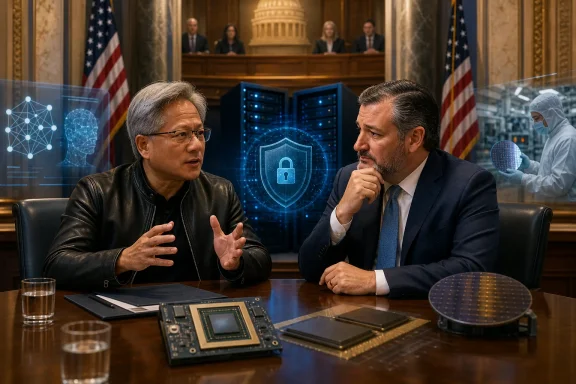 NVIDIA makes open AI a security argument
The timing is notable. On July 27, NVIDIA launched the Open Secure AI Alliance, a group of more than 30 technology, cybersecurity, enterprise software and open-source organizations working on shared tools and techniques to secure AI systems and agents.
NVIDIA says the alliance includes Microsoft, CrowdStrike, Cisco, IBM, Red Hat, Palo Alto Networks, Hugging Face and the Linux Foundation, among others. Its stated objective is not simply to distribute models freely; it is to develop defensive AI capabilities that organizations can inspect, adapt and operate across multi-vendor environments.
Huang has argued that both frontier closed models and frontier open models are necessary. That distinction matters in policy discussions that increasingly treat “open source AI” as a single category despite wide differences in model weights, training data, licensing, deployment controls and real-world capability.
For Windows administrators and enterprise security teams, the practical case is familiar: a defensive tool that cannot be audited, run in a controlled environment or connected to an existing incident-response workflow can become another opaque dependency. NVIDIA’s alliance is positioning open technologies as a way to avoid that outcome, particularly where AI agents gain access to business systems and security operations.
The policy fight reaches beyond model access
Huang’s Washington trip also comes amid intensified scrutiny of advanced-chip supply, export controls and the United States’ ability to scale domestic AI infrastructure. NVIDIA’s statement to Nextgov/FCW emphasized chip supply-chain investment alongside AI policy, tying the company’s lobbying message directly to manufacturing and national competitiveness.
That framing aligns with Cruz’s focus on preserving U.S. AI leadership, but it does not resolve the central legislative tension. A sandbox approach could make it easier for companies to test and deploy AI products, while critics will ask which regulations can be waived, how long exemptions last and whether agencies retain meaningful authority when an experimental system affects consumers, critical infrastructure or cybersecurity.
The immediate result may be less a finished AI bill than a clearer division of the debate: NVIDIA is asking lawmakers to see accessible models and open defensive tooling as part of national resilience. Whether Congress accepts that premise will shape not only AI developers’ compliance burden, but also the choices IT teams have when they need to secure and govern AI systems on their own networks.
