
NVIDIA began shipping DGX Spark systems through its own store and partners in October 2025, after first showing the device as Project DIGITS at CES earlier that year. NVIDIA’s specifications confirm the essential hardware: a GB10 Grace Blackwell superchip with a 20-core Arm CPU, Blackwell GPU, 128GB of LPDDR5X unified memory, 273GB/s of memory bandwidth, 4TB of self-encrypting NVMe storage, ConnectX-7 networking, and a 240W power adapter.
The supplied guide gets the central buying distinction right: Spark is a capacity-first local AI machine. But several details commonly repeated around it need more careful framing before an IT department or developer treats the box as an easy alternative to a Windows RTX workstation.
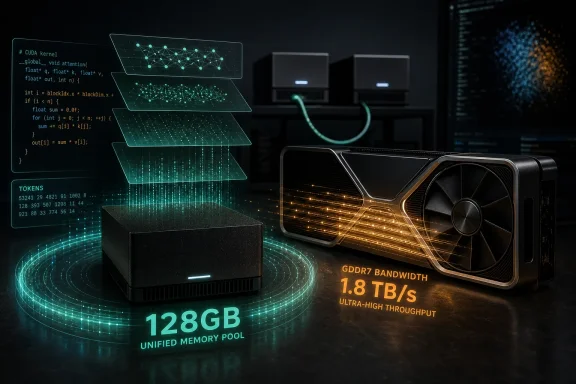 The 128GB advantage is real, but it is not VRAM
DGX Spark’s 128GB is coherent unified system memory. The CPU, GPU, and other engines access the same LPDDR5X pool, rather than juggling separate DRAM and VRAM allocations across PCIe. NVIDIA says that enables inference with models up to 200 billion parameters and fine-tuning up to 70 billion parameters, depending on the model format, context size, framework, and available working memory.
That distinction solves a practical problem for developers experimenting with 70B-class models, larger mixture-of-experts models, or long-context workloads. An RTX 5090 has far more memory bandwidth, but its 32GB VRAM limit means a model that exceeds that capacity must be quantized more aggressively, offloaded into system RAM, or split across GPUs. Each option creates extra configuration work and often harms latency.
The Spark’s memory is not all free to an application. The operating system, firmware reservations, model runtime, tokenizer, context window, and KV cache all consume part of that 128GB. Parameter-count claims are therefore planning ceilings, not deployment guarantees. A “200B model” can mean very different memory requirements depending on whether it is dense or mixture-of-experts, what quantization scheme it uses, and how much context the deployment needs.
NVIDIA’s own user guide also confirms a useful operational point overlooked by many first-time owners: nvidia-smi does not report a traditional dedicated-VRAM figure on Spark because the platform uses unified memory. Administrators need to monitor whole-system memory pressure, not just the GPU-oriented metrics they would use on a discrete GeForce or RTX Pro card.
Bandwidth, not compute marketing, limits the desktop box
NVIDIA advertises up to one petaflop of FP4 AI performance. That number is valid within NVIDIA’s stated sparse-FP4 measurement, but it does not predict how responsive a local chatbot or coding assistant will feel.
LMSYS, which received an early-access unit from NVIDIA and published detailed testing, found that the device could load GPT-OSS 120B and Llama 3.1 70B, while cautioning that very large-model work was better suited to prototyping and experimentation than production serving. In one direct Ollama comparison using GPT-OSS 20B in MXFP4, LMSYS measured 49.7 tokens per second for DGX Spark decoding, against 205 tokens per second for an RTX 5090 and 215 tokens per second for an RTX Pro 6000 Blackwell workstation card.
The reason is straightforward. Spark’s 273GB/s LPDDR5X memory bandwidth is substantial for an Arm-based mini PC but far below the RTX 5090’s 1,792GB/s of GDDR7 bandwidth. Many autoregressive LLM inference workloads are constrained by how quickly weights can be read, not merely by nominal Tensor Core throughput. For models that fit comfortably in 32GB, the RTX 5090 has the hardware advantage.
Tom’s Hardware reached a similar conclusion in its January review: Spark’s CUDA stack, 128GB capacity, and efficient package make it a capable local AI toolkit, but its price makes sense only for buyers who can use its particular combination of memory and software. That is a much more useful assessment than calling it a “supercomputer” and leaving the performance implication unexplained.
Spark does scale well when a service can batch requests. LMSYS measured Llama 3.1 8B at 20.5 decode tokens per second at batch size one, but 368 aggregate decode tokens per second at batch size 32 using SGLang. For a developer running one interactive coding session, batch-one latency matters. For a team testing an internal multi-user service or agent workflow, aggregate throughput can be more relevant.
Two DGX Sparks are a cluster, not one 256GB UMA machine
NVIDIA says two DGX Spark systems connected with ConnectX networking can work with models up to 405 billion parameters. That is an important capability, but marketing shorthand has muddied what happens technically.
Each Spark retains its own 128GB physical memory. Linking two systems over their 200GbE ConnectX-7 interfaces does not turn them into one cache-coherent 256GB unified-memory computer in the same sense that GB10’s CPU and GPU share memory inside a single box. The model and inference work must be distributed across two nodes by software that supports the deployment topology.
NVIDIA’s own two-Spark setup guidance describes the connection as a 200GbE direct link for high-speed inter-node communication. That means buyers considering Llama 3.1 405B-class experiments must budget for two systems, cabling, supported frameworks, distributed-model setup, and the operational reality of a two-node deployment. The capability is meaningful for private model testing, but it is not plug-and-play memory expansion.
This also changes the economics. At the present $4,699 Founders Edition MSRP, a two-Spark installation starts near $9,400 before any related infrastructure or support costs. NVIDIA raised the Founders Edition MSRP from $3,999 to $4,699 in February 2026, an increase the company attributed to memory supply constraints. That is not a small revision: it pushes the platform into workstation territory where alternatives deserve serious consideration.
DGX OS is the product boundary Windows users need to notice
The Founders Edition is a Linux-focused appliance running NVIDIA DGX OS, not a Windows desktop PC with a GeForce-like user experience. It is built around NVIDIA’s AI software stack and targets developers, data scientists, and researchers working with CUDA, containers, PyTorch, RAPIDS, TensorRT-LLM, NIM, SGLang, Ollama, and related tools.
That can be an advantage for teams that want a validated Linux environment rather than another DIY workstation build. It can also be a limitation for organizations whose local AI workflow depends on Windows-only applications, conventional endpoint tooling, gaming, or broad driver and peripheral compatibility. The Arm CPU architecture adds another consideration: native Arm64 support is strong for the supported NVIDIA stack, but x86 assumptions still need testing before an existing Linux project is moved over.
The submitted guide’s DGX OS version information is already dated. NVIDIA’s current DGX Spark release notes list DGX OS 7.5.0, while DGX OS 7.4.0 was released in January 2026 with CUDA Toolkit 13.0 Update 3 and a 6.17-series kernel for the Arm64 platform. Prospective buyers should verify the image and framework compatibility they need at the time of deployment instead of treating an early-2026 software stack as fixed.
NVIDIA has separately announced RTX Spark systems aimed at Windows PCs and laptops. Those products broaden the relevance of GB10-class hardware for Windows users, but they should not be conflated with the shipping DGX Spark Founders Edition. The latter remains the Linux AI-development appliance.
A justified purchase only when model fit comes first
DGX Spark is a sensible purchase for a developer or small team that repeatedly needs local CUDA inference or fine-tuning beyond a single consumer GPU’s VRAM limit, has privacy or air-gap requirements, and accepts lower interactive speed in exchange for fitting the model locally. Its physical size, 140W GB10 TDP, and integrated networking make it unusually compact for that job.
It is a poor value for someone primarily running 7B-to-32B models, serving latency-sensitive single-user workloads, or looking for a gaming and general-purpose Windows machine. A conventional RTX 5090 desktop will be substantially faster for models that fit in VRAM, and it remains far more flexible for mainstream PC tasks.
The sharper conclusion is not that DGX Spark defeats the RTX 5090, Mac Studio, or high-memory AMD systems. It gives developers a compact, supported CUDA route to model sizes that commonly force a discrete-GPU user into multi-GPU configuration or cloud infrastructure. For buyers whose workloads stay inside 32GB, the 128GB box is an expensive compromise.
