
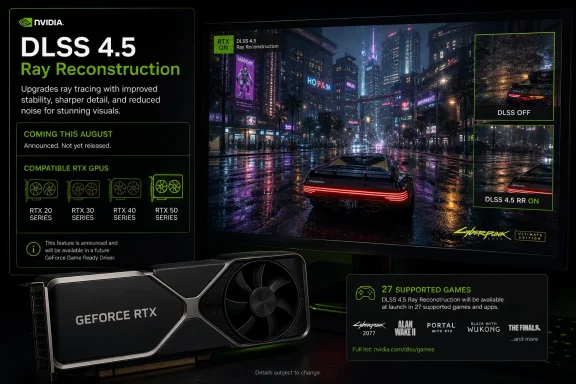
NVIDIA’s DLSS 4.5 Ray Reconstruction is slated to give GeForce RTX 20-, 30-, 40-, and 50-series owners a new AI denoising model for supported ray-traced games, but it had not been released as of August 5, 2026. NVIDIA’s own announcement still describes the update as “coming this August,” with no launch day, NVIDIA app version, driver version, or downloadable model package identified.
That timing distinction is more than editorial housekeeping. The headline claim that the feature “brings AI upgrades to every RTX GPU” correctly reflects NVIDIA’s stated hardware compatibility, but it can be read as an update every RTX owner can enable across their library today. It is neither. Ray Reconstruction requires a game that already supplies the necessary DLSS and ray-tracing integration, and NVIDIA currently names 27 compatible games rather than the more than 1,000 RTX games and applications it cites elsewhere in the same announcement.
NVIDIA announced the second-generation Ray Reconstruction model around Computex in June, and Tom’s Hardware, TechSpot, and PC Gamer independently reported the August target. None of those reports identified a specific release date. For Windows gamers watching the NVIDIA app for an update, the practical status remains: announced, compatible in principle with all RTX generations, but not yet delivered.
Ray Reconstruction is often bundled into broad conversations about DLSS, which makes its role easy to misunderstand. It is not DLSS Super Resolution, which renders at a lower input resolution and reconstructs the full image. It is not Frame Generation or Multi Frame Generation, which synthesize frames to raise displayed frame rates.
Instead, Ray Reconstruction replaces the conventional denoisers used to make ray-traced images usable at real-time speeds. A game can trace only a limited number of light rays per pixel without destroying frame rate. The raw result is noisy, so games traditionally rely on several hand-tuned denoisers for effects such as shadows, reflections, and global illumination.
NVIDIA’s approach uses one trained neural model to infer missing detail from the noisy ray-tracing result and from game-engine inputs including motion vectors and frame history. In theory, that can reduce familiar artifacts: unstable reflections, smeared fine detail, ghosting after bright effects disappear, and the shimmering or “boiling” appearance that can emerge when a scene or camera moves.
NVIDIA says the new transformer-based model processes 20% more parameters and offers 35% more compute capability than the preceding Ray Reconstruction model while maintaining similar performance. Those are NVIDIA’s claims, demonstrated in controlled comparisons involving Indiana Jones and the Great Circle, PRAGMATA, and Alan Wake 2. Independent performance testing of the released model does not yet exist because the update is still pending.
The important practical point is that this is aimed at image quality under ray tracing or path tracing. It will not create ray-tracing performance where a GPU lacks it, increase VRAM capacity, cure a CPU bottleneck, or turn an RTX 2060 into an RTX 5090. Older cards should be able to run the model, but the resolution, ray-tracing preset, frame-rate target, and VRAM demands still decide whether a given title is playable on a particular system.
The second-generation DLSS Super Resolution transformer model is available across RTX hardware through NVIDIA app overrides, but NVIDIA has explicitly cautioned that RTX 20- and RTX 30-series cards lack native FP8 support. On those architectures, the newer Super Resolution models can carry a more significant performance cost, and NVIDIA says users may prefer the prior DLSS 4.0 Model K depending on their quality-versus-frame-rate tradeoff.
Dynamic Multi Frame Generation and the six-times Multi Frame Generation mode are more restricted still. NVIDIA markets those modes around the GeForce RTX 50 series, whose hardware is intended to handle the additional generated-frame workload. A player seeing “DLSS 4.5” in a game’s settings should therefore not assume every item under that umbrella applies to their card.
Ray Reconstruction is the exception NVIDIA is emphasizing: a quality-focused model refresh that is not limited to Blackwell or Ada Lovelace hardware. That does not mean it is free. It means NVIDIA expects the new model to fit within a broadly similar performance envelope to the existing Ray Reconstruction path on supported RTX GPUs.
For owners of an RTX 2060, RTX 2070 Super, RTX 3060, or RTX 3080, that is the story worth tracking. A newer AI model may improve a game they already run with ray tracing enabled, without requiring a new GPU. But the benefit only appears where the game already supports the relevant rendering path.
Several forthcoming releases are included, such as Call of Duty: Black Ops 7, Crimson Desert, PRAGMATA, Resident Evil Requiem, and Sword of Justice. Their presence on NVIDIA’s list signals planned support, not evidence that the feature can be tested by players today.
This is where the submitted report blends distinct DLSS announcements together. Marvel Rivals is receiving DLSS 4.5 Super Resolution and Dynamic Multi Frame Generation support, according to NVIDIA’s June announcement, but it does not appear in NVIDIA’s 27-game Ray Reconstruction list. The same caution applies to claims around Squad, Where Winds Meet, and Phantom Blade Zero: a title can support a DLSS 4.5 component without being confirmed for the new Ray Reconstruction model.
That distinction matters because the software is not a universal post-processing filter that the NVIDIA app can impose on any DirectX game. The model needs the rendering data that comes from a compatible DLSS Ray Reconstruction integration. NVIDIA’s app is expected to distribute or select the new model, but it cannot manufacture those engine inputs for titles that never implemented the feature.
The company’s “more than 1,000 RTX games and apps” figure is also broader than Ray Reconstruction. It counts the full RTX portfolio: games and applications using any mix of DLSS, ray tracing, Reflex, RTX Remix, AI acceleration, or professional graphics capabilities. It is a measure of platform reach, not a compatibility count for this specific denoising update.
That could be useful in look development, where the difference between a noisy preview and a stable near-final view can affect decisions about materials, lighting, and composition. It should not be mistaken for a guarantee of faster final renders in every Blender project. NVIDIA has described the integration as a viewport and denoising improvement; it has not published project-level benchmarks, VRAM requirements, Linux support details, or a feature matrix for Blender 5.3.
Blender’s planned support also underscores the core limitation of the consumer rollout. Ray Reconstruction is valuable when software developers integrate it into an application’s rendering pipeline. Broad GPU eligibility removes one hardware gate, but adoption remains a software-by-software matter.
There is no reason to buy hardware solely for this announcement. NVIDIA has not claimed a VRAM reduction, a universal frame-rate increase, or support beyond games that already expose Ray Reconstruction. The company has also not said whether the new model will require a game patch in every case, which NVIDIA app and driver releases will carry it, or whether users will be able to choose between the old and new Ray Reconstruction models.
For now, DLSS 4.5 Ray Reconstruction is a potentially meaningful longevity update for existing RTX cards, especially the RTX 20 and RTX 30 generations that are excluded from NVIDIA’s newest frame-generation advantages. The concrete next event is not another hardware launch: it is NVIDIA publishing the August app update and turning its 27-title compatibility list into something users can actually verify on their own Windows systems.
NVIDIA announced the second-generation Ray Reconstruction model around Computex in June, and Tom’s Hardware, TechSpot, and PC Gamer independently reported the August target. None of those reports identified a specific release date. For Windows gamers watching the NVIDIA app for an update, the practical status remains: announced, compatible in principle with all RTX generations, but not yet delivered.
The upgrade is a denoiser replacement, not a performance mode
Ray Reconstruction is often bundled into broad conversations about DLSS, which makes its role easy to misunderstand. It is not DLSS Super Resolution, which renders at a lower input resolution and reconstructs the full image. It is not Frame Generation or Multi Frame Generation, which synthesize frames to raise displayed frame rates.Instead, Ray Reconstruction replaces the conventional denoisers used to make ray-traced images usable at real-time speeds. A game can trace only a limited number of light rays per pixel without destroying frame rate. The raw result is noisy, so games traditionally rely on several hand-tuned denoisers for effects such as shadows, reflections, and global illumination.
NVIDIA’s approach uses one trained neural model to infer missing detail from the noisy ray-tracing result and from game-engine inputs including motion vectors and frame history. In theory, that can reduce familiar artifacts: unstable reflections, smeared fine detail, ghosting after bright effects disappear, and the shimmering or “boiling” appearance that can emerge when a scene or camera moves.
NVIDIA says the new transformer-based model processes 20% more parameters and offers 35% more compute capability than the preceding Ray Reconstruction model while maintaining similar performance. Those are NVIDIA’s claims, demonstrated in controlled comparisons involving Indiana Jones and the Great Circle, PRAGMATA, and Alan Wake 2. Independent performance testing of the released model does not yet exist because the update is still pending.
The important practical point is that this is aimed at image quality under ray tracing or path tracing. It will not create ray-tracing performance where a GPU lacks it, increase VRAM capacity, cure a CPU bottleneck, or turn an RTX 2060 into an RTX 5090. Older cards should be able to run the model, but the resolution, ray-tracing preset, frame-rate target, and VRAM demands still decide whether a given title is playable on a particular system.
“All RTX GPUs” does not mean every DLSS 4.5 feature
NVIDIA’s compatibility language is unusually broad for this generation of DLSS technology. The company says the revised Ray Reconstruction model will be available to every GeForce RTX GPU, reaching back to the original RTX 20 series. That separates it from some other DLSS 4.5 features.The second-generation DLSS Super Resolution transformer model is available across RTX hardware through NVIDIA app overrides, but NVIDIA has explicitly cautioned that RTX 20- and RTX 30-series cards lack native FP8 support. On those architectures, the newer Super Resolution models can carry a more significant performance cost, and NVIDIA says users may prefer the prior DLSS 4.0 Model K depending on their quality-versus-frame-rate tradeoff.
Dynamic Multi Frame Generation and the six-times Multi Frame Generation mode are more restricted still. NVIDIA markets those modes around the GeForce RTX 50 series, whose hardware is intended to handle the additional generated-frame workload. A player seeing “DLSS 4.5” in a game’s settings should therefore not assume every item under that umbrella applies to their card.
Ray Reconstruction is the exception NVIDIA is emphasizing: a quality-focused model refresh that is not limited to Blackwell or Ada Lovelace hardware. That does not mean it is free. It means NVIDIA expects the new model to fit within a broadly similar performance envelope to the existing Ray Reconstruction path on supported RTX GPUs.
For owners of an RTX 2060, RTX 2070 Super, RTX 3060, or RTX 3080, that is the story worth tracking. A newer AI model may improve a game they already run with ray tracing enabled, without requiring a new GPU. But the benefit only appears where the game already supports the relevant rendering path.
The actual launch list is 27 games, not the RTX catalog
NVIDIA’s own announcement names 27 games that Ray Reconstruction can enhance when the new model ships. That group includes Alan Wake 2, Avatar: Frontiers of Pandora, Cyberpunk 2077, DOOM: The Dark Ages, F1 25, Half-Life 2 RTX, Hogwarts Legacy, Indiana Jones and the Great Circle, NARAKA: BLADEPOINT, Portal with RTX, Star Wars Outlaws, and The First Descendant.Several forthcoming releases are included, such as Call of Duty: Black Ops 7, Crimson Desert, PRAGMATA, Resident Evil Requiem, and Sword of Justice. Their presence on NVIDIA’s list signals planned support, not evidence that the feature can be tested by players today.
This is where the submitted report blends distinct DLSS announcements together. Marvel Rivals is receiving DLSS 4.5 Super Resolution and Dynamic Multi Frame Generation support, according to NVIDIA’s June announcement, but it does not appear in NVIDIA’s 27-game Ray Reconstruction list. The same caution applies to claims around Squad, Where Winds Meet, and Phantom Blade Zero: a title can support a DLSS 4.5 component without being confirmed for the new Ray Reconstruction model.
That distinction matters because the software is not a universal post-processing filter that the NVIDIA app can impose on any DirectX game. The model needs the rendering data that comes from a compatible DLSS Ray Reconstruction integration. NVIDIA’s app is expected to distribute or select the new model, but it cannot manufacture those engine inputs for titles that never implemented the feature.
The company’s “more than 1,000 RTX games and apps” figure is also broader than Ray Reconstruction. It counts the full RTX portfolio: games and applications using any mix of DLSS, ray tracing, Reflex, RTX Remix, AI acceleration, or professional graphics capabilities. It is a measure of platform reach, not a compatibility count for this specific denoising update.
Blender support is real, but it is later and narrower than the gaming pitch
The update has a consequential non-gaming component. NVIDIA says Blender Cycles will add DLSS 4.5 Ray Reconstruction as a denoiser in Blender 5.3, expected this fall. For artists working in Cycles, the promise is a more responsive viewport with an image closer to the final ray-traced result, rather than waiting for traditional denoising passes to settle.That could be useful in look development, where the difference between a noisy preview and a stable near-final view can affect decisions about materials, lighting, and composition. It should not be mistaken for a guarantee of faster final renders in every Blender project. NVIDIA has described the integration as a viewport and denoising improvement; it has not published project-level benchmarks, VRAM requirements, Linux support details, or a feature matrix for Blender 5.3.
Blender’s planned support also underscores the core limitation of the consumer rollout. Ray Reconstruction is valuable when software developers integrate it into an application’s rendering pipeline. Broad GPU eligibility removes one hardware gate, but adoption remains a software-by-software matter.
What RTX owners should watch for this month
The release will be worth installing and testing once NVIDIA publishes the matching NVIDIA app update, particularly for players already using Ray Reconstruction in Cyberpunk 2077, Alan Wake 2, Indiana Jones and the Great Circle, or another title on NVIDIA’s confirmed list. The right comparison is not the game’s average frame rate alone; it is motion clarity, reflection stability, particle behavior, and whether difficult scenes trade one artifact for another.There is no reason to buy hardware solely for this announcement. NVIDIA has not claimed a VRAM reduction, a universal frame-rate increase, or support beyond games that already expose Ray Reconstruction. The company has also not said whether the new model will require a game patch in every case, which NVIDIA app and driver releases will carry it, or whether users will be able to choose between the old and new Ray Reconstruction models.
For now, DLSS 4.5 Ray Reconstruction is a potentially meaningful longevity update for existing RTX cards, especially the RTX 20 and RTX 30 generations that are excluded from NVIDIA’s newest frame-generation advantages. The concrete next event is not another hardware launch: it is NVIDIA publishing the August app update and turning its 27-title compatibility list into something users can actually verify on their own Windows systems.
References
- Primary source: noobfeed.com
Published: 2026-08-05T00:00:00+00:00
DLSS 4.5 Ray Reconstruction Brings AI Upgrades To Every RTX GPU | NoobFeed
NVIDIA says DLSS 4.5 Ray Reconstruction arrives in August for every GeForce RTX GPU, including older generations, not just the RTX50 series.www.noobfeed.com - Related coverage: nvidia.com
DLSS 4.5 Ray Reconstruction Announced
DLSS 4.5 Ray Reconstruction features a new 2nd gen transformer model to deliver superior image quality in ray-traced and path-traced games. Plus, 1000+ RTX games and apps have been released, and another 11 games are upgrading to DLSS 4.5.www.nvidia.com - Related coverage: tomshardware.com
DLSS 4.5 Ray Reconstruction update arrives in August for better ray tracing visuals — broader training data set and second-gen transformer architecture combine for improved image quality | Tom's Hardware
Nvidia's neural RT denoiser now produces more detailed, dynamic, and lifelike resultswww.tomshardware.com - Related coverage: nvidia.com
NVIDIA DLSS 4.5 Delivers Major Upgrade With 2nd Gen Transformer Model For Super Resolution & 6X Dynamic Multi Frame Generation
Upgrade coming to a massive library of over 250 titles with DLSS Multi Frame Generation, and over 400 titles with DLSS Super Resolution.www.nvidia.com - Related coverage: techspot.com
DLSS 4.5 Ray Reconstruction arrives this August to make ray tracing look cleaner and more stable | TechSpot
Ray Reconstruction is designed to replace the hand-tuned denoisers traditionally used in ray-traced and path-traced games.www.techspot.com - Related coverage: developer.nvidia.com
- Related coverage: tomshardware.com
DLSS Ray Reconstruction might be living on borrowed time, DLSS 4.5 can reconstruct ray-traced reflections almost perfectly without any denoisers | Tom's Hardware
Who needs Ray Reconstruction when the upscaler itself can do the same thingwww.tomshardware.com - Related coverage: pcgamer.com
Nvidia announces that a DLSS 4.5 update for Ray Reconstruction is finally on its way, promising better ray-traced and path-traced graphics for 'similar performance' as the old model | PC Gamer
It's very late to the party, but better than never having it at all.www.pcgamer.com - Related coverage: tomsguide.com
Resident Evil Requiem made me believe in path tracing — and I wish it hadn’t | Tom's Guide
I’ve been a path tracing doubter for a while now, but then I got my hands on Resident Evil Requiem. With Nvidia's DLSS 4 and path tracing, immersion is taken to a new level I've never seen before.www.tomsguide.com - Related coverage: gamestar.de
Bessere Bildqualität für alle RTX-GPUs: Nvidia startet DLSS 4.5 Ray Reconstruction im August
Nvidia hat DLSS 4.5 Ray Reconstruction angekündigt: Die neue neuronale Denoiser-Technik erscheint im August für alle Geforce-RTX-GPUs.www.gamestar.de
- Related coverage: dsogaming.com
NVIDIA DLSS 4.5 Ray Reconstruction is coming out in August 2026
NVIDIA has just announced that DLSS 4.5 Ray Reconstruction will be officially released in August 2026.www.dsogaming.com - Related coverage: dlcompare.ru
NVIDIA DLSS 4.5 Ray Reconstruction выходит в августе с поддержкой 27 игр
Нейронный денойзер трассировки лучей Nvidia теперь обеспечивает повышенную детализацию, динамичность и реалистичность изображения.www.dlcompare.ru - Related coverage: dlcompare.co.uk
NVIDIA DLSS 4.5 Ray Reconstruction launches this August supporting 27 games
Nvidia’s neural ray tracing denoiser now delivers enhanced detail, greater dynamism, and more realistic visuals.www.dlcompare.co.uk - Related coverage: dlcompare.it
NVIDIA DLSS 4.5 Ray Reconstruction viene lanciato ad agosto con il supporto di 27 giochi
Il denoiser del ray-tracing neurale di Nvidia offre ora dettagli migliori, maggiore dinamismo e immagini più realistiche.www.dlcompare.it - Related coverage: letsdatascience.com
NVIDIA Delivers DLSS 4.5 Ray Reconstruction Update in August | Let's Data Science
According to NVIDIA, `DLSS 4.5 Ray Reconstruction` arrives in August 2026 and will be distributed through the NVIDIA App to all GeForce RTX GPUs, including **RTX 20**, **RTX 30**, **RTX 40** and **RTX 50** series (reported by NVIDIA and Videocardz). Videocardz and NVIDIA documentation state the...letsdatascience.com
- Related coverage: clubic.com
DLSS 4.5 : le nouveau Ray Reconstruction de NVIDIA arrive dès août sur (presque) toutes les GeForce RTX
NVIDIA prépare une évolution importante de son Ray Reconstruction, la brique IA chargée d'améliorer le rendu des jeux en ray tracing et path tracing. Attendu dès août 2026, ce nouveau modèle intégré au DLSS 4.5 sera disponible sur la plupart des cartes GeForce RTX, des séries 20 aux 50 (Blackwell).
www.clubic.com
- Related coverage: creativebloq.com
Nvidia's game-changing DLSS is finally coming to Blender | Creative Bloq
The AI upscaling tech could be a game changer for 3D lighting and lookdev.www.creativebloq.com