
Quantum Zeitgeist first reported the July 28 release, while NVIDIA’s NGC catalog lists version 1.5.0 as available through NVIDIA NIM and NVIDIA Build from July 23. NVIDIA has published both BF16 and NVFP4 model variants, with the latter intended to reduce the memory and compute burden of local inference.
 Calibration analysis moves from plots to agent workflows
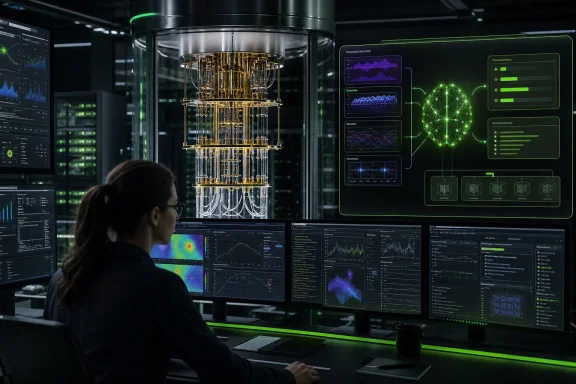
Ising Calibration 1.5 accepts images and text, then produces outputs including plot descriptions, experimental conclusions, fit-quality assessments, extracted parameters, and success classifications. NVIDIA positions it as a component in an agentic workflow: software can inspect measurement results, recommend a next adjustment, run another calibration experiment, and repeat until the quantum processor meets a chosen target.
That is a narrower task than general-purpose AI, but a consequential one for quantum labs. Calibration is a recurring operational burden because qubit behavior shifts with environmental noise, hardware drift, and control changes. NVIDIA’s earlier Ising documentation describes partners supplying data across superconducting qubits, quantum dots, trapped ions, neutral atoms, electrons on helium, and related calibration-and-control stacks.
The company’s QCalEval benchmark provides the central performance test. NVIDIA Research describes QCalEval as a 243-sample benchmark spanning 87 scenarios and 22 experiment families, with questions covering the interpretation of real calibration plots. The benchmark was initially introduced with Ising Calibration 1; performance figures for 1.5, including its claimed improvement through related-experiment examples, remain vendor-reported results rather than an independent operational validation.
NVFP4 makes local deployment more plausible, not effortless
The headline hardware development is the NVFP4-quantized release. NVIDIA says the 31B model is based on Gemma 4 31B and offers both BF16 and NVFP4 profiles in the same NIM container. Quantization reduces the precision used to store and run model weights, potentially allowing labs to use far less GPU memory than a full BF16 deployment requires.
That does not mean every desktop GPU will be a straightforward target. The full model remains positioned for NVIDIA’s data-center hardware, while NVIDIA’s local deployment messaging emphasizes DGX Spark and supported GPU systems. Windows users interested in evaluating the stack should expect a Linux-container workflow—typically through WSL2, Docker, or a remote GPU host—rather than a conventional Windows desktop application.
NVIDIA’s documentation says the NIM exposes an OpenAI-compatible HTTP API on port 8000 and supports multimodal image analysis, but not tool calling. In practice, labs building a calibration agent will need to supply the orchestration layer themselves, connecting the model’s analysis to experiment-control software and enforcing human review or operational guardrails before hardware changes are applied.
Open weights expand experimentation, while licensing still matters
The BF16 checkpoint and an NVFP4 checkpoint are available through Hugging Face under the OpenMDW License 1.1, and NVIDIA also offers a GitHub agent-workflow example. That makes the release useful for teams that want to evaluate models on their own instrument output without sending sensitive experimental plots to a third-party hosted service.
For IT teams, the more immediate value is architectural: Ising Calibration 1.5 can be treated as a self-hosted multimodal inference service with a defined API, container packaging, and GPU requirements. The unresolved test is whether its QCalEval gains translate cleanly to a lab’s own hardware, plots, control software, and failure modes—where a confident but wrong calibration recommendation carries a cost far beyond a benchmark score.
