
That leaves DLSS 4 Multi Frame Generation as the defining delivered Blackwell gaming feature, while Reflex 2 remains an announced capability without the broad, finished game support implied by early RTX 50 coverage. NVIDIA demonstrated Frame Warp in VALORANT and THE FINALS at CES 2025 and claimed major latency reductions, but its current public status matters more to a buyer than that launch-stage demonstration.
VideoCardz’s series catalogue correctly captures the broad shape of the lineup: Blackwell, GDDR7 across nearly every desktop card, PCIe 5.0, new Tensor and ray-tracing hardware, and a China-specific 5090D branch. Its table also illustrates why prospective buyers should avoid treating a one-page specification roundup as a purchase guide. It mixes confirmed retail products, board-level targets, die-code reporting, and unannounced SUPER entries in one grid, even though those categories carry very different levels of certainty.
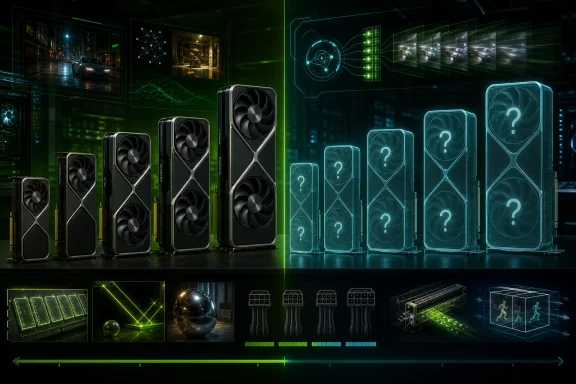 Seven card names, eight retail configurations
NVIDIA began the desktop rollout on January 30, 2025, with the GeForce RTX 5090 and RTX 5080. The RTX 5070 Ti followed on February 20, the RTX 5070 on March 5, the RTX 5060 Ti 16GB and 8GB versions on April 16, the RTX 5060 on May 19, and the RTX 5050 in July 2025.
There are seven global product names—RTX 5090, 5080, 5070 Ti, 5070, 5060 Ti, 5060, and 5050—but eight practical retail configurations once the 8GB and 16GB RTX 5060 Ti cards are counted separately. That distinction is worth making because the two 5060 Ti models share the same 4,608 CUDA cores and 128-bit bus, while their memory capacity can produce very different outcomes in newer games, AI-assisted creative workloads, and longevity at high texture settings.
NVIDIA’s public product pages confirm the core memory splits that shape this generation:
| GeForce RTX 50 card | Standard memory configuration | U.S. launch MSRP |
|---|---|---|
| RTX 5090 | 32GB GDDR7 | $1,999 |
| RTX 5080 | 16GB GDDR7 | $999 |
| RTX 5070 Ti | 16GB GDDR7 | $749 |
| RTX 5070 | 12GB GDDR7 | $549 |
| RTX 5060 Ti | 16GB or 8GB GDDR7 | $429 or $379 |
| RTX 5060 | 8GB GDDR7 | $299 |
| RTX 5050 | 8GB GDDR6 | $249 |
The RTX 5050 is the deliberate exception to the new-memory story. NVIDIA confirms that it has 2,560 CUDA cores, 8GB of GDDR6 on a 128-bit bus, and a 130W maximum board-power target. The “135W” figure that appears in some aggregate tables is therefore not NVIDIA’s stated stock specification. For builders, that 130W rating and a single eight-pin PCIe power connector are more useful facts than an uncertain die-code label: the card is intended for modest power supplies and small upgrades, but its 8GB buffer remains the same capacity constraint found on the base RTX 5060.
The RTX 5060 Ti presents the sharper choice. Paying the $50 launch-price difference for 16GB doubled the memory capacity of the 8GB model without reducing compute resources. Independent reviews from TechSpot and TechPowerUp found the 8GB card far harder to recommend in memory-heavy scenarios, a conclusion that has aged better as game requirements and GPU pricing have moved upward. The 16GB model cannot create performance the GPU does not have, but it avoids the abrupt texture-quality and frame-time compromises associated with an 8GB ceiling.
Blackwell’s real divide is generated frames
NVIDIA calls the RTX 50 generation a Blackwell architecture launch, and the physical upgrades are substantial on the top end. The RTX 5090 carries 21,760 CUDA cores, 32GB of GDDR7, and a 512-bit memory interface; NVIDIA lists 10,752 cores and 16GB for the RTX 5080; and the RTX 5070 Ti and RTX 5070 pair 8,960 and 6,144 cores with 16GB and 12GB respectively. The family also introduces fifth-generation Tensor Cores, fourth-generation RT Cores, and support for FP4 data formats in consumer Tensor hardware.
But the feature with the biggest visible effect in supported games is DLSS 4 Multi Frame Generation. Unlike conventional rendering performance, Multi Frame Generation inserts additional AI-generated frames between rendered frames. It can make a high-refresh monitor appear far better utilized, especially when ray tracing is enabled, but it does not turn a low base frame rate into equally responsive gameplay.
That is the operational limitation often lost in comparisons built around headline FPS. A generated frame is useful for display smoothness; it does not independently advance simulation, improve CPU performance, or provide fresh player input. Start with a healthy native or DLSS-upscaled frame rate, then use Multi Frame Generation to raise presentation fluidity. Starting from a poor base frame rate produces an impressive benchmark number with a less convincing control response.
NVIDIA’s new transformer-based DLSS models also matter beyond RTX 50 hardware. The company has made broader DLSS 4 improvements available to earlier RTX generations, while Multi Frame Generation remains the RTX 50-exclusive portion. An RTX 40 owner deciding whether to upgrade should therefore distinguish better image reconstruction from the new multi-frame capability. The former may arrive through software; the latter requires Blackwell.
The company’s Reflex 2 messaging requires the same discipline. NVIDIA’s January 2025 announcement said Frame Warp updates an image using more recent mouse input shortly before display, a technique meant to reduce displayed input latency. NVIDIA’s own current Reflex page still says it is coming soon. Until the SDK, supported-title list, driver requirements, and deployment status are published as a completed feature set, it should not be counted as a reason an RTX 50 card delivers a shipping advantage over a comparable older card.
PCIe 5.0 and DisplayPort claims need model-level checks
Every RTX 50 desktop card is associated with a PCIe 5.0 interface, but “PCIe 5.0” should not be read as “PCIe 5.0 x16” across the range. The RTX 5050 uses an x8 interface. That does not automatically mean trouble in a current PCIe 5.0 system, but it cuts the available link width in half and can become more relevant in older PCIe 3.0 platforms, where an x8 electrical connection has much less bandwidth available.
The same warning applies to display output claims. NVIDIA and board partners advertise DisplayPort 2.1 capabilities on RTX 50 products, but port layouts, certified data rates, USB-C omissions, BIOS behavior, cooling, physical dimensions, and power connectors are all board-specific. A reference-style core table cannot tell a Windows user whether a particular triple-slot card will fit a compact case, whether it needs a 12V-2x6 cable, or whether it provides the exact multi-monitor layout needed for a desk setup.
The RTX 5090 is the clearest example. NVIDIA’s reference target calls for 575W board power and a 1,000W system power supply. That is not a casual drop-in replacement for an RTX 4080 or RTX 3080 system. It demands case clearance, adequate cooling, a power supply with the proper connector or a carefully managed adapter, and attention to cable bend radius. The RTX 5050 lives at the other end of the installation spectrum, but neither card is adequately described by CUDA-core counts alone.
China’s 5090D V2 is a separate regional product
NVIDIA’s Chinese site lists the GeForce RTX 5090D V2, a China-market model with 24GB of GDDR7 memory on a 384-bit bus. Partner specifications, including INNO3D’s published sheet, list 21,760 CUDA cores and a 575W card-power specification. That combination makes the V2 look deceptively close to the global RTX 5090 in a short table.
It is not a substitute for the global product in the U.S. channel. The 5090D line exists because of export-control constraints, and NVIDIA does not position it as a normal global retail SKU. Imported inventory creates the usual warranty, firmware, regional support, and pricing risks. Windows users looking for a supported local purchase should treat RTX 5090D and 5090D V2 listings as specialist-market hardware rather than alternatives to the RTX 5090.
The public reporting around exact GB202 variant labels also deserves caution. NVIDIA confirms the product-level CUDA-core and memory figures, but its consumer pages center on retail specifications rather than the internal die identifiers repeated in leak tables. Those codes can be useful for technical tracking; they are a poor basis for deciding which board to buy.
The RTX 50 SUPER cards remain unannounced
The rumored RTX 5080 SUPER 24GB, RTX 5070 Ti SUPER 24GB, and RTX 5070 SUPER 18GB do not belong beside released cards as though they were pending retail launches. NVIDIA has announced none of them, published no specifications, and set no release date or pricing.
VideoCardz has reported that a proposed SUPER refresh faced delays tied to the cost and availability of 3GB GDDR7 memory devices. Tom’s Hardware has separately reported that NVIDIA may not introduce new gaming GPUs during 2026 amid memory constraints. Those reports explain why the rumored cards keep appearing and disappearing from roadmaps, but neither is a product announcement. They also describe a market condition that makes a generous-memory refresh harder to price, not easier.
For buyers, the consequence is straightforward: do not postpone a needed build around a rumored 18GB or 24GB RTX 50 SUPER card. The RTX 5070 Ti 16GB remains the practical upper-midrange option in the shipping range, while the RTX 5060 Ti 16GB is the safer mainstream purchase than its 8GB sibling. At the high end, the RTX 5090’s 32GB remains unmatched within GeForce—but its power requirement and real-world street price put it in a different class of purchase entirely.
The RTX 50 Series is no longer waiting for its entry-level card. It is waiting for NVIDIA to either ship the memory-expanded refresh long rumored around it or formally leave Blackwell’s original desktop lineup in place.
