
That distinction gets lost in the handheld excitement. Nvidia has not teased a finished console, announced a reference design, named a manufacturing partner, or committed its own hardware team to a portable PC. In comments reported by Tom’s Guide from a Computex 2026 Q&A, Huang said, “If somebody wants to do it, we’ll work with them on it,” before stressing that Nvidia’s present focus is launching RTX Spark as a new Windows PC platform.
PC Gamer separately reported the same underlying message: Nvidia sees bringing its first Windows-on-Arm PC chip to market as the major project, and a handheld is presently an OEM opportunity rather than a Nvidia product plan. For buyers waiting for an “Nvidia Steam Deck,” this is not a launch signal. It is an invitation for Asus, MSI, Lenovo, Acer, or another partner to take the risk.
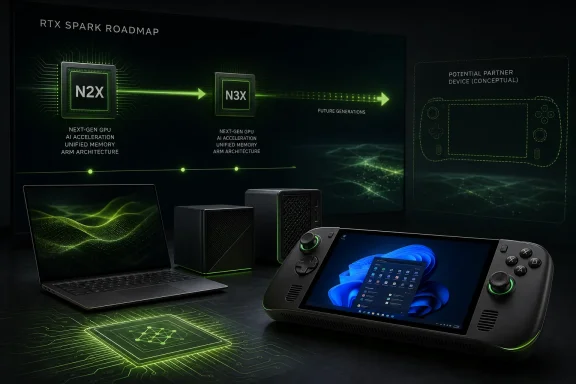 N2X and N3X are a roadmap commitment, not a release schedule
Huang told Tom’s Guide that “N2X and N3X are already planned,” while explaining that RTX Spark’s current flagship chip was internally known as N1X. The important part is that Nvidia is publicly committing to continued Arm-based PC silicon beyond the first generation. That is a meaningful change for OEMs and enterprise buyers who have watched previous attempts to challenge x86 fade after a single product cycle.
Nvidia’s own RTX Spark material does not yet list N2X or N3X. It does not state their CPU architecture, GPU generation, memory technology, manufacturing process, power targets, form factors, or release years. The company also has not said whether the “X” suffix will continue to identify a higher-end configuration, whether N2 and N3 variants will exist alongside those chips, or whether every generation will be suitable for desktops, laptops, and handhelds.
The naming does establish one thing: RTX Spark is intended as a family, rather than a one-off Windows adaptation of Nvidia’s Grace Blackwell work. Huang said Nvidia expects buyers to keep Spark systems for five to 10 years, comparing the device concept to home theater equipment. That supports a longer platform-support story, but it should not be mistaken for a published driver-support guarantee or a commitment to specific Windows feature-update lifetimes.
There is also a timing problem in treating N2X and N3X as near-term hardware. The first retail RTX Spark Windows PCs have not reached the market as of August 4, 2026. Nvidia announced that laptops and compact desktop PCs from Asus, Dell, HP, Lenovo, Microsoft Surface, and MSI are due in fall 2026, with Acer and Gigabyte models to follow. Nvidia’s current product page still asks visitors to sign up for availability notifications.
In other words, Nvidia has announced its second and third Spark generations before the first retail Windows systems have built a public track record. That is a vote of confidence in the architecture, but it leaves the usual first-generation questions — sustained performance, battery life, translated-game behavior, thermals, driver quality, and real device pricing — unanswered.
RTX Spark’s current hardware is designed for premium PCs, not a 7-inch console
Nvidia describes the top RTX Spark configuration as pairing a 20-core Grace Arm CPU with a Blackwell RTX GPU containing 6,144 CUDA cores, alongside up to 128GB of unified LPDDR5X memory. The company advertises up to one petaflop of FP4 AI performance and claims AAA gaming at 1440p and more than 100 frames per second under appropriate conditions.
Those figures explain why RTX Spark is attractive to local-AI developers and creators. A large unified memory pool gives a laptop or compact desktop a route to running models and handling data sets that do not fit in the discrete VRAM of conventional mobile GPUs. Nvidia and Microsoft have positioned the platform around CUDA, local AI agents, large-model inference, rendering, video work, and high-end Windows gaming.
They also explain why the full N1X configuration is an awkward starting point for a handheld. A portable console is governed by battery capacity, cooling, weight, screen resolution, controller placement, and a sustained power envelope far below what an AI-oriented workstation chip can reasonably exploit. Cramming a 20-core CPU, a 6,144-core Blackwell GPU, and memory meant to support up to 128GB of unified capacity into a handheld would produce a costly device with difficult thermal and battery tradeoffs.
A smaller chip identified as N1 has been discussed in reporting, and Huang acknowledged to Tom’s Guide that N1X has a smaller sibling. But Nvidia has not published official N1 specifications or identified a shipping N1 device. Reports describing N1 core counts and graphics configurations are based on pre-launch information, not an Nvidia data sheet.
That makes N1 — rather than the published top-end Spark specifications — the more plausible starting point for a handheld. Yet no OEM has said it is building one. Nvidia’s willingness to collaborate does not solve the business case: a partner would still need to design the chassis, validate firmware and controllers, secure component supply, price the device, and support it through the unusually demanding Windows handheld market.
The Windows-on-Arm compatibility work is real, but unproven in retail hardware
The strongest reason not to treat an RTX Spark handheld as imminent is software validation. Windows 11 on Arm can run many x86 and x64 applications through Microsoft’s Prism translation technology, but that does not make every PC game and peripheral stack transparently compatible.
Microsoft’s developer documentation is explicit that kernel-mode drivers must be compiled natively for Arm64; they cannot be emulated. That is relevant to games because competitive titles often rely on low-level anti-cheat or DRM components. A game executable might translate and launch, while the anti-cheat driver that determines whether a player can join a match does not.
Nvidia is not ignoring that problem. In its RTX Spark launch material, the company said it is working with game developers, while Microsoft named KRAFTON, NetEase, Remedy Entertainment, Riot Games, and Xbox among companies embracing the platform. Tom’s Hardware, reporting from an Nvidia briefing, said the company was working to bring native Arm support for Easy Anti-Cheat, BattlEye, Denuvo, and related technology, with games themselves still able to run through emulation.
That is a more substantial position than the claim that publishers must individually rebuild every game for Arm. Native Arm64 anti-cheat components can address the driver-level blocker while the game continues under Prism. But Nvidia has not released a complete compatibility database, a list of confirmed titles, or launch-day test results for retail Spark laptops — much less a handheld.
The practical takeaway is simple: compatibility has become a launch requirement Nvidia and Microsoft are actively funding, not an unsolved theoretical barrier. It is still not a blanket assurance that a future Spark handheld will run a player’s entire Steam, Xbox, Epic, Battle.net, Game Pass, or anti-cheat-protected multiplayer library on day one.
Intel and AMD already have the handheld market Nvidia would enter
Any Spark-based handheld would enter a market that is no longer waiting for a new silicon vendor to define it. AMD’s Ryzen Z-series chips established the template for Windows handhelds, and Intel announced its purpose-built Arc G3 and Arc G3 Extreme processors in May 2026. Intel says designs from Acer, MSI, and OneXPlayer are either launching or due in the coming months, while MSI’s Claw 8 EX AI+ is already on sale.
Unlike RTX Spark, Intel’s Arc G-series is specifically framed around handheld power management, optimized core counts, software support, and portable play. That does not prove it will outperform Nvidia in graphics or efficiency, but it shows the competitive bar: an Nvidia partner would need to offer more than a powerful GPU in a compact shell.
A successful Spark handheld would need credible low-watt performance, quiet cooling, a competitive price, reliable sleep-and-resume behavior, controller integration, driver updates tailored to portable play, and a compatibility message that holds up in the games buyers actually use. Large unified memory and CUDA are valuable for AI and creation, but they do not automatically justify a premium in a device bought mainly to play games at 800p or 1080p.
Nvidia’s existing Nintendo relationship does not fill that gap. Tegra-powered Switch hardware has been a closely controlled Nintendo platform with its own operating system, storefront, software certification model, and custom hardware decisions. A Windows-on-Arm Spark handheld sold by an independent PC OEM would be a fundamentally different product, with Windows compatibility and PC-game support as central obligations.
The first Spark PCs will decide whether a handheld partner appears
Nvidia has made the long-term part clear: N2X and N3X are planned, and RTX Spark is meant to remain an Arm-based Windows platform rather than a single generation. What it has not made clear is whether the platform can meet the ordinary expectations of a Windows PC without exception — particularly for games, anti-cheat systems, drivers, and peripherals.
The fall 2026 laptops and mini PCs are therefore the real milestone. They will show whether RTX Spark’s claims about full Windows software, high-end games, native CUDA, and long battery life can coexist outside a Computex demo. Until that evidence exists, a Spark handheld remains an unclaimed OEM project — and N2X and N3X remain names on Nvidia’s roadmap rather than chips buyers can plan around.
