
Tech4Gamers’ August 9 report describes 1440p ray-traced AAA gaming, measurable 1% and 0.1% low-frame-rate penalties under Prism, and “dramatic” native-Arm gains. It does not identify a single game, executable version, driver, laptop or desktop configuration, power mode, image-quality preset, upscaling setting, or benchmark result. Those omissions matter more than the sweeping conclusion: NVIDIA has announced RTX Spark hardware for this fall, but its own July developer-preview notice tells developers to validate performance on RTX Spark when supported hardware and software become available.
For now, RTX Spark’s gaming case rests on vendor commitments and a promising software direction—not a reproducible comparison between x86 emulation and native Arm builds.
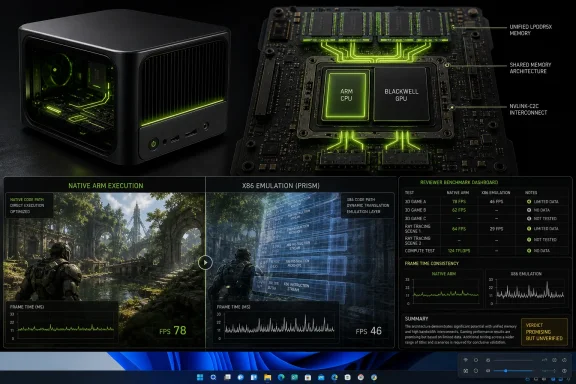 RTX Spark is a Windows platform, not the existing DGX Spark box
NVIDIA announced RTX Spark with Microsoft on May 31 as a Windows PC platform intended for thin laptops and compact desktops. NVIDIA says the superchip combines a 20-core Grace CPU, a Blackwell RTX GPU with up to 6,144 CUDA cores, NVLink-C2C chip-to-chip connectivity, and up to 128GB of unified memory. MediaTek collaborated on the custom CPU design and associated platform integration.
That is distinct from NVIDIA’s already available DGX Spark: a Linux-based, $3,999 AI workstation built around the related GB10 Grace Blackwell design. The hardware resemblance is real, but it does not make DGX Spark Linux results a stand-in for a Windows RTX Spark laptop. Different operating systems, graphics drivers, power limits, cooling systems, memory configurations, and game-compatibility layers can all change the result.
Microsoft’s Windows Experience Blog has confirmed that it tuned Windows scheduling and the Microsoft Power and Thermal Framework for RTX Spark. It also says the platform will support DirectX 12 improvements, including neural rendering and optimized ray tracing. These are meaningful platform-level commitments, but they are still not a published game benchmark suite.
NVIDIA has said RTX Spark systems from ASUS, Dell, HP, Lenovo, Microsoft Surface, and MSI are due in fall 2026, with Acer and Gigabyte to follow. As of August 10, however, NVIDIA and the PC makers have not provided model-by-model prices, final power envelopes, retail dates, memory tiers, or a public compatibility matrix for games. A claimed gaming conclusion before those details exist is necessarily provisional.
Unified memory removes a copy, not every bottleneck
The strongest part of the RTX Spark pitch is its physical design. On a conventional gaming laptop, a CPU and discrete GPU have separate memory pools; moving data between system RAM and VRAM can involve PCIe transfers and explicit copying. RTX Spark’s CPU and GPU instead share a unified LPDDR5X memory pool, with NVLink-C2C connecting the two parts of the package.
That can be a practical advantage for workloads that move large assets repeatedly between CPU and GPU: AI models, video pipelines, certain content-creation jobs, and some game-engine streaming paths. Microsoft specifically points to a higher, smarter limit on how much total system memory is accessible to the GPU on high-memory RTX Spark systems. A machine with 128GB of unified memory could accommodate assets and local models that would not fit within the dedicated VRAM of many laptop GPUs.
But calling shared memory the elimination of “any bandwidth bottlenecks” overstates what the architecture can do. Memory bandwidth remains finite, and the CPU and GPU share it. Cache behavior, memory-controller efficiency, shader occupancy, driver overhead, CPU scheduling, asset decompression, and the game engine’s own threading model remain possible limits. NVLink-C2C reduces the cost of crossing between CPU and GPU components; it does not make data transfer instantaneous.
The DGX Spark specification gives a useful reference point: its 128GB LPDDR5X design has a 256-bit interface and 273GB/s of memory bandwidth. That is substantial for an integrated system, but it is far below the 672GB/s bandwidth of a desktop GeForce RTX 5070, which happens to use the same 6,144-CUDA-core count. NVIDIA has not yet published an equivalent final bandwidth figure for every RTX Spark PC configuration, so assuming all systems will behave like a maximum-spec DGX Spark would be another mistake.
This is also why raw CUDA-core comparisons are insufficient. RTX Spark may have Blackwell graphics, DLSS, ray tracing, Reflex, and G-SYNC support, but the performance of a particular game will be set by its GPU limit, its CPU limit, its available memory bandwidth, and whether its x86 code can run cleanly through Windows on Arm.
Prism has advanced, but it is not a kernel-driver translator
Microsoft’s Prism emulator is much better positioned for modern PC software than earlier Windows on Arm translation layers. Microsoft’s December 2025 Prism update added support for more x86 instruction-set extensions, including AVX, AVX2, BMI, FMA, and F16C—important because some contemporary games and tools would not launch without them. Windows 11 version 24H2 includes Prism, and Microsoft describes it as the compatibility layer that converts x86 and x64 user-mode instructions into Arm64 code as an application runs.
This means the basic proposition in the Tech4Gamers article is sound: native Arm64 game code should avoid the CPU translation work required by Prism. In a CPU-limited game, that can improve frame time consistency, reduce CPU work, and potentially improve battery life. A native build can also simplify profiling, debugging, and support for developers targeting an Arm PC.
The missing evidence is the size and consistency of that benefit. It cannot be inferred from architecture diagrams. In a GPU-bound game at high resolution with aggressive ray tracing, a lower CPU translation cost may have little effect on average frame rate. In a strategy simulation, crowded open-world scene, esports title chasing high refresh rates, or game with expensive draw-call submission, the CPU and translation cost can matter much more. The outcome will differ game by game.
Nor does native Arm code make DirectX 12 or Vulkan overhead disappear. Windows games still use graphics APIs, drivers, engine abstractions, shader compilers, and runtime services. Native compilation removes x86-to-Arm instruction translation from the game’s CPU code path; it does not eliminate the rest of the software stack.
NVIDIA’s developer guidance reflects that reality. It recommends that developers audit third-party dependencies, choose an Arm64 or Arm64EC strategy, build and test on Windows on Arm, validate NVIDIA and CUDA paths, and then test on RTX Spark hardware. A game is only as Arm-ready as its engine, launcher, middleware, DRM, anti-cheat, overlays, mod tools, and drivers.
Anti-cheat support is progressing title by title
The compatibility gap that still deserves the most attention is kernel-level software. Microsoft’s own Windows on Arm support documentation remains clear: drivers must be written for Windows on Arm, and games can fail when their anti-cheat drivers are not made for Arm64 Windows. Prism translates user-mode application code; it cannot transparently turn an x86 kernel driver into an Arm64 driver.
There is real progress. Microsoft has highlighted native anti-cheat work with Epic’s Easy Anti-Cheat and BattlEye, while Tom’s Hardware reported from an NVIDIA briefing that support efforts also involve DRM providers such as Denuvo. That development can enable an x86 game to remain emulated while its required anti-cheat component runs as native Arm code.
It is not equivalent to blanket compatibility for every multiplayer game. Publishers still have to update, ship, enable, and maintain the appropriate components for their own title. A game using a supported anti-cheat product may still lack an Arm-ready configuration; a game using a different driver-level protection system may remain unavailable. The practical test remains the game’s own publisher support statement or a current compatibility database, not the name of the anti-cheat vendor on a slide.
Tech4Gamers’ suggestion that protection software itself causes Prism “microstutters” is also unsupported without frame-time captures and controlled comparisons. An anti-cheat compatibility failure is easy to observe: the game does not launch, cannot connect, or rejects the machine. Attributing a specific stutter pattern to translated anti-cheat requires evidence the article does not supply.
Existing DGX Spark results show why the missing data matters
The limited gaming reporting around DGX Spark demonstrates how sensitive results are to platform choices. An early Cyberpunk 2077 test on DGX Spark running NVIDIA’s Linux-based DGX OS and Box64 emulation recorded about 50 frames per second at 1080p medium settings, with DLSS reportedly unavailable. A later update cited more than 175 frames per second in the game’s benchmark with high settings, Ultra Ray Tracing, DLSS 4, and Multi Frame Generation enabled.
Those numbers are not contradictory once the settings and frame-generation behavior are disclosed. They are also not a meaningful measure of Windows Prism performance, much less proof of the native-Arm uplift on RTX Spark. They show why average FPS alone is inadequate: reviewers need render settings, native resolution, DLSS mode, frame-generation status, average frame rate, 1% lows, frame-time charts, power draw, thermals, and clear confirmation of whether the game binary is x86-64 or Arm64.
RTX Spark can make a credible case for high-performance Windows on Arm gaming. NVIDIA’s graphics stack gives it an advantage previous Arm Windows PCs lacked, while Microsoft’s Prism work and anti-cheat partnerships address two of the platform’s hardest obstacles. But buyers should treat claims of smooth x86 emulation, negligible performance tax, and superior native Arm frame pacing as unverified until retail hardware and repeatable benchmarks arrive.
The first useful RTX Spark gaming review will not be the one that declares x86 obsolete. It will be the one that publishes the game list, the build numbers, the anti-cheat status, the power profile, and frame-time data—and shows exactly where Prism is good enough today and where a native Arm port still changes the result.
References
- Primary source: Tech4Gamers
Published: August 9, 2026 at 11:22 PM UTC
Nvidia RTX Spark: x86 Emulation vs. Native Arm Gaming - Tech4Gamers
Testing x86 emulation against native Arm ports on the Nvidia RTX Spark to reveal how translation impacts frame rates and efficiency. tech4gamers.com
- Related coverage: nvidia.com
NVIDIA DGX Spark: AI Supercomputer on Your Desk
Build and run autonomous AI agents securely and locally with up to 200 billion parameters. 128GB of unified system memory. Preloaded with the NVIDIA AI software stack. On your desktop.www.nvidia.com - Related coverage: techcommunity.microsoft.com
Windows on Arm runs more apps and games with new Prism update | Microsoft Community Hub
Today, Windows on Arm devices, such as those powered by the Snapdragon X series processors, are getting a boost thanks to an update to Prism that increases... techcommunity.microsoft.com
- Related coverage: nvidia.com
NVIDIA RTX Spark — Slim Laptops & Small Desktops
The fusion of NVIDIA AI and RTX graphics in slim laptops and small desktops. For creators, developers, and gamers.www.nvidia.com - Related coverage: docs.nvidia.com
System Overview — NVIDIA DGX Spark Porting Guide
docs.nvidia.com
- Related coverage: learn.microsoft.com
How emulation works on Arm | Microsoft Learn
Learn how emulation for x86 and x64 apps makes the rich ecosystem of existing Win32 apps available on Arm devices.learn.microsoft.com - Related coverage: docs.nvidia.com
- Related coverage: tech4gamers.com
How the NVIDIA RTX Spark Superchip Changes Portable Gaming - Tech4Gamers
The Nvidia RTX Spark superchip combines Blackwell graphics and Arm efficiency to eliminate performance limits in portable gaming.
tech4gamers.com
- Related coverage: learn.microsoft.com
Adjust Emulation Settings on Arm | Microsoft Learn
Guidance for adjusting compatibility settings if your app isn't working correctly on Arm.learn.microsoft.com - Related coverage: support.microsoft.com
DUK apie „Windows“ ARM pagrįstus kompiuterius | Microsoft Support
Sužinokite apie "Windows" ARM pagrindo kompiuterio naudojimą ir gaukite atsakymus į dažnai užduodamus klausimus apie ARM pagrindo kompiuterius.support.microsoft.com - Related coverage: forums.developer.nvidia.com
DGX Spark vs RTX Spark - DGX Spark / GB10 - NVIDIA Developer Forums
Pardon me if this has been discussed and answered already, but I am still struggling to find info around it, and perhaps we simply just do not know yet. DGX Spark vs RTX Spark. What is really the differences here? Why a… forums.developer.nvidia.com
- Related coverage: nvidianews.nvidia.com
NVIDIA and Microsoft Reinvent Windows PCs for the Age of Personal AI | NVIDIA Newsroom
NVIDIA today unveiled NVIDIA RTX Spark™, a new superchip that reinvents Windows PCs for the era of personal AI agents — offering a new class of computer that moves from tool to teammate.nvidianews.nvidia.com - Related coverage: nvidia.cn
NVIDIA DGX Spark:桌面上的 AI 超级计算机
在本地安全构建并运行多达 2000 亿个参数的自主 AI 智能体。128GB 统一系统内存。预加载 NVIDIA AI 软件栈。桌面端电脑。www.nvidia.cn - Related coverage: devblogs.microsoft.com
A Step Forward for Gaming on Arm Devices - DirectX Developer Blog
This year at Microsoft Build 2024 we announced a new set of Windows devices, Copilot+ PCs. Copilot+ PCs are a new class of Windows 11 PCs, includingdevblogs.microsoft.com - Related coverage: pny.com
- Related coverage: nvidianews.nvidia.com
- Related coverage: tomshardware.com
As expected, Nvidia's $3,999 mini AI supercomputer tested in gaming — DGX Spark tested at 1080p on medium settings in Cyberpunk 2077 | Tom's Hardware
Great for AI, not so much for gamingwww.tomshardware.com - Related coverage: windowscentral.com
Xbox PC is expanding to a whole new ecosystem, thanks to Arm | Windows Central
Microsoft's Prism translation layer just got a beefy update. After a few months in testing, the Xbox PC store is now available on Windows Arm devices, expanding the footprint of its PC gaming aspirations.www.windowscentral.com - Related coverage: tomsguide.com
Microsoft promises to improve PC gaming in 2026, but will it be enough to topple Steam? | Tom's Guide
Microsoft has improved gaming on Windows this year but it has even bigger plans for 2026.www.tomsguide.com - Related coverage: mediatek.com
MediaTek | RTX Spark | Next Era of Windows PCs
Explore MediaTek and NVIDIA's new collaboration, RTX Spark, powering Windows PCs designed for slim laptops and ultra-efficient desktops.www.mediatek.com
- Related coverage: blogs.windows.com
Introducing a powerful new chapter for Windows PCs, accelerated by NVIDIA RTX Spark
Today at NVIDIA GTC, Microsoft and NVIDIA announced the world’s most powerful and efficient thin-and-light Windows PCs ever. Accelerated by NVIDIA RTX Sparkblogs.windows.com - Related coverage: newsroom.arm.com
Arm-based NVIDIA RTX Spark is redefining PCs for the agentic era - Arm Newsroom
Arm-based NVIDIA RTX Spark redefines Windows PCs for the agentic era, bringing advanced AI performance to creators, developers, and gamers.newsroom.arm.com - Related coverage: mediatek.com
MediaTek、NVIDIAと「RTX Spark」で協業し、次世代のWindows PC体験を推進
MediaTek、NVIDIAと「RTX Spark」で協業し、次世代のWindows PC体験を推進 - Related coverage: forums.developer.nvidia.com
RTX Spark Developer Preview - Announcements - NVIDIA Developer Forums
Start Porting Your Applications to Windows on Arm Developers can begin preparing their applications for Windows on Arm and RTX Spark today. You do not need RTX Spark hardware to get started—an existing Windows on Arm dev…
forums.developer.nvidia.com
- Related coverage: arstechnica.com
Nvidia RTX Spark comes to Windows PCs with Arm CPU, RTX GPU, and unified memory - Ars Technica
Nvidia's new chips will power laptop workstations and mini desktop PCs at first.arstechnica.com - Related coverage: pcgamer.com
Developers are creating Arm game ports, wholly Arm-native versions, and Prism-optimised updates for Nvidia's RTX Spark | PC Gamer
Nvidia's gaming relationships could push Arm gaming into the mainstream.www.pcgamer.com - Related coverage: newsroom.arm.com
The Dawn of New Desktop Devices: Arm-Powered NVIDIA DGX Spark Workstations to Redefine AI Computing - Arm Newsroom
NVIDIA DGX Spark is now available, with leading OEMs launching new AI workstations built on NVIDIA’s Arm-powered GB10 Grace Blackwell Superchip.newsroom.arm.com - Related coverage: blogs.nvidia.com.tw
NVIDIA 攜手 Microsoft 重塑 Windows PC 開啟個人 AI 時代 - NVIDIA 台灣官方部落格 NVIDIA 攜手 Microsoft 重塑 Windows PC 開啟個人 AI 時代
全新 RTX Spark 集結 1 Petaflop 超級晶片、完整 CUDA 與 RTX 生態系,以及原生 Windows 代理,開啟個人電腦全新篇章blogs.nvidia.com.tw - Related coverage: 39718632.fs1.hubspotusercontent-na1.net
- Related coverage: tomshardware.com
Nvidia says RTX Spark chip will support all major anti-cheat and DRM technologies — Fortnite, Valorant, Denuvo, and more to work natively with Windows on Arm | Tom's Hardware
Solving one of the biggest hurdles of a non-x86 platform.www.tomshardware.com - Related coverage: techradar.com
'Welcome to the family' — Qualcomm says it's glad Nvidia is joining the Arm race with the RTX Spark | TechRadar
Qualcomm is unfazed about Nvidia's new Arm chip for Windows 11 PCswww.techradar.com - Related coverage: windowscentral.com
How to watch Microsoft Build 2026: Windows 11, NVIDIA RTX Spark, AI agents, and more | Windows Central
Build isn't just some boring developer conference. It showcases the future of Windows and computing.www.windowscentral.com - Related coverage: tomsguide.com
Nvidia RTX Spark vs Apple M5 Pro: Which laptop chip could win in 2026? | Tom's Guide
Apple Silicon has been transformative for Mac users, but could the RTX Spark be even better?www.tomsguide.com
