

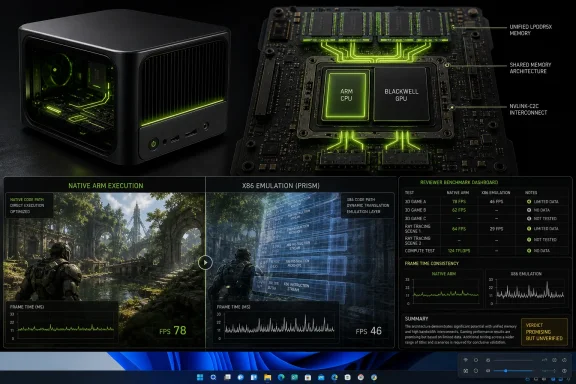
Tech4Gamers’ August 9 report describes 1440p ray-traced AAA gaming, measurable 1% and 0.1% low-frame-rate penalties under Prism, and “dramatic” native-Arm gains. It does not identify a single game, executable version, driver, laptop or desktop configuration, power mode, image-quality preset, upscaling setting, or benchmark result. Those omissions matter more than the sweeping conclusion: NVIDIA has announced RTX Spark hardware for this fall, but its own July developer-preview notice tells developers to validate performance on RTX Spark when supported hardware and software become available.
For now, RTX Spark’s gaming case rests on vendor commitments and a promising software direction—not a reproducible comparison between x86 emulation and native Arm builds.
RTX Spark is a Windows platform, not the existing DGX Spark box
NVIDIA announced RTX Spark with Microsoft on May 31 as a Windows PC platform intended for thin laptops and compact desktops. NVIDIA says the superchip combines a 20-core Grace CPU, a Blackwell RTX GPU with up to 6,144 CUDA cores, NVLink-C2C chip-to-chip connectivity, and up to 128GB of unified memory. MediaTek collaborated on the custom CPU design and associated platform integration.
That is distinct from NVIDIA’s already available DGX Spark: a Linux-based, $3,999 AI workstation built around the related GB10 Grace Blackwell design. The hardware resemblance is real, but it does not make DGX Spark Linux results a stand-in for a Windows RTX Spark laptop. Different operating systems, graphics drivers, power limits, cooling systems, memory configurations, and game-compatibility layers can all change the result.
Microsoft’s Windows Experience Blog has confirmed that it tuned Windows scheduling and the Microsoft Power and Thermal Framework for RTX Spark. It also says the platform will support DirectX 12 improvements, including neural rendering and optimized ray tracing. These are meaningful platform-level commitments, but they are still not a published game benchmark suite.
NVIDIA has said RTX Spark systems from ASUS, Dell, HP, Lenovo, Microsoft Surface, and MSI are due in fall 2026, with Acer and Gigabyte to follow. As of August 10, however, NVIDIA and the PC makers have not provided model-by-model prices, final power envelopes, retail dates, memory tiers, or a public compatibility matrix for games. A claimed gaming conclusion before those details exist is necessarily provisional.
Unified memory removes a copy, not every bottleneck
The strongest part of the RTX Spark pitch is its physical design. On a conventional gaming laptop, a CPU and discrete GPU have separate memory pools; moving data between system RAM and VRAM can involve PCIe transfers and explicit copying. RTX Spark’s CPU and GPU instead share a unified LPDDR5X memory pool, with NVLink-C2C connecting the two parts of the package.
That can be a practical advantage for workloads that move large assets repeatedly between CPU and GPU: AI models, video pipelines, certain content-creation jobs, and some game-engine streaming paths. Microsoft specifically points to a higher, smarter limit on how much total system memory is accessible to the GPU on high-memory RTX Spark systems. A machine with 128GB of unified memory could accommodate assets and local models that would not fit within the dedicated VRAM of many laptop GPUs.
But calling shared memory the elimination of “any bandwidth bottlenecks” overstates what the architecture can do. Memory bandwidth remains finite, and the CPU and GPU share it. Cache behavior, memory-controller efficiency, shader occupancy, driver overhead, CPU scheduling, asset decompression, and the game engine’s own threading model remain possible limits. NVLink-C2C reduces the cost of crossing between CPU and GPU components; it does not make data transfer instantaneous.
The DGX Spark specification gives a useful reference point: its 128GB LPDDR5X design has a 256-bit interface and 273GB/s of memory bandwidth. That is substantial for an integrated system, but it is far below the 672GB/s bandwidth of a desktop GeForce RTX 5070, which happens to use the same 6,144-CUDA-core count. NVIDIA has not yet published an equivalent final bandwidth figure for every RTX Spark PC configuration, so assuming all systems will behave like a maximum-spec DGX Spark would be another mistake.
This is also why raw CUDA-core comparisons are insufficient. RTX Spark may have Blackwell graphics, DLSS, ray tracing, Reflex, and G-SYNC support, but the performance of a particular game will be set by its GPU limit, its CPU limit, its available memory bandwidth, and whether its x86 code can run cleanly through Windows on Arm.
Prism has advanced, but it is not a kernel-driver translator
Microsoft’s Prism emulator is much better positioned for modern PC software than earlier Windows on Arm translation layers. Microsoft’s December 2025 Prism update added support for more x86 instruction-set extensions, including AVX, AVX2, BMI, FMA, and F16C—important because some contemporary games and tools would not launch without them. Windows 11 version 24H2 includes Prism, and Microsoft describes it as the compatibility layer that converts x86 and x64 user-mode instructions into Arm64 code as an application runs.
This means the basic proposition in the Tech4Gamers article is sound: native Arm64 game code should avoid the CPU translation work required by Prism. In a CPU-limited game, that can improve frame time consistency, reduce CPU work, and potentially improve battery life. A native build can also simplify profiling, debugging, and support for developers targeting an Arm PC.
The missing evidence is the size and consistency of that benefit. It cannot be inferred from architecture diagrams. In a GPU-bound game at high resolution with aggressive ray tracing, a lower CPU translation cost may have little effect on average frame rate. In a strategy simulation, crowded open-world scene, esports title chasing high refresh rates, or game with expensive draw-call submission, the CPU and translation cost can matter much more. The outcome will differ game by game.
Nor does native Arm code make DirectX 12 or Vulkan overhead disappear. Windows games still use graphics APIs, drivers, engine abstractions, shader compilers, and runtime services. Native compilation removes x86-to-Arm instruction translation from the game’s CPU code path; it does not eliminate the rest of the software stack.
NVIDIA’s developer guidance reflects that reality. It recommends that developers audit third-party dependencies, choose an Arm64 or Arm64EC strategy, build and test on Windows on Arm, validate NVIDIA and CUDA paths, and then test on RTX Spark hardware. A game is only as Arm-ready as its engine, launcher, middleware, DRM, anti-cheat, overlays, mod tools, and drivers.
Anti-cheat support is progressing title by title
The compatibility gap that still deserves the most attention is kernel-level software. Microsoft’s own Windows on Arm support documentation remains clear: drivers must be written for Windows on Arm, and games can fail when their anti-cheat drivers are not made for Arm64 Windows. Prism translates user-mode application code; it cannot transparently turn an x86 kernel driver into an Arm64 driver.
There is real progress. Microsoft has highlighted native anti-cheat work with Epic’s Easy Anti-Cheat and BattlEye, while Tom’s Hardware reported from an NVIDIA briefing that support efforts also involve DRM providers such as Denuvo. That development can enable an x86 game to remain emulated while its required anti-cheat component runs as native Arm code.
It is not equivalent to blanket compatibility for every multiplayer game. Publishers still have to update, ship, enable, and maintain the appropriate components for their own title. A game using a supported anti-cheat product may still lack an Arm-ready configuration; a game using a different driver-level protection system may remain unavailable. The practical test remains the game’s own publisher support statement or a current compatibility database, not the name of the anti-cheat vendor on a slide.
Tech4Gamers’ suggestion that protection software itself causes Prism “microstutters” is also unsupported without frame-time captures and controlled comparisons. An anti-cheat compatibility failure is easy to observe: the game does not launch, cannot connect, or rejects the machine. Attributing a specific stutter pattern to translated anti-cheat requires evidence the article does not supply.
Existing DGX Spark results show why the missing data matters
The limited gaming reporting around DGX Spark demonstrates how sensitive results are to platform choices. An early Cyberpunk 2077 test on DGX Spark running NVIDIA’s Linux-based DGX OS and Box64 emulation recorded about 50 frames per second at 1080p medium settings, with DLSS reportedly unavailable. A later update cited more than 175 frames per second in the game’s benchmark with high settings, Ultra Ray Tracing, DLSS 4, and Multi Frame Generation enabled.
Those numbers are not contradictory once the settings and frame-generation behavior are disclosed. They are also not a meaningful measure of Windows Prism performance, much less proof of the native-Arm uplift on RTX Spark. They show why average FPS alone is inadequate: reviewers need render settings, native resolution, DLSS mode, frame-generation status, average frame rate, 1% lows, frame-time charts, power draw, thermals, and clear confirmation of whether the game binary is x86-64 or Arm64.
RTX Spark can make a credible case for high-performance Windows on Arm gaming. NVIDIA’s graphics stack gives it an advantage previous Arm Windows PCs lacked, while Microsoft’s Prism work and anti-cheat partnerships address two of the platform’s hardest obstacles. But buyers should treat claims of smooth x86 emulation, negligible performance tax, and superior native Arm frame pacing as unverified until retail hardware and repeatable benchmarks arrive.
The first useful RTX Spark gaming review will not be the one that declares x86 obsolete. It will be the one that publishes the game list, the build numbers, the anti-cheat status, the power profile, and frame-time data—and shows exactly where Prism is good enough today and where a native Arm port still changes the result.