
The distinction matters because the N1X name has been used in earlier reporting and leaks, while NVIDIA’s official product announcement frames the silicon as RTX Spark. NVIDIA and Microsoft announced the platform around Computex in late May and early June 2026, positioning it as a high-performance Windows on Arm option for local AI, creator workloads and RTX-accelerated graphics.
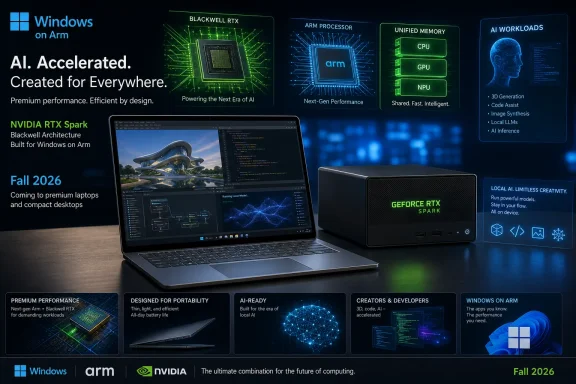 Fall 2026 is the announced availability window
NVIDIA says RTX Spark systems will arrive this fall, which places first availability between September and November 2026 rather than sometime in 2027. Acer and GIGABYTE are also expected to follow with their own systems, though NVIDIA has not attached model-by-model launch dates or prices.
That leaves room for a wider range of designs to emerge in early 2027, but it is not accurate to describe the platform itself as set to debut then. Microsoft’s Windows Experience Blog likewise described an initial fall rollout across laptops and small-form-factor desktop PCs.
A serious new Windows on Arm hardware tier
RTX Spark combines Arm CPU cores, Blackwell RTX graphics and unified memory in one system-on-chip design. NVIDIA has advertised configurations with up to 20 Arm cores, up to 128GB of unified memory and up to 6,144 Blackwell RTX cores, alongside up to one petaflop of AI performance for supported low-precision workloads.
For Windows users, the practical implication is that the traditional divide between an efficient Arm laptop and a GPU-heavy creator or gaming system may narrow. NVIDIA is betting that developers and creative professionals will want a portable PC capable of running demanding AI models locally while retaining RTX software features.
The performance comparisons circulating around N1X should still be treated cautiously. NVIDIA has not positioned RTX Spark as a direct replacement for every desktop GeForce configuration, and final performance will depend heavily on cooling, power limits, memory capacity and individual laptop designs.
Compatibility remains the test
These machines will run Windows on Arm, not x86 Windows. Microsoft says its Prism translation layer will be available and optimized for RTX Spark PCs to run 32-bit and 64-bit x86 software, but emulation does not eliminate every compatibility concern.
Administrators and buyers should expect the usual Windows on Arm checks: native Arm builds for critical applications, driver support for specialized peripherals, anti-cheat behavior in games, and compatibility with legacy line-of-business software. A powerful GPU cannot resolve an application or kernel driver that was never built for the architecture.
The first RTX Spark systems this fall will show whether NVIDIA can turn Windows on Arm from an efficiency-focused alternative into a credible premium performance platform.
