
The announcement, published by NVIDIA on August 24, comes with a significant limitation. Neither NVIDIA nor SpaceXAI disclosed processor quantities, system configurations, commercial terms, deployment dates, power figures for the terrestrial clusters, or a timeline for putting a Vera Rubin-derived system into orbit. Light Reading and The Fast Mode carried the announcement as a press release, rather than independently reporting a completed installation.
What has been confirmed is a plan and a platform direction. It is not evidence that Vera systems are already operating at SpaceXAI, nor that a data-center-class NVIDIA rack has been space-qualified.
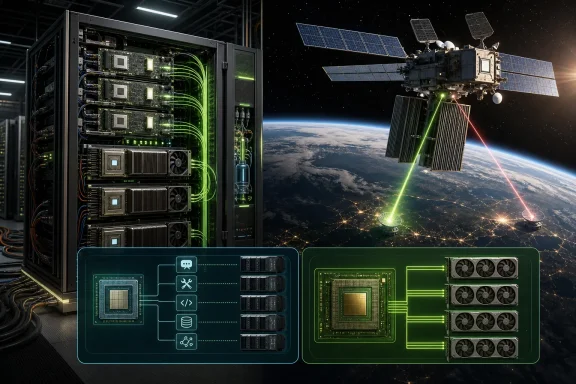 Vera is being positioned for the work GPUs do not do
NVIDIA’s Vera is a CPU architecture designed around the growing amount of non-model work in agentic applications. An AI agent that merely generates a response can lean heavily on GPUs. An agent asked to inspect files, call APIs, use a database, execute code in a sandbox, simulate an outcome and evaluate the result must constantly move between the model and conventional compute, storage, networking and control software.
That pattern is why NVIDIA is emphasizing Vera’s CPU role rather than claiming the processor replaces its GPUs. The company says Vera will accelerate orchestration, tool use, code execution, data processing and simulation between model calls, keeping GPU infrastructure busy with the work it is best suited to do.
For administrators, the distinction is practical. Organizations rolling out agentic systems often discover that adding GPUs alone does not eliminate latency or raise useful throughput. The bottleneck can sit in Python runtimes, retrieval systems, container startup, queueing, API calls, network storage, database queries and isolated code execution. A faster or more memory-bandwidth-rich CPU can matter, but only if the software architecture is actually CPU-bound.
NVIDIA says Vera has 88 internally designed Olympus CPU cores, Spatial Multithreading, and LPDDR5X memory bandwidth of up to 1.2TB/s. It also claims up to 1.8 times faster task completion than x86 CPUs across agentic AI, reinforcement learning and data-processing workloads. Those figures remain vendor claims: NVIDIA has not provided the comparison CPUs, workload mix, model sizes, software stack, concurrency level, power draw or methodology needed for an enterprise buyer to reproduce the result.
The company’s own earlier Vera launch announcement says systems will be sold by server vendors and cloud providers beginning in fall 2026. That makes the SpaceXAI news an adoption commitment for a platform entering the market, rather than a post-deployment case study with measured results.
The larger deal is Vera Rubin, not a standalone CPU purchase
NVIDIA describes SpaceXAI’s intended build-out as a Vera Rubin deployment, which combines Vera CPUs with NVIDIA accelerated computing, NVLink interconnects, Spectrum-X Ethernet, BlueField data processing units and NVIDIA software. In other words, the company is selling a tightly integrated rack-and-network architecture rather than simply winning a socket in a general-purpose server.
SpaceXAI says it is expanding infrastructure behind Grok toward gigawatts of computing capacity. That wording is prospective. It identifies a scale target, not installed capacity, and it does not state where the systems will be built, how quickly they will be brought online, or how much of the capacity will use Vera Rubin.
The common architecture could still be important. A customer operating large training and inference fleets faces real operational friction when its CPU, GPU, networking and storage layers are acquired and managed as separate platforms. NVIDIA’s pitch is that a common hardware and software foundation simplifies the path from CPU-side agent execution to GPU inference, high-speed east-west traffic and storage services.
That integration creates a tradeoff. The potential benefit is fewer incompatibilities across rack components and a more predictable support model. The cost is a deeper dependency on NVIDIA’s hardware, networking and software stack. For companies that need the option to mix accelerators, DPUs, Ethernet fabrics or orchestration tools from several vendors, the value proposition should be evaluated against that loss of flexibility.
SpaceX’s own Starmind page adds an important nuance. It says its satellite design is modular and supports compute modules from any chip vendor. That does not contradict a first-generation system built around NVIDIA Vera Rubin, but it does mean the reported NVIDIA design win should not be treated as a permanent exclusive commitment for all future orbital deployments.
Starmind has a real regulatory record, but no approved fleet yet
The orbital element is more concrete than a concept illustration, but it is still far from an operational AI data center in space. SpaceX’s Starmind site describes an AI1 satellite with a stated compute payload of 150 kW peak and 120 kW average, using solar power, radiative heat rejection and laser links to relay results through the Starlink constellation. It says a Bastrop, Texas, “Gigasat Factory” is planned to support production and deployment of thousands of satellites starting as soon as late 2027.
NVIDIA now says the first-generation Starmind satellite will be based on an optimized Vera Rubin NVL72 rack-scale system. A conventional NVL72 is a dense terrestrial system built around 72 GPUs and substantial networking, power and cooling infrastructure. Putting a derivative of that design on a satellite is therefore not a matter of lifting a data-center rack into a launch fairing. It requires a redesign around mass, radiation tolerance, power conversion, thermal pathways, fault isolation, structural loads, remote operations and component replacement assumptions that are radically different from those in a terrestrial facility.
SpaceX and NVIDIA acknowledge several of those constraints, including power, thermal management, bandwidth, reliability and physical integration. Neither company has published details on radiation protection, cooling hardware, network topology, failure handling, serviceability, launch date or on-orbit performance validation. The announcement should be read as a joint development and architecture plan.
There is also a regulatory distinction worth keeping straight. The Federal Communications Commission accepted SpaceX’s application for an orbital data-center system for filing in February 2026. The proposed non-geostationary system could include up to one million satellites and would use optical inter-satellite links, including connections with Starlink. But the FCC notice was not an authorization to operate the constellation. It opened the proposal for comment and identified SpaceX requests for waivers, including exemptions from some deployment milestone and surety-bond requirements.
An accepted filing is not a license, and a planned Starmind satellite is not a deployed compute platform.
What enterprise teams should take from the announcement
This is most relevant to organizations building or buying AI infrastructure for multi-step agents, coding agents, automated support systems, simulations or other workloads where GPU inference is only one stage of a longer pipeline. NVIDIA’s message is that cluster sizing has to account for the CPU, memory, storage and orchestration path between inference calls.
That should prompt more detailed questions than “how many GPUs do we need?” A serious evaluation should ask how much time an agent spends in tool execution, how many concurrent sandboxes are required, whether retrieval or database work dominates response time, where the KV cache and intermediate data live, and whether networking or CPU-side scheduling is starving the accelerators.
Vera may prove valuable in those environments, but SpaceXAI is not yet the evidence base for that conclusion. NVIDIA has announced the deployment and described the intended workloads; it has not shown a SpaceXAI benchmark, a cluster bill of materials, a before-and-after throughput measurement, or a cost-per-token comparison against a conventional x86-based design.
The immediate consequence is narrower than the headlines suggest: NVIDIA has secured a high-profile commitment for Vera and Vera Rubin in Grok-related infrastructure, while SpaceXAI has publicly tied its future agentic AI and first Starmind design to NVIDIA’s stack. The next meaningful milestone will be a disclosed terrestrial deployment with workload data—or a detailed AI1 spacecraft design that shows how a rack-scale AI architecture survives the transition from the data center to orbit.
