
OAC Technology’s newly circulated 25-year anniversary story lands a year late: the Minneapolis-area managed-service provider says it began operating in May 2000, and the Better Business Bureau lists its business start date as May 26, 2000. On August 5, 2026, that makes OAC 26 years old, not 25. The date mismatch does not erase a quarter-century of operation, but it does expose how a marketing milestone can get repeated after the calendar has moved on.
The article published by Analytics Insight on August 4 frames OAC’s history as a steady evolution from break-fix support into a nationwide managed IT provider, retaining a dedicated-technician model through server, cloud, and AI transitions. OAC’s own site supports parts of that account: it identifies founder Adam Claude, says the company has operated since 2000, serves small and midsize businesses, and offers help desk, server, cloud, security, backup, network, phone, and remote-support work.
What the record does not support is the article’s more specific claim that customers work with the same IT professional “roughly 90 percent of the time.” On OAC’s website, the 90 percent figure refers to the share of its business said to come through referrals, not technician continuity. The company does say it matches a technician to a client and seeks to put clients on a first-name basis with that technician, but it publishes no service-level metric showing that one named technician handles 90 percent of a client’s interactions.
That is more than a copy-editing issue. For businesses choosing an MSP, the difference between a relationship-oriented staffing philosophy and a measurable continuity guarantee is significant. One is a stated approach; the other is a procurement claim that a buyer could reasonably expect to see reflected in ticketing data, escalation coverage, account staffing, and contract language.
OAC’s own media-inquiries page still describes its history as “over the last 25 years,” despite identifying 2000 as its founding year. That language may have been accurate during 2025, but it is stale in August 2026. The company’s public-facing copy appears to have preserved a prior anniversary message rather than updating the basic chronology.
Other promotional coverage has already treated the firm as a 26-year-old business. A sponsored April 2026 article in Benzinga described OAC as reaching its 26th anniversary, while the Better Business Bureau profile lists 26 years in business and gives the May 26, 2000 start date. Those sources align with the calendar and with OAC’s own statement that it was founded in 2000.
This is a routine lapse, but a revealing one because the anniversary itself is the news hook. A company can properly celebrate 25 completed years at any point between May 2025 and May 2026. Once it passes May 26, 2026, however, the precise claim changes: OAC is in its 27th year of operation and has completed 26 years.
The supplied Analytics Insight piece also carries no disclosed operating figures that would let readers independently measure “nationwide” growth. OAC says it is Minnesota-based and provides services to clients across the United States. That establishes an interstate service footprint, particularly plausible for remote support, but does not establish a client count, revenue mix outside Minnesota, number of staffed markets, or on-site coverage model.
A December 2025 promotional story in the LA Weekly named Alaska, California, Wisconsin, Kansas, Texas, Florida, and New York as states where OAC served customers. But that account relied on company-supplied information, and no public client roster or service map independently confirms its present footprint. “Nationwide” should therefore be read as OAC’s description of its remote-capable client reach, rather than evidence of a nationwide office network or a large field-services operation.
But the published material does not spell out the operational limits of that model. It does not identify whether each account has a primary technician and secondary backup, whether support is staffed outside normal business hours, what happens during leave or turnover, whether the same person performs project work and incidents, or whether customers can demand continuity in an agreement.
Those details decide whether the model improves support in practice. A small MSP can provide deeper institutional memory when a primary technician knows the Windows endpoints, Microsoft 365 tenant, line-of-business applications, firewall rules, ISP setup, backup policies, and recurring user issues. The same model can also become fragile if knowledge is held informally by one person rather than documented in a shared platform and tested through backup coverage.
OAC’s LinkedIn profile lists a company size of two to ten employees, although LinkedIn figures are self-reported and can lag staffing changes. If that remains broadly accurate, the dedicated-technician approach is less a mass-scale support architecture than a high-touch staffing choice. That may appeal to smaller organizations tired of ticket queues, but it also makes documentation, escalation procedures, and cross-training central questions for any prospective client.
The original anniversary account turns that choice into a broad argument about OAC resisting the centralization pressures of managed services. That is plausible context, but it is not independently demonstrated by the company’s public materials. OAC has not published historical staffing data, ticket-resolution data, customer retention figures, or pricing that would show the cost of retaining its relationship model as it grew.
The available evidence supports a narrower conclusion: OAC has long marketed personal technician-client relationships as part of its service model. It does not support the claim that clients get the same professional 90 percent of the time.
SOC 2 is an attestation examination performed by an independent licensed CPA firm against selected AICPA Trust Services Criteria. A useful SOC 2 disclosure normally identifies whether the report is Type I or Type II, the audit period or point-in-time date, the applicable trust-services categories, the auditor, and how a qualified prospective customer can review the report under nondisclosure.
OAC’s public pages reviewed for this article do not provide those details. They do not name an audit firm, specify a Type I or Type II report, state a report period, identify the controls in scope, or provide a customer-access procedure. That does not prove OAC lacks a SOC 2 report; many providers restrict reports because they contain sensitive control information. It does mean that the website’s compliance wording alone cannot tell a prospective client what was evaluated or whether the report is current.
There is another ambiguity in OAC’s own cloud-migration material. The company says it can tailor security to meet or exceed PCI, SOC 2, HIPAA, or NIST requirements. Those frameworks apply differently: SOC 2 assesses a service organization’s controls, while HIPAA and PCI create obligations that depend on the customer’s role, data, systems, contracts, and scope. An MSP can help a customer build controls aligned to those obligations without transferring the customer’s responsibility or making every service automatically compliant.
For Windows administrators, this is practical rather than semantic. An MSP with administrative access to Microsoft 365, Entra ID, Windows endpoints, servers, backups, remote-management agents, and network equipment becomes part of the security boundary. Before accepting a broad “SOC 2 compliant” statement, a customer should establish which OAC systems and services are covered, whether its remote-management and backup vendors are in scope, how privileged access is protected, how logs are retained, and whether incident notification terms are contractual.
The more dramatic narrative — that the company rebuilt its expertise repeatedly from on-premises infrastructure through cloud computing and into AI — rests mostly on company and sponsored coverage. OAC’s current LinkedIn posts promote AI integration and mention Microsoft Copilot, ChatGPT, and OpenLLaMA, but there are no public technical case studies showing specific AI deployments, data-governance controls, model choices, or client outcomes.
That omission matters because AI work is qualitatively different from simply adding another support category. Advising a business on Copilot or ChatGPT can involve tenant permissions, information barriers, Microsoft Purview settings, retention, content indexing, identity controls, and a decision about what data should never enter an external model. The next meaningful measure of OAC’s claimed AI-era evolution will be whether it publishes concrete guardrails and implementation details, not whether it adds AI to its service menu.
OAC Technology has a legitimate long operating history and a public service portfolio that extends well beyond the break-fix work associated with small IT shops in 2000. But the August 2026 anniversary coverage is strongest when it sticks to that verifiable point. The company’s age should be corrected to 26 years, its dedicated-technician promise should be separated from an unsupported 90 percent continuity figure, and its SOC 2 language should be backed by the audit scope that enterprise and regulated customers need to see.
What the record does not support is the article’s more specific claim that customers work with the same IT professional “roughly 90 percent of the time.” On OAC’s website, the 90 percent figure refers to the share of its business said to come through referrals, not technician continuity. The company does say it matches a technician to a client and seeks to put clients on a first-name basis with that technician, but it publishes no service-level metric showing that one named technician handles 90 percent of a client’s interactions.
That is more than a copy-editing issue. For businesses choosing an MSP, the difference between a relationship-oriented staffing philosophy and a measurable continuity guarantee is significant. One is a stated approach; the other is a procurement claim that a buyer could reasonably expect to see reflected in ticketing data, escalation coverage, account staffing, and contract language.
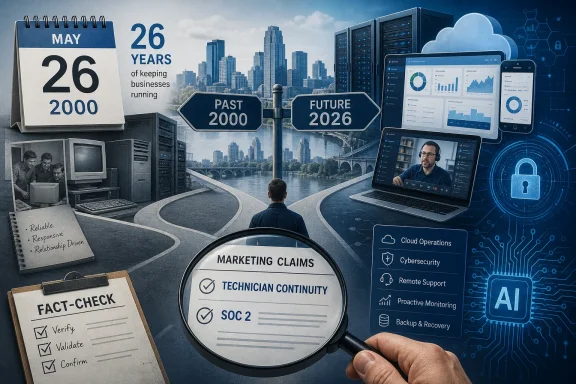 The anniversary date has already shifted
OAC’s own media-inquiries page still describes its history as “over the last 25 years,” despite identifying 2000 as its founding year. That language may have been accurate during 2025, but it is stale in August 2026. The company’s public-facing copy appears to have preserved a prior anniversary message rather than updating the basic chronology.Other promotional coverage has already treated the firm as a 26-year-old business. A sponsored April 2026 article in Benzinga described OAC as reaching its 26th anniversary, while the Better Business Bureau profile lists 26 years in business and gives the May 26, 2000 start date. Those sources align with the calendar and with OAC’s own statement that it was founded in 2000.
This is a routine lapse, but a revealing one because the anniversary itself is the news hook. A company can properly celebrate 25 completed years at any point between May 2025 and May 2026. Once it passes May 26, 2026, however, the precise claim changes: OAC is in its 27th year of operation and has completed 26 years.
The supplied Analytics Insight piece also carries no disclosed operating figures that would let readers independently measure “nationwide” growth. OAC says it is Minnesota-based and provides services to clients across the United States. That establishes an interstate service footprint, particularly plausible for remote support, but does not establish a client count, revenue mix outside Minnesota, number of staffed markets, or on-site coverage model.
A December 2025 promotional story in the LA Weekly named Alaska, California, Wisconsin, Kansas, Texas, Florida, and New York as states where OAC served customers. But that account relied on company-supplied information, and no public client roster or service map independently confirms its present footprint. “Nationwide” should therefore be read as OAC’s description of its remote-capable client reach, rather than evidence of a nationwide office network or a large field-services operation.
The dedicated-technician claim is real — the 90 percent metric is not
OAC’s public pitch has a consistent theme: customers should not have to start from scratch with a different support person every time. Its homepage says clients receive an expert who has taken time to understand their business, while its “About” page says the company matches a technician to the client best suited to that company’s needs. That is a clear differentiator from a conventional shared help-desk queue.But the published material does not spell out the operational limits of that model. It does not identify whether each account has a primary technician and secondary backup, whether support is staffed outside normal business hours, what happens during leave or turnover, whether the same person performs project work and incidents, or whether customers can demand continuity in an agreement.
Those details decide whether the model improves support in practice. A small MSP can provide deeper institutional memory when a primary technician knows the Windows endpoints, Microsoft 365 tenant, line-of-business applications, firewall rules, ISP setup, backup policies, and recurring user issues. The same model can also become fragile if knowledge is held informally by one person rather than documented in a shared platform and tested through backup coverage.
OAC’s LinkedIn profile lists a company size of two to ten employees, although LinkedIn figures are self-reported and can lag staffing changes. If that remains broadly accurate, the dedicated-technician approach is less a mass-scale support architecture than a high-touch staffing choice. That may appeal to smaller organizations tired of ticket queues, but it also makes documentation, escalation procedures, and cross-training central questions for any prospective client.
The original anniversary account turns that choice into a broad argument about OAC resisting the centralization pressures of managed services. That is plausible context, but it is not independently demonstrated by the company’s public materials. OAC has not published historical staffing data, ticket-resolution data, customer retention figures, or pricing that would show the cost of retaining its relationship model as it grew.
The available evidence supports a narrower conclusion: OAC has long marketed personal technician-client relationships as part of its service model. It does not support the claim that clients get the same professional 90 percent of the time.
SOC 2 language needs more detail before it becomes a buying signal
OAC repeatedly describes itself as “SOC 2 compliant” on its homepage, services pages, and marketing materials. For IT buyers, that phrase will immediately read as a security assurance claim. It should not be treated as a substitute for due diligence.SOC 2 is an attestation examination performed by an independent licensed CPA firm against selected AICPA Trust Services Criteria. A useful SOC 2 disclosure normally identifies whether the report is Type I or Type II, the audit period or point-in-time date, the applicable trust-services categories, the auditor, and how a qualified prospective customer can review the report under nondisclosure.
OAC’s public pages reviewed for this article do not provide those details. They do not name an audit firm, specify a Type I or Type II report, state a report period, identify the controls in scope, or provide a customer-access procedure. That does not prove OAC lacks a SOC 2 report; many providers restrict reports because they contain sensitive control information. It does mean that the website’s compliance wording alone cannot tell a prospective client what was evaluated or whether the report is current.
There is another ambiguity in OAC’s own cloud-migration material. The company says it can tailor security to meet or exceed PCI, SOC 2, HIPAA, or NIST requirements. Those frameworks apply differently: SOC 2 assesses a service organization’s controls, while HIPAA and PCI create obligations that depend on the customer’s role, data, systems, contracts, and scope. An MSP can help a customer build controls aligned to those obligations without transferring the customer’s responsibility or making every service automatically compliant.
For Windows administrators, this is practical rather than semantic. An MSP with administrative access to Microsoft 365, Entra ID, Windows endpoints, servers, backups, remote-management agents, and network equipment becomes part of the security boundary. Before accepting a broad “SOC 2 compliant” statement, a customer should establish which OAC systems and services are covered, whether its remote-management and backup vendors are in scope, how privileged access is protected, how logs are retained, and whether incident notification terms are contractual.
A changed service catalog is easier to verify than a claimed transformation
OAC’s current catalog clearly reflects the technical transition described in the anniversary coverage. Alongside server support and desktop support, the company advertises cloud migration, Microsoft 365 email, OneDrive, SharePoint, Azure, Google, AWS, remote monitoring, network security, hosted phones, hardware recycling, and help-desk services. That is a recognizable managed-services portfolio for a small-business IT provider in 2026.The more dramatic narrative — that the company rebuilt its expertise repeatedly from on-premises infrastructure through cloud computing and into AI — rests mostly on company and sponsored coverage. OAC’s current LinkedIn posts promote AI integration and mention Microsoft Copilot, ChatGPT, and OpenLLaMA, but there are no public technical case studies showing specific AI deployments, data-governance controls, model choices, or client outcomes.
That omission matters because AI work is qualitatively different from simply adding another support category. Advising a business on Copilot or ChatGPT can involve tenant permissions, information barriers, Microsoft Purview settings, retention, content indexing, identity controls, and a decision about what data should never enter an external model. The next meaningful measure of OAC’s claimed AI-era evolution will be whether it publishes concrete guardrails and implementation details, not whether it adds AI to its service menu.
OAC Technology has a legitimate long operating history and a public service portfolio that extends well beyond the break-fix work associated with small IT shops in 2000. But the August 2026 anniversary coverage is strongest when it sticks to that verifiable point. The company’s age should be corrected to 26 years, its dedicated-technician promise should be separated from an unsupported 90 percent continuity figure, and its SOC 2 language should be backed by the audit scope that enterprise and regulated customers need to see.
References
- Primary source: Analytics Insight
Published: 2026-08-04T04:47:44+00:00
OAC Technology Marks 25 Years Of Strengthening Its Nationwide IT Presence
OAC Technology celebrates 25 years of IT innovation, evolving from break-fix support to managed services, cloud and AI.www.analyticsinsight.net - Related coverage: benzinga.com
- Related coverage: news.marketersmedia.com
OAC Technology Announces Plans for Nationwide Client Growth
OAC Technology, a Minneapolis–Saint Paul managed services provider, plans to measure client growth while continuing to serve small and medium-sized businesses. Building on 26 years, 500-plus clients, and revenue gains, the firm aims to expand remote IT, cybersecurity, backup, and cloud support...news.marketersmedia.com
