
As reported by The Columbus Dispatch and detailed in an Ohio Secretary of State release, EVA is an internal AI chatbot trained on the state’s 524-page Election Official Manual and annual election calendar. It is not available to voters or connected to the broader internet, a design choice intended to keep responses bounded to official Ohio guidance.
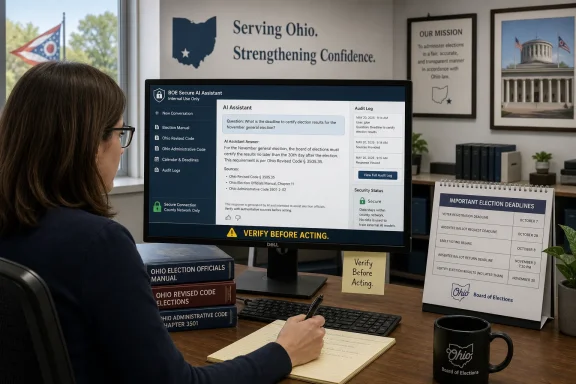 A Search Tool, Not an Election Authority
Secretary of State Frank LaRose’s office deployed EVA in November 2025 as a beta tool for county boards of elections. The system is meant to speed up routine research on subjects ranging from voter-registration database management to post-election audits—work that previously required staff to hunt through lengthy manuals and directives.
That makes EVA closer to a retrieval-augmented knowledge tool than a general-purpose public chatbot. Its practical job is to locate and summarize material from a limited source set, rather than generate answers from the open web.
But the boundary is not a substitute for accountability. LaRose has said users should check EVA’s responses against statutes and directives, and that the bot is not legal counsel. According to ABC News, officials have also found it can struggle with future election dates, a small but consequential failure mode in an environment where deadlines determine ballot access, early-voting schedules, and certification steps.
Other States See the Operational Risk
Ohio’s guarded deployment contrasts with a more cautious position in West Virginia and Maine. ABC News reported that West Virginia Secretary of State Kris Warner warned that chatbots can return the wrong local guidance when a user leaves out essential context—such as the state name for a county name shared across multiple jurisdictions.
Maine Deputy Secretary of State Kate McBrien told ABC News that the technology remains too risky for election administration until cybersecurity assurances improve. Those concerns are not simply about whether an AI system can sound plausible. Election offices must consider whether prompts, source documents, access logs, retained conversations, and model integrations could expose sensitive operational information or create a misleading record of what staff were told.
The distinction matters for IT teams supporting government workflows. A chatbot can be restricted to a trusted corpus and still produce a wrong summary, omit an exception, misread a date, or answer confidently when the authoritative rule has changed. In elections, the correct process is not merely the most likely response; it is the legally controlling one.
The Useful Model Is Human-in-the-Loop
Ohio’s approach is notable because it limits EVA to trained officials and positions it as an accelerator for document research rather than an autonomous decision-maker. That is a more defensible use case than a public-facing bot dispensing voting instructions without a human check.
For election administrators, the sensible controls are familiar to Windows and enterprise IT professionals:
- The source documents must be versioned, authoritative, and updated on a defined schedule.
- Every response should link back to the exact manual section or directive it summarizes.
- Access should be role-based, logged, and separated from public election-information systems.
- Staff need a clear escalation path to counsel or policy officials when the answer affects a legal deadline or procedure.
EVA’s test will not be whether it can answer routine questions quickly. It will be whether Ohio can demonstrate that its convenience never displaces the verification, auditability, and human judgment that election administration requires.
