

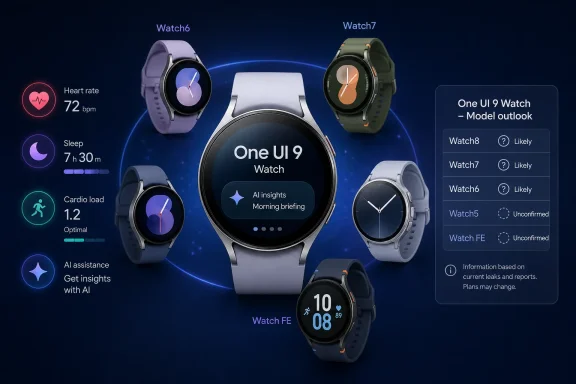
One UI 9 Watch launched on the Galaxy Watch9 and Galaxy Watch Ultra2 at Samsung’s July 22 Unpacked event, with both watches reaching general availability on August 7. Samsung confirms that the new software is based on Wear OS 7 and anchors a major Samsung Health revision built around Vitals, Heart Health Score, Daily Cardio Load, and Fitness Index. Google has separately confirmed the new raise-to-talk Gemini interaction for the Galaxy Watch9.
The missing part is the one existing owners need most: Samsung has not issued a support bulletin naming the watches that will receive One UI 9 Watch, giving beta dates, or committing any older hardware to the headline health and AI functions. The Nokiamob report presents those details as settled; the primary record does not.
The practical One UI 9 Watch candidate list
Firmware discoveries reported by Android Authority, Sammy Fans, Frandroid, and other Samsung-focused outlets show One UI 9 Watch test activity tied to the Galaxy Watch 5, Watch 6, Watch 7, Watch 8, and Watch FE families. That is credible evidence that Samsung is actively preparing the software for a substantial portion of its recent Wear OS lineup.
Based on those reports, these are the models with the strongest evidence of planned One UI 9 Watch work:
- Galaxy Watch8 and Galaxy Watch8 Classic are expected to receive the update.
- The original Galaxy Watch Ultra is expected to receive the update.
- Galaxy Watch7 is expected to receive the update.
- Galaxy Watch FE appears in test-firmware reporting and is expected to receive the update.
- Galaxy Watch6 and Galaxy Watch6 Classic appear in test-firmware reporting and are expected to receive the update.
- Galaxy Watch5 and Galaxy Watch5 Pro appear in test-firmware reporting, but Samsung has not confirmed a final rollout commitment.
The distinction around the Galaxy Watch5 series is more than legalistic caution. The Watch5 generation is now at the outer edge of Samsung’s established four-generation Wear OS and One UI Watch update policy. Multiple reports list it as eligible, and internal builds make an update plausible, but neither Samsung’s July Watch9 launch materials nor its U.S. support documentation currently says that Watch5 and Watch5 Pro owners will receive One UI 9 Watch.
The Galaxy Watch4 and Watch4 Classic are the notable absences. They are not in the published candidate lists, and no credible One UI 9 Watch test evidence has surfaced for them. That will frustrate owners because the Galaxy Watch FE shares much of the Watch4-era hardware platform, but software support is determined by the product’s policy window rather than a simple silicon comparison. For Watch4 owners, the responsible assumption is that One UI 8 Watch was the last major platform release unless Samsung says otherwise.
Samsung could still narrow, expand, or regionalize the list before release. Internal firmware is evidence that code is being built and validated; it is not the same thing as a public support promise.
One UI 9 Watch does not mean every new feature
The eligibility question has two layers that much of the early coverage collapses into one: whether a watch receives the operating-system update, and whether it receives each new health or AI feature. Samsung’s own materials make clear that those are separate questions.
Samsung Health 7.0 introduced the framework for several new measurements before One UI 9 Watch was available on older watches. The app presents Vitals, Heart Health Score, Daily Cardio Load, and Fitness Index as new health features, but Samsung’s availability language does not promise them across every watch that could receive the new operating system.
Vitals is based on overnight heart rate, heart-rate variability, respiratory rate, skin temperature, and blood-oxygen readings, measured against an individual baseline. Samsung says users need at least seven of 28 nights of initial setup wear before the feature can establish that baseline. It is a wellness feature, not a diagnostic tool, and Samsung explicitly says it is not intended to diagnose, treat, mitigate, or prevent disease.
Heart Health Score combines sleep, stress, activity, and body-composition information into a single daily score. Samsung’s U.S. announcement initially described it as available on an “upcoming Galaxy Watch” running One UI 9, rather than publishing compatibility for prior models. That wording has not been replaced with a model-specific guarantee for Galaxy Watch5 or Watch6.
Daily Cardio Load analyzes accumulated cardiovascular strain and estimates both a daily load and training capacity. Samsung says it needs at least seven days of activity history, with 28 days of continuous wear recommended for best accuracy. Fitness Index also has baseline requirements: at least one body-composition measurement, one VO2 max measurement, and two days of activity and step data.
Those setup requirements mean a feature can arrive in a firmware update yet provide no meaningful output on day one. A Watch7 owner who installs One UI 9 Watch should expect a data-collection period, not immediate personalized coaching. IT teams and support staff handling employee wellness devices should account for this before treating the update as a simple feature switch.
There is also evidence that at least some functions will be limited by model. Community posts and Samsung Health compatibility text observed by users point to Galaxy Watch Ultra and Galaxy Watch7-or-newer requirements for several of the new health tiles. Those reports are not a substitute for a Samsung compatibility table, but they reinforce the central point: a One UI 9 Watch build on a Watch5 or Watch6 would not automatically establish parity with the Watch9.
Gemini’s raise-to-talk feature is confirmed for the 2026 watches, not older ones
The article’s Gemini claim is accurate for the Galaxy Watch9 and Galaxy Watch Ultra2. Google says owners of the Watch9 can raise the watch to speak to Gemini without using a wake word, and Samsung markets the same “Raise. Talk. Done.” interaction on both new watch models.
What neither company has announced is a backport to Galaxy Watch8, Watch7, Watch6, Watch5, or the original Watch Ultra. One UI 9 Watch may bring broader Gemini integration to older watches, but that has not been confirmed. The raise-to-talk gesture is tied closely to the 2026 launch hardware and is being promoted as a Watch9 and Ultra2 capability.
That matters because the new Watch9 line has moved to Qualcomm’s Snapdragon Wear Elite platform, while the preceding Galaxy Watch generations use Samsung’s Exynos-based wearable chips. Samsung and Google have not said that older hardware lacks the capability for wrist-raise Gemini, but they have not committed to delivering it there either.
The same restraint applies to performance claims. Samsung says its new watches benefit from improved responsiveness and a newer processor, but there is no public benchmark showing that One UI 9 Watch will “significantly boost” app-launch speed on existing Galaxy Watches. A platform update can improve scheduling, background behavior, and interface efficiency, but it cannot convert a Watch6 or Watch5 into a Watch9-class device.
Samsung Health 7.0 also removes Vascular Load for U.S. users
The most consequential omission from upbeat One UI 9 Watch coverage is that some users may lose a prior health metric as the new system arrives. Android Central and TechRadar reported that Samsung is retiring Vascular Load for U.S. users alongside the Samsung Health 7.0 and One UI 9 Watch transition, replacing that presentation with blood-pressure trend information.
Vascular Load was introduced with the Galaxy Watch8 generation in 2025 as a preventative-care measure intended to track vascular stress during sleep. Samsung has positioned Heart Health Score as a broader successor that draws on sleep, stress, activity, and body-composition signals. The newer score may be more accessible, but it is not a direct continuation of the old metric: users who have tracked Vascular Load trends for a year will no longer have a like-for-like longitudinal view in the United States.
That is a real operational change for people using a Galaxy Watch as a consistent personal data source. It also illustrates why “more AI-powered health tracking” should not be read as “all existing measurements remain available.” Samsung has not published a clear migration guide explaining what historical Vascular Load data remains visible, whether it can be exported, or how its prior results correspond to the new Heart Health Score.
The beta and stable rollout remain unannounced
Reports of an August beta program in the United States and South Korea are based on Samsung’s previous rollout patterns and observed internal development, not a Samsung announcement. Samsung has not opened enrollment through Samsung Members, published a beta notice, named participating countries, or provided a stable-release calendar for the older watches.
For now, Galaxy Watch8, original Watch Ultra, Watch7, Watch FE, Watch6, Watch6 Classic, Watch5, and Watch5 Pro owners should treat One UI 9 Watch as in active preparation rather than in rollout. The correct place to watch is the Galaxy Wearable app and Samsung Members for the exact watch model and region, not a generic eligibility chart.
The update’s first concrete test will be whether Samsung publishes a real compatibility matrix before the beta begins — one that separates the firmware itself from Vitals, Heart Health Score, Daily Cardio Load, Fitness Index, Gemini raise-to-talk, and any regional feature removals. Until then, the “full list” is a well-supported projection, not a completed support roadmap.