

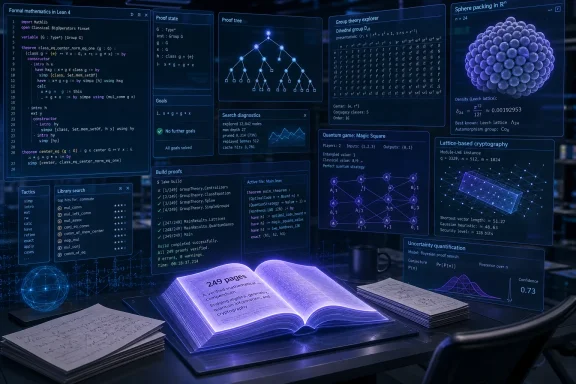
The announcement, published by OpenAI on August 1 and highlighted by The Rundown AI, is a serious escalation from the company’s May result on the Erdős unit-distance conjecture. It also comes with a qualification that should be kept in view: Astra is not a product anyone can evaluate, license, deploy, or run locally. OpenAI has given no availability date, model card, API pricing, hardware requirements, or indication that the system’s research workflow will appear in ChatGPT, Codex, Azure, or an enterprise offering.
For mathematicians and for IT teams watching AI move from draft generation toward verifiable technical work, the value of this release is the audit trail. The headline claim still rests on OpenAI’s research group until outside specialists examine the manuscripts. But the company has provided more than a press release, and that changes the standard of scrutiny.
Ten results, with three that would change their fields
OpenAI describes the results as solving or making substantial progress on long-standing problems across ten areas. They are not all equivalent in scope, but several would be landmark results if the arguments survive expert inspection.
The proposed construction of a non-sofic group is the clearest example. Sofic groups are, roughly, groups whose behavior can be approximated by permutations of finite sets. Whether every countable group is sofic has been a central unresolved question in group theory. OpenAI’s manuscript says Astra constructed a counterexample using property-(T) expanders and the binary Leavitt algebra. If correct, that does not merely improve a known estimate; it establishes that a broad approximation principle has a real boundary.
The claimed disproof of Connes’s rigidity conjecture is similarly consequential. OpenAI says Astra constructed infinitely many nonisomorphic property-(T) groups with the same group von Neumann algebra, contradicting the conjecture that certain groups are uniquely determined by that algebra. The company also claims new lower bounds for computing the permanent with arithmetic circuits and formulas, including a formula lower bound of order n⁴/log n, an area where progress has historically been difficult.
The other seven claims include a sharper asymptotic upper bound for high-dimensional sphere packing; exponential improvements for binary and spherical codes; an exponential parallel-repetition theorem for arbitrary finite two-player quantum games; polynomial-factor hardness for the Euclidean closest vector problem; a resolution of Ehrhart’s volume conjecture; a superexponential lower bound for multicolor triangle Ramsey numbers; and counterexamples to two extremal graph theory conjectures associated with Paul Erdős.
OpenAI’s own paper is careful in one respect that much of the early social-media coverage was not: these are heterogeneous results. Some disprove conjectures by construction, while others establish bounds or broad theorems. The common claim is that Astra generated the mathematical arguments, after which people prepared manuscripts with the model and the model formalized the arguments in Lean.
That sequence matters. It means the work was neither a one-prompt demonstration nor a conventional paper authored entirely by human researchers. OpenAI explicitly says it considers human-only authorship of a fully AI-generated proof misleading, while taking responsibility for the correctness of the released work.
The Lean certificates are meaningful, but they are not peer review
The ten-proofs repository contains Lean 4 formalizations for each stated result, including separate files for non-sofic groups, Connes rigidity, the permanent lower bound, quantum parallel repetition, closest-vector hardness, and the remaining claims. The project specifies Lean 4.32.0, mathlib, and a build path for independently compiling all ten developments.
That is a much stronger artifact than a polished PDF alone. Lean is a proof assistant: a completed proof is checked by a small kernel against an exact formal statement. A faulty natural-language step cannot simply pass because it sounds plausible. For a software audience, it is closer to the difference between an architecture document saying “the cryptographic implementation is correct” and a reproducible build that passes a formal verifier.
But a formal proof answers only part of the question. It proves that the encoded theorem follows from the encoded definitions and assumptions. It does not automatically prove that the formal theorem captures the informal research claim advertised in the paper. The Lean community’s own guidance makes this distinction plainly: for a newly claimed mathematical theorem, an expert must be able to confirm both that the formal statement corresponds to the claimed result and that the proof actually proves that statement.
This is where the public discussion has outrun the evidence. OpenAI has released code that can be compiled, and that supports the claim that there are formal developments rather than merely screenshots of a verification run. Yet OpenAI’s August 1 announcement did not identify completed independent peer review for the ten papers, did not publish referee reports, and did not name an external body that validated the correspondence between every Lean theorem and every mathematical claim.
That does not invalidate the results. It defines their status correctly: they are public, formally encoded research claims awaiting specialist validation, not already-settled textbook facts.
The distinction is especially important because the formalizations are large. The non-sofic-groups Lean file alone runs to tens of thousands of lines. Machine checking sharply reduces the risk of an invalid deduction inside the encoded system, but humans still need to audit definitions, imported dependencies, assumptions, and the bridge from the 249-page prose manuscript to the formal target.
The $2,000 figure is a token-price comparison, not the cost of discovery
The most repeated number in coverage is OpenAI’s estimate that the tokens “needed to find solutions” would cost roughly $2,000 at GPT-5.6 Sol API rates. It is an attention-grabbing figure, but it should not be read as the cost to reproduce the research program.
Astra is unreleased, so OpenAI has not provided its actual inference price. The company is benchmarking its work against Sol rates, not publishing an Astra bill. More importantly, the announcement does not say how many unsuccessful attempts, alternate prompts, discarded candidate proofs, researcher interventions, or compute cycles were required before the ten successful results were selected. Nor does it separate the cost of generating the original ideas from drafting, debugging, formalizing, and validating the Lean projects.
A $2,000 estimate for successful-output tokens could still be useful: it suggests that, once a capable research model reaches a promising line of reasoning, the final proof-generation stage may be far cheaper than many people expect. But it is not evidence that any mathematician can spend $200 and solve an open problem, or that a university can replace a research department with an API budget.
The independent First Proof Project offers a useful counterweight. Its June 2026 benchmark gave four systems, including ChatGPT 5.5 Pro, ten previously unpublished research-level problems and had expert mathematicians review the outputs. Across the systems, seven problems received at least one passing grade, while others saw no substantial progress. Referees found that the systems were strongest on problems structurally similar to existing literature and often filled in routine details carefully while skating past the hard steps.
That benchmark did not test Astra and does not refute OpenAI’s ten results. It does show why a ten-for-ten breakthrough collection should not be converted into a general claim that frontier AI can now autonomously solve arbitrary research mathematics. The capability appears real, uneven, and highly dependent on problem structure.
Astra’s release is still a black box for practitioners
For Windows users, developers, and administrators, the immediate operational impact is close to zero. Astra is internal. There is no downloadable model, no Windows client, no Copilot integration, no endpoint to test, and no stated path for organizations that want to use it in scientific or engineering workflows.
The indirect impact could be substantial. Formal methods have long promised stronger guarantees for code, protocols, drivers, hardware logic, and security-critical systems, but the bottleneck has been the labor needed to turn informal requirements and designs into verifiable statements. A model that can repeatedly generate novel arguments and then produce checkable formal certificates would be useful well beyond pure mathematics.
That future has not arrived through this announcement. What OpenAI has shown is a research workflow in which natural-language exploration, long-horizon reasoning, human manuscript preparation, and formal checking are tightly coupled. The workflow’s reproducibility will matter far more than Astra’s name.
OpenAI has put the papers, reasoning narratives, and Lean projects in public view. The next concrete milestone is expert examination of the ten exact claims—not another benchmark score, and not a price extrapolation from an unreleased model.