
The Independent reports that OpenAI’s ambition is not merely to add another gadget beside the smartphone, but to shift routine computing toward an always-available conversational device. Digital Trends, meanwhile, points to confirmation from OpenAI chief global affairs officer Chris Lehane that multiple devices are part of the company’s coming plans, with more news expected later in 2026.
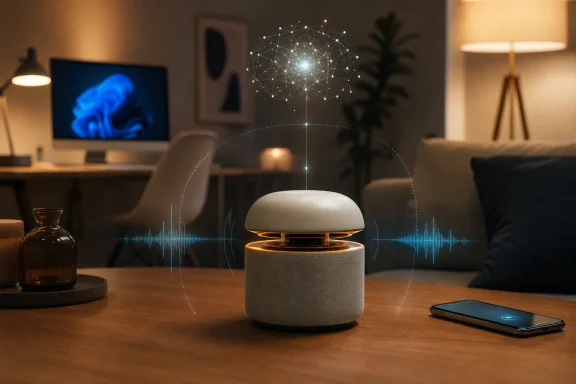
Bloomberg’s reporting, subsequently covered by TechCrunch and others, describes the first product as a mobile smart-speaker-like device with no display and some moving mechanical elements. Internally, it is reportedly positioned as a humanlike companion and a physical manifestation of ChatGPT rather than an iPhone-style slab.
 The First Device Is Not Yet a Phone Replacement
“Replace your smartphone” is a useful shorthand for the ambition, but it overstates what has actually been confirmed. The reported first device appears intended to live in the home, respond through speech and audio, and make ChatGPT feel more ambient than app-based. There is no announced price, launch date, specification sheet, battery claim, or public demonstration.
That distinction matters. Voice-first AI hardware has a difficult recent history: it must be helpful enough to avoid becoming an expensive speaker, yet privacy-conscious enough that users accept microphones, possible cameras or sensors, and a cloud-connected assistant in their personal spaces.
OpenAI’s own public confirmation is narrower. In January, Lehane told Axios that the company was on track to unveil its first device in the second half of 2026, describing “devices” as one of its major upcoming areas. The plural supports Digital Trends’ framing of a product family, but does not establish what form those later products will take.
Jony Ive’s Design Team Is the Strategic Signal
The hardware effort follows OpenAI’s 2025 acquisition of io, the AI-device startup co-founded by former Apple design chief Jony Ive, in a deal valued at about $6.5 billion. Ive and his LoveFrom collective give OpenAI an industrial-design operation that most AI software rivals lack.
For Windows users, that is more consequential than the device’s rumored moving parts. Microsoft has embedded OpenAI technology across Copilot, Windows, Microsoft 365, Azure and developer tools, but OpenAI’s own hardware strategy could create a separate consumer endpoint for the same broad class of AI interactions.
A ChatGPT companion will not automatically compete with a Windows PC. It could instead become another endpoint in the personal-computing stack: one optimized for voice, memory and quick requests, while a PC remains the place for work, creation, management and a full graphical interface. Whether OpenAI can make the handoff between those modes work is the practical test.
The Hard Problem Is Trust, Not Conversation
OpenAI is betting that conversational AI can become a primary interface rather than a feature accessed through Windows, iOS, Android, or a browser. That requires much more than fluent speech. A companion device needs reliable identity handling, permissions, data retention controls, child-safety measures, account recovery, and clear limits on when it can act autonomously.
Enterprise administrators should also watch for a familiar boundary problem. If employees begin using a consumer ChatGPT device to capture meeting notes, retrieve work information, or manage tasks, organizations will need to determine whether that data is governed through sanctioned Microsoft 365 and Copilot controls or sits outside them.
OpenAI has confirmed the hardware direction, but the key details remain unannounced. A second-half 2026 reveal would show whether the company has built a new interface for ChatGPT—or simply another device asking users to trust an AI assistant in their living rooms.
