

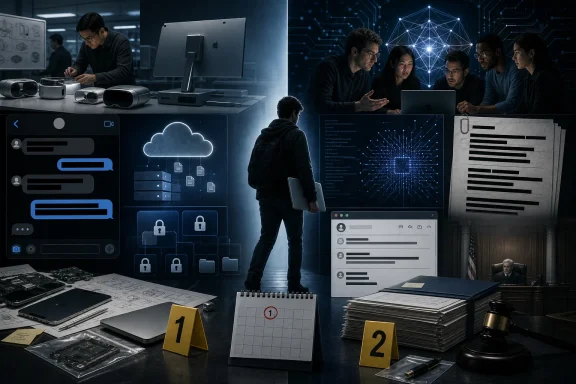
Business Insider’s August 4 roundup, also carried by AOL, collected reactions from Elon Musk, Apple analyst Neil Cybart, CNBC host Jim Cramer, former Apple marketing manager Todd Dailey, and Blimpp founder Harpal Singh. The reactions point in different directions, but the more important divide is between comments on OpenAI’s public-relations tactics and what the material actually establishes in court.
OpenAI did not merely issue a denial. It published a heavily redacted iMessage record involving former Apple engineer Chang Liu, alongside February correspondence showing Apple’s outside counsel mistakenly emailed OpenAI General Counsel Che Chang while intending to contact another former Apple employee. On August 5, OpenAI and the other defendants followed the public post with a 34-page motion to dismiss Apple’s complaint in Apple Inc. v. Liu et al., case 5:26-cv-07078 in the Northern District of California.
That motion is scheduled for an October 1 hearing before U.S. District Judge Edward J. Davila. Apple has separately sought a preliminary injunction, a far more immediate request that could restrict use of allegedly misappropriated information while the case proceeds.
The messages show an Apple offboarding failure — and a deeper exposure problem
OpenAI’s most persuasive exhibit is the record of Apple employees continuing to contact Liu after his January 22, 2026 departure. The messages, as published by OpenAI, show former colleagues asking him to help locate material and explain technical decisions connected to ongoing Apple work. They also indicate that an Apple employee retained access to Liu’s personal iCloud account on an Apple computer for days after he left, apparently to transfer files.
That is damaging to Apple’s simple public narrative that Liu was a former employee who independently and improperly accessed data after joining OpenAI. The published exchanges support OpenAI’s argument that Apple personnel treated Liu as an informal resource after his departure and that access boundaries were not cleanly enforced.
Todd Dailey, who spent more than two decades in Apple enterprise marketing, seized on exactly that point. In the Business Insider roundup, Dailey said he still possessed two unreleased Apple prototypes after his own departure and argued that an older, more tightly run Apple would have retrieved them promptly. It is a personal anecdote, not corroboration of the events in Liu’s case, but it makes OpenAI’s basic premise — that Apple’s controls can be inconsistent at exit — plausible.
For Windows administrators and security teams, the operational lesson is uncomfortable but familiar. An exit process that revokes Active Directory access, retrieves the managed PC, and closes a ticket is incomplete if it leaves personal cloud accounts, device-level synchronization, file-sharing links, corporate chat sessions, local archives, or recovery credentials in an ambiguous state. Apple’s alleged use of personal iCloud accounts for work, raised in OpenAI’s motion to dismiss, would be particularly risky because it blends personally owned data with company material and complicates both preservation and deletion.
But the published messages also create a problem for OpenAI’s framing. They show Liu discussing Apple product and engineering information after he joined OpenAI. The details have been redacted, and the visible record does not establish that OpenAI received or used those details. Still, the exchanges do not demonstrate that Liu lacked access to confidential Apple knowledge. They demonstrate the opposite: an ex-employee remained able to help with sensitive work, whether because Apple asked him to or because its systems and relationships had not been properly severed.
That distinction will matter. Trade-secret litigation does not turn solely on whether access existed; it turns on what the information was, whether reasonable measures protected it, and whether it was improperly acquired, disclosed, or used.
The mistaken email is embarrassing, but it is not the lawsuit
OpenAI is also on firm ground when it attacks Apple’s February pre-suit correspondence. The email chain it published shows Apple’s lawyer, Gabriel Gross of Weil, Gotshal & Manges, sending OpenAI General Counsel Che Chang a message thanking him for a phone call that had never occurred. Gross later acknowledged that the email was intended for a different former Apple employee and apologized for the confusion. An Apple in-house lawyer confirmed that Weil represented the company.
OpenAI has made the episode central to its claim that Apple’s suit was “careless” and that Apple wrongly said it tried to raise the specific allegations with OpenAI before filing suit five months later. Its August 5 motion repeats the argument and says Apple never described the lawsuit’s allegations in those earlier communications.
On the narrow factual point, the record published by OpenAI supports the company: a mistaken email was sent, and the apparent conversation with Che Chang did not happen. That is a serious lapse in a high-stakes legal escalation, particularly when the sender was accusing employees at a major rival of retaining confidential information.
Neil Cybart, founder of Above Avalon, called OpenAI’s response “nonsensical” and characterized it as an attempt to redirect attention from Apple’s central allegations. His criticism is the stronger interpretation of the email episode as a legal matter. A botched communication can undermine Apple’s portrayal of its pre-lawsuit diligence, but it does not determine whether Liu accessed Apple systems after leaving, whether Tang Yew Tan solicited confidential information during recruiting, or whether OpenAI and io Products used anything Apple identifies as a trade secret.
OpenAI’s motion to dismiss makes a larger legal argument: that Apple has described broad categories of ordinary hardware-development knowledge rather than sufficiently specific, protectable secrets, and that Apple has not plausibly alleged actual misuse or injury. That is the argument with consequence. The email mistake is evidence for OpenAI’s narrative that Apple acted sloppily; it is not a substitute for defeating the complaint on the elements of the Defend Trade Secrets Act.
“Gloves off” is accurate, but the injunction is the real escalation
Jim Cramer’s reaction — “Gloves off” — was directed at Apple’s preliminary-injunction push, and it captures the practical shift better than the social-media argument over OpenAI’s blog post. A preliminary injunction asks a judge to intervene before trial because the plaintiff says the harm is ongoing and cannot be adequately remedied later with money damages.
Apple’s original July 10 complaint named Liu, OpenAI chief hardware officer Tang Yew Tan, OpenAI Foundation, OpenAI Group PBC, and io Products. It alleged that Liu retained an Apple laptop and accessed confidential material after joining OpenAI, while Tan and others sought Apple information through recruiting and hardware-development activity. TechCrunch’s reporting on the complaint detailed Apple’s allegation that more than 400 former Apple employees now work at OpenAI — a figure Apple uses to argue that the conduct described may be broader than the named incidents.
OpenAI’s defense has grown more aggressive in response. Its dismissal motion says Apple is using litigation to compensate for failures to retain employees and integrate AI into its products. It says Apple’s account depends on selective excerpts and conduct stripped of context, while asserting that Tan repeatedly told recruits and employees not to bring confidential information from prior employers.
The language is combative because the remedy Apple seeks could impose concrete constraints on OpenAI’s hardware operation. A court order preventing the use or disclosure of specified Apple information would force the defendants to identify, segregate, preserve, and potentially wall off contested work. That could affect a product-development program even before a jury ever decides whether Apple’s allegations are true.
The “smart people” chorus is not a consensus
The Business Insider list is useful as a snapshot of influence, not an expert verdict. Musk’s “Can’t trust OpenAI” response is rhetoric from a business figure with a highly public history of conflict with OpenAI, not an analysis of Apple’s evidence. Cramer’s comment recognized escalation but did not address the underlying trade-secret claims.
Cybart’s dismissal of the post as diversion is a substantive critique. Dailey’s account adds real-world color to OpenAI’s offboarding argument. Singh’s observation is different again: he told Business Insider that OpenAI was trying to shape the version of events repeated by journalists, search engines, and AI answer systems.
Singh is right about the strategy. By posting selected source material itself, OpenAI ensured that the company’s preferred context — not merely its lawyers’ legal filing — entered public search results as a readable, quotable narrative. The post has already shifted the discussion toward Apple’s access controls, its use of personal cloud accounts, and the mistaken February email.
Yet public visibility does not resolve evidentiary weight. OpenAI selected the messages, redacted the engineering details, and presented its interpretation of why Liu had access. Apple’s complaint similarly selected communications and framed them as a coordinated effort to obtain secrets. Neither side’s public packet has been tested through discovery, deposition, forensic review, or a judge’s findings.
October 1 is the first concrete marker
The next meaningful date is October 1, 2026, when Judge Davila is scheduled to hear OpenAI’s motion to dismiss. The preliminary-injunction process may matter sooner if the court accelerates briefing or permits targeted discovery, because that process would require Apple to connect its alleged secrets to a credible risk of present use.
For IT professionals, the case has already supplied a practical warning. A former employee’s residual access, a personally managed cloud account, an unreturned device, and colleagues who still seek informal help can turn an ordinary departure into a litigation-grade information-control failure. Apple may yet prove that OpenAI crossed the line from recruiting talent to using protected information. But the material OpenAI released makes clear that Apple’s own exit controls will be examined alongside OpenAI’s conduct, and that is a vulnerability no litigation narrative can redact away.