
OpenAI says Jalapeño delivered 1.5 to 1.9 times more AI work per watt at peak throughput, alongside 1.7 to 3.6 times lower end-to-end latency, than the commercial systems it compared. The comparison included Nvidia GB200 and GB300 systems and covered GPT-OSS 120B, DeepSeek R1 670B, and Kimi K2.5 1T. SemiAnalysis, whose public InferenceX benchmark OpenAI used, says it ran the tests with OpenAI engineers in the company’s lab and characterized Jalapeño as outperforming the Nvidia, AMD, and Google hardware it had tested.
For Windows and enterprise IT readers, the immediate consequence is not a new accelerator to order. OpenAI has said Jalapeño will be used internally, with an initial deployment planned by the end of 2026, and Axios reports that the company does not intend to sell the chip because it expects to need the capacity itself. The practical story is that a major Microsoft-linked AI customer is moving more of its inference stack—from model serving software through hardware design—under its own control.
 The benchmark lead is real, but its boundaries matter
OpenAI’s results are more useful than the broad claim of “industry-leading” performance because they test a complete serving flow rather than reporting a theoretical FLOPS number. The company measured throughput, latency, and power while holding the requested user experience within defined limits. That is closer to the work behind ChatGPT, Codex, and enterprise AI assistants, where a response must arrive quickly enough for a human or an agent chaining several model calls together.
Jalapeño’s architectural target is inference, the phase where a trained model reads a prompt and generates tokens. Nvidia GPUs remain central to both training and inference, but inference is the recurring workload that grows with every new user, API request, automated support interaction, code-generation task, and multi-step agent run. A custom processor that reduces energy and hardware required per completed request can therefore lower operating costs even if it never trains a frontier model.
The comparison does not demonstrate that Jalapeño is universally faster than every Nvidia platform. Tom’s Hardware notes that OpenAI did not test against Nvidia’s newer Vera Rubin platform, and that Jalapeño does not perform model training. The major comparison also used Nvidia systems in single-token-prediction configurations, whereas production deployments can use multi-token prediction and other serving optimizations to change the performance picture.
Those are important limits, but they do not erase the result. A purpose-built inference ASIC should be judged on inference, and OpenAI’s claim is supported by a public benchmark framework rather than a slide of in-house synthetic scores. The evidence says Jalapeño is a credible high-volume inference competitor to Blackwell-era systems, not that Nvidia has lost its position across AI computing.
The power comparison needs a closer reading
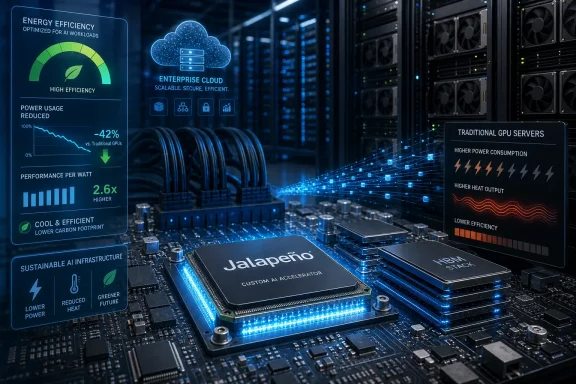
The most eye-catching numbers use performance per kilowatt, which is a meaningful metric for data centers constrained by electricity, cooling, and available grid capacity. Yet readers should distinguish chip package power from the electricity consumed by an entire deployed system.
Tom’s Hardware reports that Jalapeño is rated at 700W, while the Nvidia accelerators cited in the comparison carry ratings of 1,200W and 1,400W. OpenAI says the Jalapeño part sustained 550W or less in its tests. That makes the chip’s efficiency result notable, especially given its six HBM4 memory stacks and 216GB of memory capacity.
However, OpenAI’s appendix also provides an all-in utility-power comparison: 1.18kW per Jalapeño accelerator against 2.55kW per GB300 accelerator. The advantage narrows when measuring that wider system boundary, and narrows again when Nvidia’s GB300 is configured with multi-token prediction. In other words, OpenAI’s processor appears substantially more efficient in the tested configurations, but the exact advantage an operator obtains depends on how racks are configured and software is deployed.
This is the part of the report that matters to capacity planners. A claim based solely on chip-level watts can conceal networking, memory, host, cooling, and power-conversion costs. Conversely, a system-level result can penalize a platform with a different rack design. OpenAI at least exposed enough of the comparison to show that the answer is more complicated than the headline ratio.
Nvidia’s exposure is inference economics, not an immediate displacement
CNBC framed Jalapeño as a threat to Nvidia’s margins, citing Yole Group analyst Adrien Sanchez. The more defensible conclusion is narrower: OpenAI’s project gives it bargaining power and an alternative supply path for a growing slice of its compute demand. Whether that becomes a material hit to Nvidia’s margins depends on deployment scale, yields, total cost of ownership, software maturity, and how quickly Nvidia’s next platforms improve.
Nvidia retains advantages Jalapeño has not attempted to replace. Its accelerators span training and inference, its CUDA software stack is deeply embedded in research and production workflows, and its hardware is available to a far wider base of cloud providers, enterprises, universities, and developers. Jalapeño is OpenAI’s internal hardware, engineered for a particular class of large-language-model serving workloads.
OpenAI also is not presenting Jalapeño as a clean break from Nvidia. Axios reported that OpenAI hardware vice president Richard Ho named Nvidia, AMD, Cerebras, and Jalapeño as components of the company’s future compute supply. The company’s own benchmark material says it is building a multi-generation platform, which is an admission that one first-generation ASIC cannot absorb the rapidly expanding range of AI workloads on its own.
The point is less that OpenAI will stop buying Nvidia hardware than that it can shift selected inference workloads when its own silicon makes economic sense. For Nvidia, the pressure comes from customers with enough scale to design chips around their models and serving patterns, then operate them in huge dedicated fleets. Google’s TPUs, Amazon’s Trainium and Inferentia families, Meta’s internal accelerators, and Microsoft’s Maia work all point in the same direction.
Broadcom and Microsoft are part of the deployment picture
OpenAI designed Jalapeño, but Broadcom is doing much more than supplying a manufacturing relationship. The June announcement assigns Broadcom silicon implementation, networking, and connectivity duties, while Celestica is named for board, rack, and systems expertise. This makes Jalapeño a data-center platform program rather than a lone chip project.
Broadcom and OpenAI had already announced a broader collaboration in October 2025 aimed at deploying 10 gigawatts of OpenAI-designed accelerators and networking systems, with rack deployment scheduled to begin in the second half of 2026 and completion targeted for the end of 2029. Those timings remain forward-looking plans, not an installed-capacity figure. The companies have not publicly specified how many Jalapeño systems will be live in 2026, where they will be located, or what share of OpenAI inference they will handle.
Microsoft is explicitly named in the June OpenAI-Broadcom announcement as one of the data-center partners expected to participate in gigawatt-scale deployments beginning in 2026. That does not amount to an Azure product announcement. Microsoft has not announced a public Azure VM, an Azure AI SKU, or a customer migration path based on Jalapeño, and enterprises should not assume that their OpenAI Service workloads will run on this hardware.
Still, the connection matters. If OpenAI can place more inference capacity within facilities operated with Microsoft and other partners, it could reduce the infrastructure cost per response without customers needing to alter an application. That benefit remains a future possibility, not a published pricing or service-level commitment.
What IT teams should take from the announcement
Jalapeño is evidence that the AI infrastructure market is separating into two layers. General-purpose GPU fleets will remain necessary for diverse workloads, model development, research, and customers that need broadly supported hardware. At the same time, the largest model providers are increasingly treating high-volume inference as a specialized systems problem involving model architecture, compilers, memory bandwidth, networking, and energy constraints.
For enterprises building on Azure, OpenAI APIs, or internal Windows-based developer tooling, no operational action is required today. There is no driver, SDK, instance type, compatibility list, or procurement option attached to Jalapeño. The relevant planning lesson is to avoid anchoring long-term AI cost models to a single accelerator vendor or to a single performance metric.
OpenAI’s first systems are expected before December 31, 2026, but the public record leaves the rollout deliberately vague. Until the company discloses deployed capacity, reliability results, workload mix, and whether lower infrastructure cost changes API pricing or service availability, Jalapeño is best understood as a validated internal alternative for inference—not yet a market-wide replacement for Nvidia hardware.
