
For Windows players, the important change is less the visual upgrade list than the delivery model. OpenPete is built around decompilation and static recompilation work: PlayStation MIPS code is translated and compiled for the PC, while a runtime recreates the console hardware services the game expects. That can expose settings and mod hooks that are difficult or impossible to add cleanly through an emulator-only setup.
But “native” should not be read as a guarantee that every instruction of the 1998 game has already been cleanly converted into ordinary PC code. The PSXRecomp framework used by OpenPete describes a hybrid execution model in which known game code is compiled ahead of time, while disc-streamed code can be captured and compiled later; an interpreter remains a compatibility fallback where necessary. In other words, OpenPete is a Windows-native application with a recompilation pipeline, not a claim that the original game has been wholly reauthored from scratch.
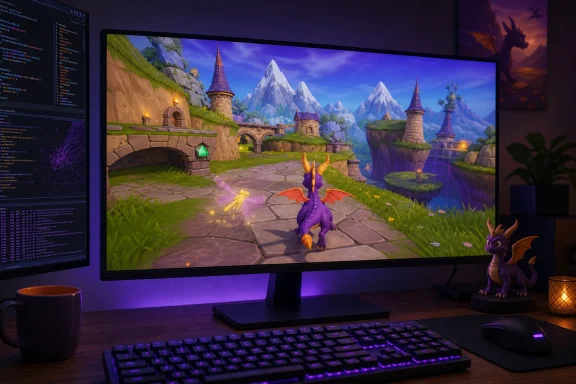 What OpenPete changes on a Windows PC
The original Spyro the Dragon was designed around the first PlayStation’s fixed resolution, 4:3 presentation, low draw distance, and distinctive fixed-point rendering artifacts. OpenPete’s stated features target precisely those constraints: higher frame rates, widescreen field-of-view support, longer-distance scene rendering, perspective-correct textures, and an optional reduction in the familiar PS1 polygon wobble.
Those last two changes are more consequential than a simple resolution multiplier. Texture warping and unstable polygon edges were properties of the PlayStation’s geometry and texture-mapping pipeline, so eliminating them alters the presentation of the original assets rather than merely making the image sharper. PSXRecomp’s own documentation says its geometry-correction and perspective-texturing options are visual enhancements designed to leave the game’s guest-visible coordinates and gameplay logic intact. Whether OpenPete applies those options identically has not been independently documented because its source repository is not public.
That limitation is worth keeping in view for speedrunners and preservation-minded players. A game can render at 60 fps or beyond while preserving original physics and timing, but that result depends on how a particular title’s frame pacing, logic loops, audio, and camera behaviors are handled. Earlier footage shared by Spyro speedrunner lumilaura showed the project running on Windows 11 with 60 fps and widescreen, and reporting in June established that Amec and tyscorp were actively developing the project. The new release changes the story from a promising demonstration into software that people can test on their own machines.
OpenPete’s project page also advertises asset replacement through WAV and PNG files. That is a practical opening for community work: music swaps, texture packs, interface revisions, translations, and visual restoration projects can be distributed as replacement assets rather than requiring users to modify compiled game code. More extensive mod support is described as future work, so users should treat the current file-replacement capability as an early foundation rather than assume OpenPete already has the equivalent of a mature mod loader.
The recompiler is doing work an emulator does not
PSXRecomp, created by Matthew Stanley, is a general-purpose PlayStation static recompilation framework. Its public documentation says it translates PS1 MIPS binaries into C and compiles them into an x64 program linked to a runtime that handles PlayStation hardware behavior, including graphics, audio, memory cards, controllers, disc access, timers, DMA, and interrupts.
The distinction matters in day-to-day use. An emulator interprets or dynamically recompiles code while presenting a virtualized version of the console. A static recompilation project converts much of a specific game into code the PC can execute directly, then provides the console behavior the game still needs. That architecture gives developers more room to add a real widescreen camera adjustment, altered rendering backends, higher internal resolution, input configuration, and game-specific fixes without relying on generic emulator hacks.
It also explains why the project’s claims deserve careful wording. PSX games can load overlays—additional executable code pulled from disc into RAM while the game runs. PSXRecomp says it captures such overlays, compiles them where possible, and uses an interpreter as a correctness fallback for code that has not yet become native. The framework’s authors explicitly characterize full static coverage as an aspiration rather than a completed condition across every supported game.
That does not make OpenPete “emulation” in the ordinary sense, nor does it undermine the usefulness of the port. It does mean that performance, compatibility, and accuracy can vary by location, feature, or game build. Players encountering a bug should report the exact game dump, Windows version, graphics settings, and in-game area rather than assume an issue will reproduce everywhere.
A public build does not mean the game is included
The OpenPete developers say their source tree cannot yet be published because it contains copyrighted validation material: memory dumps, reference screenshots, and hardware traces. That explanation is technically plausible. Recompilation projects often need reference data to compare the PC executable’s behavior against the original game and hardware, but raw memory captures can include copyrighted code and assets.
The practical consequence is that the current release is harder for outside developers to audit, build, or independently verify than a conventional open-source decompilation project. Users can test the program’s behavior, but they cannot yet inspect the game-specific changes, review the build process, or confirm which portions are decompiled versus recompiled.
PSXRecomp’s own public documentation is more explicit on distribution boundaries. It says the framework does not provide a retail PlayStation BIOS or a commercial game image, and it instructs users to supply a legally obtained disc image for a supported title. It includes OpenBIOS, an open-source PlayStation BIOS alternative, but says game data remains user-supplied.
OpenPete users should therefore expect a setup process centered on their own copy of Spyro the Dragon, rather than a self-contained download containing the PlayStation game. Any release package that includes Sony’s original game data, BIOS files, or pre-extracted overlays would raise a different legal and technical issue from the OpenPete project described by its developers.
The “AI-assisted” label needs more precision
Time Extension correctly identifies an AI connection in the toolchain: PSXRecomp’s creator has publicly described the framework’s prototype in connection with Claude Code, and the project’s repository says AI-assisted contributions are accepted if they are reviewed and tested. That establishes that AI assistance was part of PSXRecomp’s development history and remains permitted within the framework’s contribution process.
It does not establish how much, if any, of OpenPete’s game-specific code was generated with AI. Lumilaura’s early statement that the port was being made with “no AI” was later clarified as a comment about whether tyscorp was vibecoding the project, rather than a forensic account of every tool used in its dependency chain. With the OpenPete repository still unavailable, no outside reviewer can settle that distinction by examining commits or generated code.
That is not merely a semantic argument. For a recompilation project, the useful engineering questions are whether generated or hand-written changes are reproducible, tested against known behavior, and traceable when regressions appear. PSXRecomp says its core development approach emphasizes reviewing and testing AI-assisted work, with generated code regenerated rather than manually edited. OpenPete’s closed source tree means outsiders cannot yet determine how closely its game-specific work follows that discipline.
The evidence supports a narrower conclusion than the headline debate suggests: AI was involved in at least one underlying tool used by OpenPete, but the available record does not prove that OpenPete itself was substantially AI-written.
Spyro 2 and Spyro 3 remain possibilities, not releases
OpenPete’s developers have suggested that the same runtime may be able to support Spyro 2: Ripto’s Rage and Spyro: Year of the Dragon because it does not contain Spyro-specific addresses. That is encouraging architecture, but it is not a roadmap with dates, builds, or compatibility guarantees.
The original trilogy shares technology and design lineage, yet each game still has its own executable layout, data formats, rendering behavior, scripts, and edge cases. Support for the sequels would require title-specific validation and work even if the runtime foundation transfers cleanly. For now, OpenPete is a port of the first game, not an all-in-one replacement for the PS1 trilogy.
Version 0.1.3 gives Windows users a meaningful new preservation and modding route for the original Spyro the Dragon. The next concrete milestone is not speculation about the other two games; it is the promised separation of copyrighted validation data from the source tree, which would allow the community to inspect how this first release works, reproduce it, and help stabilize it.
