

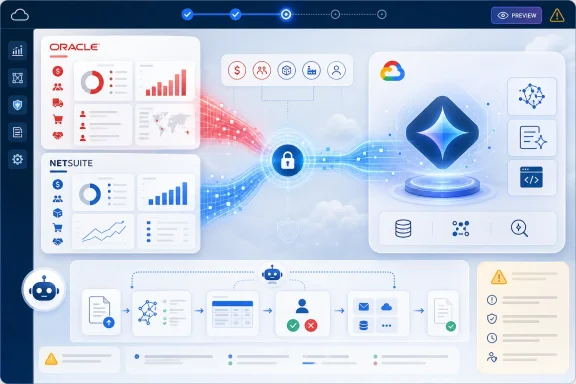
The announcement, reported by Small Business Trends on August 8 as an expansion of AI access for smaller companies, describes Gemini 3.1 Flash Lite and Gemini 3.5 Flash as the initial model choices. Oracle says the models will support agentic applications: software that can carry out defined multistep work through approved tools and business workflows, rather than simply generate a response in a chat window. Google Cloud has independently confirmed that Gemini 3.5 Flash is available in its own enterprise services, while Oracle had already made Gemini 2.5 Pro, Flash, and Flash-Lite generally available through OCI Generative AI in October 2025.
The important change is therefore not that Oracle customers can access Gemini at all. They already could through Oracle Cloud Infrastructure. The new proposal is to bring Google’s models closer to the SaaS application layer where Fusion ERP, HCM, supply-chain, CRM, and NetSuite users actually execute business processes.
That could be consequential. But it is not yet something an Oracle administrator can enable based on this announcement alone.
Oracle is moving Gemini from cloud infrastructure into application workflows
Oracle’s partnership with Google Cloud has already produced a private cloud interconnect and Oracle database services colocated in Google Cloud data centers. OCI Generative AI also offered managed Gemini 2.5 models before this latest announcement. Those services are infrastructure and development capabilities: customers provision cloud services, select models, build integrations, and take responsibility for assembling the application.
The July 30 announcement changes the target surface. Oracle says Gemini is planned for Oracle AI Agent Studio for Fusion Applications, which it describes as a platform for building, connecting, executing, and managing AI automation with Oracle, partner, and external agents. Oracle also says it intends to use Gemini for embedded AI use cases in Fusion Applications and NetSuite.
In practical terms, that is a move from “developers can call a model” to “business-application teams may be able to place a model behind an ERP, HR, finance, or customer-service workflow.” A finance team could potentially build an agent that retrieves permitted invoice, purchasing, and supplier data, summarizes exceptions, drafts follow-up actions, and presents them inside the system of record. A NetSuite administrator could potentially expose narrowly scoped AI assistance alongside existing records and approvals.
The distinction matters for governance. An enterprise AI pilot that works with copied or sanitized data is one thing. An agent that can read customer records, summarize financial documents, create transactions, or trigger workflow steps is another. The model is only one component; the real risk and value sit in identity, role permissions, data retrieval, audit logs, tool access, approval gates, and the ability to reverse an incorrect action.
Oracle has not yet published the implementation details that administrators need to evaluate those controls for Gemini in Fusion or NetSuite.
“Small business access” overstates what has actually been delivered
The supplied report casts the announcement as a breakthrough for small businesses, particularly those using NetSuite. That interpretation is understandable—NetSuite is Oracle’s cloud ERP brand most associated with midmarket and smaller organizations—but it goes further than Oracle’s own announcement.
Oracle’s release is aimed at “thousands of enterprise applications customers,” and its centerpiece is Fusion AI Agent Studio. Fusion is Oracle’s large-enterprise SaaS portfolio, while NetSuite appears in the release as a second planned destination for embedded Gemini use cases. Oracle does not identify a small-business edition, a NetSuite bundle, a minimum subscription tier, included usage allowance, or a date when Gemini-backed functions will appear in ordinary NetSuite accounts.
That omission is material because NetSuite’s existing AI features are not uniformly available. Oracle’s current NetSuite documentation says availability can vary by account region, language, account settings, role permissions, and whether OCI Generative AI is configured for the tenant. Some functions are limited to specific geographies or non-production environments. Oracle’s documentation also notes that certain NetSuite AI functions have not been assessed for customers operating under a HIPAA Business Associate Agreement.
In other words, a NetSuite customer should not interpret the Google announcement as confirmation that Gemini will appear automatically in its production account. It is not evidence that an existing invoice workflow, customer-support process, or analytics dashboard has gained a new model today.
The announcement also offers no evidence for the claim that the integration will lower costs for smaller organizations. Gemini 3.1 Flash Lite is positioned as a high-efficiency, price-performance-oriented model, and Google characterizes Gemini 3.5 Flash as a lower-cost option relative to comparable models. But model efficiency is not the same as a lower application bill. Oracle has not disclosed whether AI Agent Studio access, embedded Fusion functions, NetSuite features, model inference, agent runs, or any associated cloud capacity will be included in existing contracts or charged separately.
Oracle’s own future-product disclaimer makes this unusually clear: release timing, functionality, and pricing can change at Oracle’s discretion.
Gemini 3.1 Flash Lite and 3.5 Flash are different bets
Oracle has named two models, and their positioning gives a useful clue about how the company expects customers to divide AI work.
Gemini 3.1 Flash Lite is the efficiency option. It is designed for high-volume, latency-sensitive, cost-conscious workloads. In a business application, that could include document classification, extracting fields into structured data, routing requests, drafting short summaries, or evaluating whether a record needs human review. These are workloads where a modest per-request cost and predictable response time are usually more important than frontier reasoning performance.
Gemini 3.5 Flash is the more capable option for complex reasoning and specialized multimodal work. Google Cloud has promoted it for long-running agentic tasks, coding, and multimodal understanding. Oracle specifically cites video and presentation creation among the broader specialized tasks it expects customers to access.
For ERP and line-of-business deployments, the more relevant distinction is not “cheap model versus smart model.” It is whether an organization can enforce a model-selection policy by task. High-volume classification and retrieval should not automatically consume a more expensive reasoning model. Conversely, a workflow that interprets a contract exception, synthesizes multiple financial reports, or prepares an executive briefing should not be delegated to the least capable option just to reduce inference cost.
Oracle’s promise of model choice is sensible, particularly because it says Agent Studio will include models from other providers as well. But model choice adds operational work: teams will need testing standards, acceptable-use rules, evaluation data, fallback behavior, monitoring, and controls over which model may call which business-system tool.
A “bring your own prompt” culture will not be sufficient for a system that can act on financial, personnel, or customer data.
The missing security details matter more than the model names
Oracle and Google are emphasizing security, choice, and enterprise workflows, but the July 30 announcement does not state where Fusion or NetSuite prompt data will be processed, how data residency will be handled, whether prompts and outputs will be retained, which regional endpoints will support the service, or whether Gemini usage will be covered by the same contractual commitments as Oracle’s existing generative AI services.
Those questions cannot be answered by assuming that prior OCI or NetSuite documentation automatically applies. Oracle’s existing SuiteScript generative AI documentation describes a specific path through OCI Generative AI and says data does not leave Oracle or become available for third-party model training in that documented flow. The announced Gemini-in-applications capability is a different, future-facing integration, and Oracle has not yet published equivalent technical documentation for it.
The underlying Oracle-Google network relationship does not settle the question either. Oracle’s interconnect documentation says its private link with Google Cloud avoids the public internet, but it also says the traffic is not encrypted by the interconnect itself; customers needing encryption or inspection must add their own controls. That is relevant for customers building cross-cloud architectures, though it does not establish the data path Oracle will use for the planned Fusion and NetSuite Gemini features.
Administrators should therefore require architecture and compliance answers before allowing any future Gemini agent to process regulated or confidential records. At minimum, they will need confirmation of model hosting location, retention policy, customer-data use policy, logging behavior, encryption boundaries, permission inheritance, export controls, and audit evidence for actions initiated by agents.
What Oracle customers should do now
There is no deployment task today, but this is a useful moment to prepare. Fusion and NetSuite customers evaluating AI automation should inventory the business processes most likely to become candidates for agents, then classify the data and permissions involved. Invoice triage, purchasing exception summaries, support-case routing, and knowledge retrieval are generally easier places to begin than workflows that can alter payroll, release payments, approve vendors, or modify financial close data.
Teams should also establish a production gate before the feature arrives:
- Define which agent actions may only recommend work and which, if any, may execute a transaction.
- Require role-based access checks at the data and tool layer rather than trusting a model prompt to respect permissions.
- Test model outputs against historical business records and measure error rates, escalation rates, and harmful failure modes.
- Preserve prompts, tool calls, approvals, outputs, and final actions in audit logs appropriate to the business process.
- Obtain written confirmation from Oracle on availability, licensing, data handling, and support obligations for the customer’s exact Fusion or NetSuite tenancy.
Oracle and Google have announced a plausible next step in the convergence of cloud AI and business applications. But the record shows a planned integration with no public rollout commitment, not a generally available small-business feature. The next meaningful milestone will be Oracle documentation that names the first supported Fusion and NetSuite features, regions, commercial terms, and control model—because those details will determine whether Gemini becomes a useful enterprise automation layer or another preview that remains outside production workflows.