
SkyFall, a Ukrainian drone manufacturer, publicly unveiled the P1-SUN Jetkiller at the Farnborough International Airshow in the United Kingdom. The upgraded interceptor is reported to reach 370 km/h, compared with 310 km/h for the standard P1-SUN, and is intended specifically to pursue Russia’s newer jet-powered Shahed-family attack drones. Reuters reporting carried by Investing.com places the Jetkiller’s development in the wider race to counter mass-produced, increasingly capable loitering munitions.
That is significant because the threat is no longer static. Shahed-derived drones were once chiefly associated with noisy piston-engine propulsion and relatively modest speeds. Russia’s newer jet-equipped variants are reported to reach roughly 500 km/h, putting meaningful pressure on every element of the defensive chain: radar detection, target classification, command-and-control, interceptor launch, terminal guidance, and the final collision. United24 Media’s report on the unveiling also cited a Ukrainian Air Force commander who estimated that jet engines now power 15% to 20% of Russian Shaheds being sent against Ukraine.
The P1-SUN Jetkiller is therefore not merely another small drone. It represents a wider shift in air defense: the effort to turn relatively inexpensive unmanned aircraft into a scalable, kinetic layer between electronic warfare and costly surface-to-air missiles.
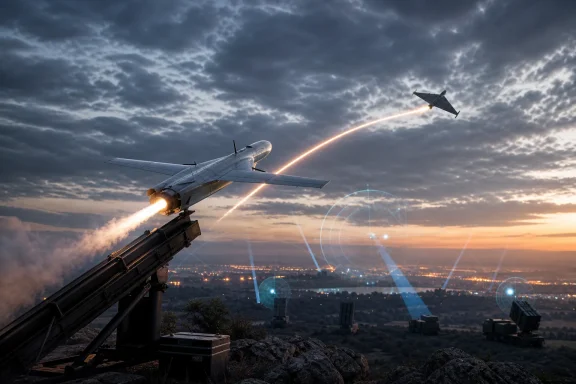 A faster Shahed demands a faster response
The essential challenge is straightforward. A conventional propeller-driven interceptor may be effective against a slower target, but it loses much of its margin when the target’s velocity rises sharply. A fast Shahed can cross defended airspace more quickly, reduce warning time for civilians and air-defense crews, and make a launch from the ground less forgiving.
Russia has adapted the Iranian-origin Shahed design under its own Geran designation, iterating on propulsion, guidance, and production methods. Reuters reported that jet-powered models are being used to penetrate farther into Ukraine, including toward Kyiv, while the faster propulsion makes them much more difficult for many existing interceptors to catch. The Reuters account frames this as an industrial-scale contest rather than an isolated technical upgrade.
The difference between a 310 km/h interceptor and a 370 km/h interceptor may sound modest on a spec sheet. In a real interception, however, speed is not valuable only as an absolute number. It affects:
- Time to altitude after launch.
- Time to reach a predicted interception point.
- Ability to correct for an evasive or changing target route.
- Energy available during the terminal approach.
- The geographic area one launch site can defend.
- The odds of reaching a target before it reaches its intended destination.
A 60 km/h increase is roughly a 19% rise in stated top speed over the regular P1-SUN. That does not turn the Jetkiller into a missile, nor does it guarantee it can overtake a jet-powered Shahed from directly behind when both are operating at maximum speed. But it can materially improve the geometry of an interception when the defender launches from the side, ahead of the target’s route, from altitude, or during a phase in which the incoming drone is not flying at peak velocity.
That caveat matters. SkyFall’s spokesman told Breaking Defense that Russian Shaheds may show top speeds near 400 km/h on Ukrainian radar but do not necessarily sustain that pace across the whole flight. The company’s argument is that those slower flight phases create opportunities for the faster P1-SUN variant to catch and destroy the target. Breaking Defense’s Farnborough report also noted plans to integrate the Jetkiller with helicopters, a concept that could reduce the energy penalty of climbing from a ground launch and extend the interceptor’s useful reach.
The P1-SUN Jetkiller: what has been disclosed
SkyFall has described the Jetkiller as a high-speed evolution of the existing P1-SUN interceptor family. The company says it developed the new model in approximately three months in response to Ukrainian military demand for a system tailored to faster Shahed variants. Reuters’ Farnborough coverage reported that the platform had already been combat-tested before its public presentation.
The publicly reported baseline specifications and claims are notable:
| Capability | Reported P1-SUN Jetkiller detail |
|---|---|
| Top speed | 370 km/h |
| Standard P1-SUN top speed | 310 km/h |
| Intended target set | Jet-powered Shahed/Geran attack drones |
| Development time | About three months |
| Combat testing | Reported before the Farnborough unveiling |
| Serial-production target | August 2026 |
| Claimed SkyFall capacity | Up to 50,000 interceptor drones per month |
The numbers demand careful interpretation. SkyFall told Reuters that the Jetkiller had downed more than a dozen jet-powered Shaheds in combat trials, while the company separately claimed that the regular P1-SUN had destroyed more than 5,500 Shaheds since its November 2025 introduction. Reuters explicitly said it could not independently verify the battlefield claims. That qualification is central to the original reporting.
There is also a difference in the public framing of Jetkiller results. Breaking Defense reported SkyFall’s assertion of dozens of confirmed hits on the front line, whereas Reuters relayed the more conservative “more than a dozen” formulation. The separate report does not necessarily indicate a contradiction—combat totals can change rapidly—but it reinforces why company-supplied kill figures should be treated as operational claims rather than independently audited performance data.
That does not weaken the central story: Ukraine has fielded and displayed a dedicated faster interceptor for the jet-Shahed problem. It does mean that readers should distinguish between the confirmed existence and deployment trajectory of the system, and the precise wartime effectiveness figures attributed to its maker.
Why interceptor drones are becoming an air-defense layer
Traditional air defense is built around a range of systems: surveillance radars, command posts, electronic warfare, anti-aircraft guns, man-portable missiles, short-range surface-to-air missiles, and longer-range missile batteries. Those systems are not obsolete. They remain indispensable against aircraft, cruise missiles, ballistic threats, and difficult targets beyond the reach of small unmanned interceptors.
But the economics change when an attacker can send large numbers of comparatively low-cost one-way attack drones. Firing a sophisticated missile at every target may be tactically effective but financially and logistically unattractive. The interceptor-drone concept seeks to create another option: a small, expendable aircraft that physically destroys an incoming drone at lower cost than a conventional missile.
The model has several clear strengths:
- Scalability: Small aircraft can potentially be manufactured in much larger quantities than missile interceptors.
- Distributed defense: Mobile teams can deploy launchers closer to likely flight paths.
- Lower cost per engagement: The objective is to avoid spending a premium interceptor missile on a lower-cost target.
- Flexible launch locations: Ground launchers, vehicle installations, and airborne launch concepts can complicate enemy route planning.
- Rapid iteration: Software, propulsion, sensors, batteries, airframes, and guidance logic can be revised faster than major missile programs.
Ukraine’s experience has turned those theoretical advantages into urgent battlefield requirements. Reuters reported that drones were a major focus at Farnborough because conflicts in Ukraine and the Middle East have exposed limitations in traditional systems when facing mass-produced aerial threats. The report also noted new counter-drone offerings from MBDA and Lockheed Martin, reflecting an international market converging on the same problem. Reuters’ airshow dispatch makes clear that the Ukrainian approach is no longer a niche wartime improvisation.
For Windows and PC enthusiasts, the deeper technology lesson is familiar. The decisive advantage in a fast-moving threat environment often comes from the combination of hardware volume, software iteration, networking, and telemetry. A drone interceptor is an airframe, but it is also a node in a sensor-to-shooter system. Its effectiveness depends on the quality of target data, navigation, onboard vision or guidance, datalinks, operator tools, and command software as much as on motor output alone.
Speed alone will not solve the interception problem
The Jetkiller’s higher speed is meaningful, but it is only one variable in a difficult system-of-systems problem. A 370 km/h interceptor still needs to be pointed toward the right place at the right time. That requires early warning, accurate tracking, resilient communications, and a method to identify the target without wasting scarce interceptor rounds.
The geometry problem
An interceptor does not always need to be faster than its target in a simple tail chase. If it is launched from a favorable position, directed toward a crossing point, or already airborne, it can approach from the front or side. In those cases, the relevant factor is closing speed, not just maximum speed.
However, a slower interceptor cannot rely on favorable geometry every time. A high-speed Shahed flying directly away from a ground-based launch site can quickly outrun a response. That is why SkyFall’s reported interest in helicopter integration is strategically relevant: launching from an aircraft can provide altitude, speed, proximity, and a broader engagement envelope. SkyFall’s spokesman described that airborne-launch advantage to Breaking Defense.
The sensing problem
Detection must happen before interception. Fast targets impose a more punishing timeline on radars and observers, especially when the threat arrives amid decoys, other drone types, electronic warfare activity, or a larger mixed strike.
The likely answer is not one sensor or one interceptor. It is a layered architecture in which:
- Surveillance systems identify a possible inbound track.
- Command software prioritizes it based on route, speed, altitude, and likely target.
- A launch crew or automated control system assigns an interceptor.
- The interceptor receives updates until it reaches terminal range.
- Its final guidance method completes the collision or proximity kill.
The public reporting does not disclose the Jetkiller’s full sensor package, warhead approach, guidance mechanism, range, altitude ceiling, or autonomy level. Those omissions are unsurprising for a wartime air-defense product. They also limit the ability to evaluate the 370 km/h speed figure in isolation.
The electronic-warfare problem
Any drone designed to intercept another drone must operate in an electronic environment where links can be jammed, navigational signals disrupted, and operators targeted. A platform that is fast but dependent on a fragile connection may have little practical value against a technologically adaptive opponent.
This is where the distinction between demonstrated top speed and repeatable mission effectiveness becomes crucial. A system must not only fly quickly. It must launch reliably, navigate in contested conditions, avoid fratricide, identify targets, and hit them in sufficient numbers to justify its production and training burden.
The industrial test: can SkyFall build at wartime scale?
SkyFall’s stated production capacity of up to 50,000 interceptor drones a month is perhaps the most consequential figure in the announcement—if it can be sustained. Reuters reported the company’s capacity claim, but it remains a manufacturer-provided number rather than an independently verified production total.
The scale is understandable in context. Russia is launching Shahed-class threats in volumes that make individual high-cost solutions difficult to rely on as the sole answer. The Missile Defense Advocacy Alliance’s June briefing said Russia had fired well over 57,000 Shahed-class drones at Ukraine since 2022 and assessed a Russian production ceiling of roughly 5,000 to 5,500 per month by late 2025. The organization’s issue brief also described Russia’s shift toward jet-powered derivatives and other upgrades.
A stated capacity of 50,000 interceptors per month does not mean 50,000 combat-ready launches every month. Actual output can be constrained by components, batteries, motors, payloads, launch hardware, operators, quality-control requirements, storage conditions, and losses in the supply chain. The key question is whether Ukraine can convert industrial output into deployed defensive coverage where it is needed most.
Still, the production ambition signals a different mindset from conventional air defense procurement. Instead of treating every interceptor as a scarce, exquisite munition, Ukraine’s drone industry is trying to create a large inventory of specialized, disposable aerial defenders. That is a hard problem, but it is arguably the correct one for a threat designed around volume and attrition.
A crowded race to defeat fast Shaheds
SkyFall is not alone. The current Ukrainian counter-drone ecosystem is beginning to resemble a high-speed engineering race, with competing firms pursuing distinct answers to the same threat.
General Cherry is reportedly completing a faster version of its Bullet interceptor, designed specifically for jet-powered Shaheds. Reuters reported that the forthcoming variant had exceeded 400 km/h in development and that the company was aiming eventually for 500 km/h, while still trying to keep pricing near that of the existing Bullet, which it put at about $2,000 or less. The Reuters report said the company was evaluating electric and small turbojet propulsion options.
The propulsion choice is not trivial. Electric systems can be simpler, cheaper, quieter, and easier to manufacture in volume, but high speed and endurance demand substantial power. Small jet engines may improve velocity and potentially altitude performance, yet they introduce cost, thermal signatures, fuel requirements, maintenance demands, and new supply-chain dependencies.
Then there is Griffen, the jet-powered interceptor from British-Ukrainian company Firebolt Engineering. The company reported a combat destruction of a Russian Shahed-type drone, described as the first verified Ukrainian interception of that class using a jet-powered interceptor. Unmanned Airspace’s report said Griffen can exceed 350 km/h, operate above 7,500 meters, cover up to 120 kilometers, and launch from a dedicated catapult.
Firebolt’s stated design premise is especially revealing. The company positioned Griffen as a bridge between slower propeller-driven interceptor drones and traditional air-defense missiles. United24 Media’s account described the system as an effort to provide a fast, scalable, lower-cost option against Shahed-class attacks without defaulting to expensive missile launches.
That framing is likely to define the next phase of counter-UAS development. The winning design may not be the drone with the highest advertised speed. It may be the one that best balances:
- Speed and range
- Cost and kill probability
- Ease of launch and field maintenance
- Resistance to jamming
- Sensor and targeting integration
- Manufacturability at volume
- Training burden for operators
- Compatibility with existing air-defense networks
What the Jetkiller announcement really signals
The P1-SUN Jetkiller does not prove that interceptor drones have solved Ukraine’s Shahed problem. The known performance claims remain incomplete, and key measurements—such as combat kill probability, average engagement range, operational availability, and cost per successful intercept—have not been publicly established.
Yet the announcement is important precisely because it shows how quickly the threat-response cycle has compressed. SkyFall says the Jetkiller moved from development work to combat testing and a public debut in roughly three months, with serial production planned for August 2026. The reported timeline reflects an unusually rapid feedback loop between frontline requirements and industrial design.
Russia’s jet-powered Shaheds are forcing Ukraine to seek more speed, more range, and more scalable interception methods. Ukraine’s response, in turn, is pushing its drone companies toward systems that blur the traditional line between an FPV-style drone, a loitering munition, and a miniature guided missile.
The P1-SUN Jetkiller’s stated 370 km/h top speed may not be enough to make every interception easy. But it is evidence that Ukrainian defense technology is adapting to the new reality: countering a fast Shahed increasingly requires a fast, affordable, networked interceptor that can be produced not by the dozen, but by the thousands.