

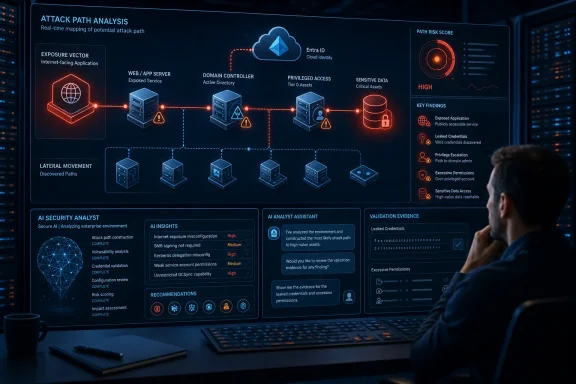
The company’s August 12 announcement says Unit 42 can direct advanced models to examine vulnerabilities, configuration errors, leaked credentials and unmanaged assets, then connect those findings into an end-to-end path and recommend the fixes that break it. Palo Alto Networks says 36% of exposures uncovered in its early work had no associated CVE because they depended on multiple conditions rather than one discrete software flaw.
That claim is significant, but it remains a vendor-reported figure. Palo Alto has not published the customer count, environments assessed, false-positive rate for this particular service expansion, or the methodology behind the 36% calculation. Its earlier model-testing work, reported by Axios in May, supplied a useful reality check: Palo Alto said its AI-assisted process still needed substantial expert customization and produced an average false-positive rate of roughly 30%, varying by the model context and training supplied to it.
The service should therefore be understood as an intensive, human-led offensive-security engagement with AI performing portions of reconnaissance, hypothesis generation and validation at speed. It is not evidence that companies can replace vulnerability management, penetration testing, identity reviews, or change control with an autonomous model.
Attack paths are the product, not raw findings
Most enterprise teams already have a queue full of CVEs, insecure settings, exposed services and stale accounts. The operational failure is rarely a total absence of findings. It is deciding whether an externally reachable application flaw, a misconfigured Active Directory permission, a leaked cloud credential and an overprivileged service account combine into a credible route to high-value systems.
That is the problem Unit 42 says the expanded offering addresses. Its stated workflow includes discovery, adversary simulation, exploit validation and a remediation plan intended to feed existing IT, development and security processes. The most valuable deliverable should be evidence: which access a tester gained, which controls failed, what preconditions were necessary, and which remediation blocks the path with the least disruptive change.
For Microsoft-heavy estates, that distinction is familiar. A monthly patching report can show that Windows Server hosts are current while an attacker’s usable route lies elsewhere: an Entra ID workload identity with broad directory permissions, an exposed VPN appliance, legacy NTLM dependencies, a service account that can modify Group Policy, or an unmonitored OAuth application consent grant. None necessarily creates a headline CVE, yet several can create an intrusion path when paired.
Palo Alto’s assertion that a substantial share of identified exposures lack CVE mapping is plausible in that narrow sense. CVEs identify vulnerabilities in products; they do not catalog every dangerous relationship between identity, endpoint configuration, cloud permissions, network reachability and operational process. Still, “no known CVE” should not be confused with a novel zero-day. Many such findings will be configuration debt, architectural exposure or privilege design problems that existing controls could have revealed if teams had the time and context to investigate them.
The model name reveals a public-information gap
Palo Alto’s post says Unit 42 can use “GPT-5.6 Daybreak,” describing it as OpenAI’s latest advanced cyber capability. OpenAI’s own public material uses Daybreak as the name of its controlled cyber-defense program rather than a model name. Axios reported on August 10 that OpenAI was introducing GPT-5.6-Cyber through Daybreak, with separate Blue and Red access tiers for vetted defenders.
That mismatch may be harmless shorthand, but it leaves buyers without a precise answer to a basic procurement question: exactly which model and access tier will operate in their environment. OpenAI’s public Daybreak partner material, including its Palo Alto Networks entry, continues to describe partner access around GPT-5.5 with trusted access. It also says the program is a controlled rollout and that registering interest does not guarantee inclusion, model access, or a production schedule.
Palo Alto Networks has not publicly specified whether every Frontier AI Exposure Analysis customer gets GPT-5.6-Cyber-equivalent capabilities, whether the model is available only in certain engagement types, how access decisions are made, or where the model executes relative to customer data. It also has not published pricing, supported regions, retention terms, or a list of required integrations and telemetry sources.
Those omissions matter more than the branding. A security team cannot assess data exposure, compliance impact or expected coverage merely from the name of an AI model. Organizations subject to regulated-data restrictions will need written answers on whether source code, infrastructure diagrams, endpoint telemetry, identity data, secrets discovered during testing, packet captures, or vulnerability evidence leave a defined processing boundary. They will also need to know whether the engagement uses customer-owned test tenants, isolated replicas, production systems, or a mixture of all three.
OpenAI’s controls are part of the service design
OpenAI describes Daybreak as a controlled-access program for authorized defensive work. Its public documentation says the advanced cyber workflows are intended for organizations working on systems, applications, networks, accounts and data they own or are explicitly authorized to test. The company also describes additional verification, scoping, logging, monitoring and review for higher-risk work.
Those safeguards are necessary because exploit validation is inherently dual-use. A model that can help prove an authentication bypass, build an exploit chain or escalate privileges is more useful to defenders when it can complete those tasks — and more dangerous if access controls are weak. Axios reported that GPT-5.6-Cyber is designed for advanced vulnerability research and exploit validation, while OpenAI separates it from a less-restricted general model tier.
Palo Alto says Unit 42 specialists remain central to its process, combining model output with offensive-security expertise, the company’s telemetry and Unit 42 Threat Intelligence. That is the correct division of responsibility. Model-generated findings must be reproduced, scoped and reviewed before remediation teams are sent into production systems, particularly where the proposed fix affects authentication, network segmentation, endpoint protections or business-critical applications.
A sensible customer engagement should define the rules before any model-led testing starts:
- The statement of work should identify authorized targets, prohibited systems, production-testing limits, escalation contacts and evidence-handling requirements.
- The customer should require reproducible proof for every material attack path, including the initial condition, each successful step, the privileges obtained and the remediation that stops it.
- The engagement should distinguish externally exploitable issues from findings that require insider access, preexisting administrative rights or assumptions that do not match the customer’s environment.
- The remediation plan should identify a compensating control when the recommended permanent fix cannot be deployed immediately.
- The final report should preserve enough technical evidence for internal red teams, Windows administrators, cloud engineers and application owners to independently verify the conclusion.
These are ordinary penetration-testing disciplines. AI changes the pace and breadth of analysis; it does not remove the need to control testing, validate evidence, and avoid breaking business systems based on an unverified recommendation.
Multi-model testing has a real rationale
Palo Alto says it uses a multi-model harness that routes tasks to different models, arguing that different systems find different weaknesses. Its previous work offers support for that approach. In the May Axios report, Palo Alto said OpenAI and Anthropic models tended to identify different vulnerability types, and that parallel use could broaden coverage.
There is a less glamorous reason for the harness as well: the model is only one component of an assessment. The useful system includes target inventory, access controls, tool permissions, retrieval of environment-specific context, safe execution environments, logging, deduplication, severity assessment and human review. Without that structure, a highly capable model can generate a high-volume stream of uncertain findings faster than a security team can consume them.
Palo Alto’s marketing places the emphasis on “machine speed,” but the constraint for a customer will still be remediation capacity. A Windows team may be able to close an exposed RDP path or rotate a leaked credential quickly. Removing an exploitable path that crosses legacy application authentication, Active Directory delegation, hybrid identity synchronization and third-party access can take weeks of owner coordination and regression testing.
The service’s success should therefore be measured by the number of high-consequence paths it removes, not by the number of model findings it generates. A report that produces hundreds of alerts is only useful if it lets a security team answer which few changes meaningfully reduce the chance of compromise.
What enterprise defenders should ask now
Palo Alto Networks has supplied a credible description of the security problem: attackers chain weaknesses across systems, while traditional exposure programs often process each finding in isolation. Its expansion of Unit 42 Frontier AI Exposure Analysis is a concrete attempt to operationalize OpenAI’s restricted cyber capabilities within a managed service, and OpenAI publicly lists Palo Alto Networks among Daybreak partners.
What remains unproven is the claimed advantage in customer environments. The company has offered a percentage for non-CVE exposures but no independently auditable results for remediation outcomes, attack-path reduction, assessment duration, false-positive performance, or cost per validated path. Until those are available, customers should buy this as a scoped validation engagement, insist on clear data-handling terms and judge it against the quality of its evidence and remediation plan.
For teams overwhelmed by vulnerability backlog, the immediate value may be simple: use the engagement to identify the handful of routes that connect an internet-facing weakness or credential exposure to privileged Windows, identity or cloud control planes. Closing those routes is a more defensible outcome than adding another large set of alerts to the queue.