
The appointment, reported by Seoul Economic Daily and corroborated by Yonhap News Agency, puts an industrial-policy veteran in a key industry liaison role as South Korea’s chip sector confronts simultaneous pressure over domestic fab construction, U.S. trade policy and China’s technology push.
Park previously led the ministry’s Industrial Policy Office and Trade Policy Bureau, and later served as president of Korea Polytechnic University, now Tech University of Korea. The association’s board approved his appointment on July 28 by majority vote, according to Yonhap.
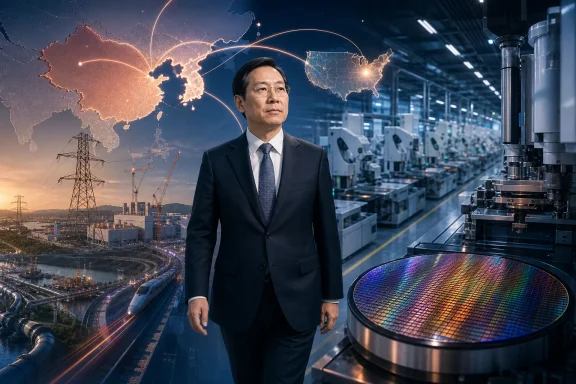 A policy operator for an infrastructure-heavy moment
The role is not a semiconductor executive job in the conventional sense. The Korea Semiconductor Industry Association represents manufacturers and the broader domestic supply chain, making its standing vice chairman a central channel between companies, ministries and regional authorities.
That makes Park’s government and industry-academia background particularly relevant to projects that hinge on more than cleanroom capacity. South Korea’s planned semiconductor expansions in Yongin and the southwest will require long-term coordination on electricity, water, transport, workforce development and permitting—areas where a trade and industrial-policy specialist can matter as much as a technical manufacturing leader.
Trade tensions are now part of fab planning
The association also faces an external agenda that has become harder to separate from domestic investment strategy. Seoul Economic Daily identified U.S. tariff barriers, pressure to locate manufacturing in the United States and China’s accelerating semiconductor capabilities as immediate challenges for Park’s incoming term.
For Windows users and IT organizations, those disputes can appear distant from endpoint management or PC procurement. But South Korea remains central to global memory supply, particularly for DRAM, NAND flash and high-bandwidth memory used in AI infrastructure. Policy shocks that affect the expansion plans of Samsung Electronics and SK hynix can ripple into server availability, SSD pricing and the supply chain behind Windows PCs and data-center hardware.
Park succeeds Kim Jung-hoe, whose three-year term concludes at the end of July. The practical test for the new vice chairman begins immediately: translating South Korea’s large semiconductor ambitions into infrastructure projects and trade positions that companies can execute against.
