

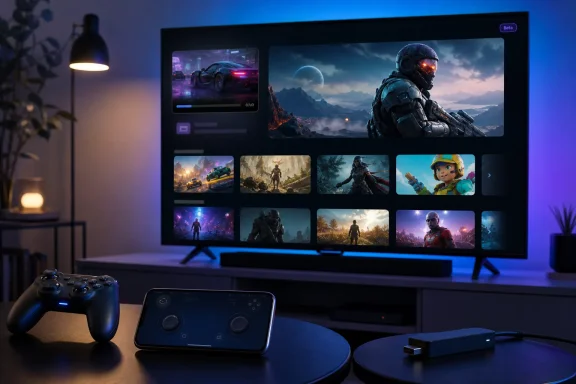
Beet.TV reported the August 11 launch as a U.S. Fire TV beta, while AFTVnews separately identified it as a new free, ad-supported gaming app arriving on Fire TVs. The Manila Times item is a GlobeNewswire distribution of PHYND’s announcement, rather than independent reporting. PHYND’s live support page now says its beta operates in both the United States and Canada, but neither the launch announcement nor Beet.TV’s report explains when Canada was added or whether that availability began simultaneously with the Fire TV rollout.
For Fire TV owners, the useful news is less about another cloud-gaming promise than about the hardware and account requirements now attached to it. PHYND is a small curated service with its own catalog, its own advertising model, and its own terms—not a way to stream an existing Steam, Xbox, PlayStation, or Amazon Luna library.
The Fire TV devices PHYND actually lists
PHYND’s current compatibility page names the following Fire TV hardware:
- Fire TV Stick 4K, second generation.
- Fire TV Stick 4K Max, first and second generation.
- Fire TV Stick 4K Plus.
- Fire TV Cube, third generation.
- Amazon Ember 2-Series, 4-Series, QLED Series, and Mini-LED Series televisions.
That list creates a clearer dividing line than the broad phrase “Fire TV devices” used in the launch coverage. Owners of the current Fire TV Stick HD are not on it. Neither are Fire TV Stick Lite models, standard non-4K Fire TV Sticks, older Fire TV Stick 4K hardware, earlier Fire TV Cubes, or the long tail of third-party Fire TV televisions. Their omission does not prove that the app cannot install or run on every one of those devices, but PHYND has not said it supports them.
This matters because cloud gaming depends on more than whether an app can appear in an app store. The client has to decode a continuous video stream, maintain a responsive connection, and accept controller input reliably enough that the game remains playable. PHYND’s terms say performance and access depend on the device, connection method, and technical environment, and explicitly decline to guarantee streaming quality or uninterrupted access. A beta label is therefore doing real work here: users should expect device-specific quirks and changing support boundaries.
Amazon’s own device documentation shows why a generic Fire TV compatibility claim has become less useful. Current Fire TV products span several software generations, including Fire OS-based televisions and sticks as well as newer Vega OS hardware. PHYND has published a narrow supported-device roster rather than an operating-system floor, so buyers should treat the list—not the Fire TV logo—as the eligibility check.
Free access comes with a separate account and ad model
PHYND says the service has no subscription fee, no credit-card requirement, and no ads that interrupt a game in progress. Beet.TV reports that the company is using formats such as pre-roll advertising and sponsored rewards instead. Those are materially different claims: free to start does not mean advertising-free, and “not during gameplay” leaves room for ads before a session and within reward or promotional flows.
The company’s terms add a condition that is easy to miss in the launch pitch: an account is necessary for ongoing play. PHYND’s support material says signing in is also how players preserve game progress. That makes sense for cloud saves and cross-device access, but it means the Fire TV app is not simply a no-strings-attached replacement for a locally installed party game.
PHYND’s privacy policy says it and third-party service providers collect account information, gameplay and saved-game information, IP addresses, device identifiers, user-agent data, and—in some configurations—geolocation data. The policy also describes data uses that include service personalization, fraud prevention, advertising and marketing, and inferences about content that may interest a user. California users are specifically told they may have rights to opt out of certain sharing or processing for targeted advertising.
There is another consumer-facing detail in the terms: disputes are subject to binding arbitration, with a 30-day opt-out window after acceptance. That clause is common in online services, but it is part of the cost of creating the account behind a supposedly frictionless television-game experience.
This is a curated service, not a PC game cloud locker
The launch catalog described by Beet.TV includes Smurfs Kart, Who Wants to Be a Millionaire?, Garfield Lasagna Party, Agatha Christie: Death on the Nile, Agatha Christie: Murder on the Orient Express, Space Adventure Cobra – The Awakening, UFO Robot Grendizer, Voodolls, Boiling Bolt, and Redout: Solar Challenge. PHYND names publishers and studios including Microids, Tate Multimedia, Fishing Cactus, and Plug In Digital.
That selection identifies what PHYND is trying to be: a television-first discovery and advertising platform built around licensed games, rather than a general-purpose cloud PC. It has not announced Windows or Mac clients, nor has it said users can bring in games they already own from PC storefronts. Its own terms describe access to a catalog of online games through compatible connected devices.
Amazon Luna remains the more directly established Amazon-adjacent cloud-gaming comparison, but it has a different distribution strategy. Amazon’s developer material describes Luna as supporting Windows, Mac, Fire TV, and iOS endpoints. PHYND’s Fire TV launch does not turn Fire TV into an open cloud-gaming client; it adds one more closed catalog alongside Luna and downloadable Appstore games.
For WindowsForum readers, that distinction should temper expectations. PHYND may be useful for occasional living-room play on compatible hardware, particularly where a household has no console. It is not currently a substitute for a Windows gaming PC, a remote-play setup, or a service centered on a player’s existing game purchases.
Controller choice is broader than the reporting first suggested
Beet.TV says Fire TV users can play with a compatible controller or PHYND’s smartphone-based virtual controller. PHYND’s current FAQ goes further, saying its service works with a controller, a virtual gamepad on a phone, or the television remote.
The remote-control claim is convenient but should be read game by game. A basic directional remote may suit menus, quiz titles, and simpler arcade games, while racing, action, and fighting games are far more likely to feel constrained without analog sticks and physical buttons. PHYND has not published a title-by-title input chart in the material accompanying this launch, so a Bluetooth controller remains the sensible option for anyone trying more demanding games.
The smartphone virtual-controller route also deserves skepticism before it is treated as an advantage. It avoids buying hardware, but it moves input onto a touchscreen and introduces another device that must stay paired and charged. For a service selling itself on low friction, a properly supported Bluetooth controller will probably provide the more consistent result.
What the Fire TV beta still leaves unanswered
PHYND has confirmed the essential pieces: Fire TV support is live in beta; supported 4K sticks, the third-generation Fire TV Cube, and certain Ember televisions are included; the service is ad-supported; and an account is required to keep playing. It has also given the most important technical warning itself—streaming quality is contingent on network and device conditions.
What remains unannounced is just as significant for a beta aimed at living-room hardware. PHYND has not published minimum connection-speed guidance, latency targets, streaming resolution, frame-rate targets, a formal supported-controller list, or a schedule for adding excluded Fire TV models. It also has not explained the apparent difference between launch coverage describing a U.S. rollout and its current FAQ listing the United States and Canada.
The immediate consequence is simple: owners of a listed Fire TV 4K stick, Fire TV Cube, or supported Ember set can try PHYND from the Amazon Appstore, but they should verify the exact model first and approach it as a catalog beta—not as universal Fire TV gaming or a replacement for their PC library.