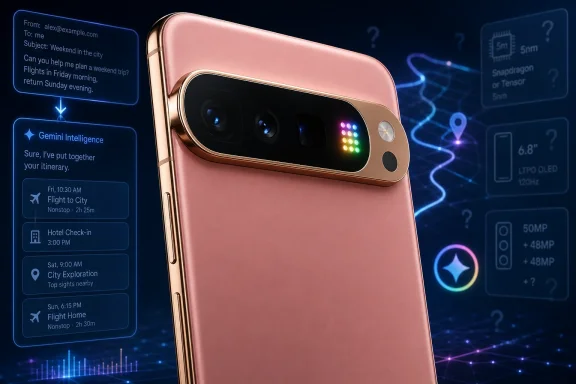
Leaked marketing images appear to show Google preparing the Pixel 11 Pro XL for a visible hardware change: an illuminated “Pixel Glow” array in the rear camera area, alongside a new
“with Gemini Intelligence” marketing line. But the accompanying Pixel 11 Pro XL specification sheet circulating through NokiaPowerUser goes well beyond what the images establish — and several of its most specific claims do not match either earlier reporting or Google’s own public teasers.
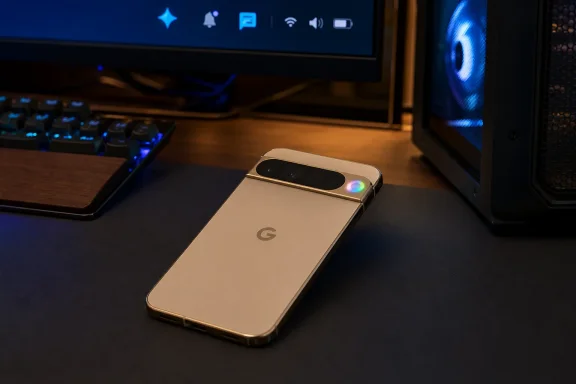
Google has confirmed that its Made by Google event will take place in New York on August 12 at 6 p.m. Eastern, where the company is expected to introduce the Pixel 11 family. The company’s own event imagery has already shown a gold-trimmed Pixel rear camera assembly with a multicolor light effect, while Android Authority previously reported that Google could replace the Pixel Pro thermometer with a small RGB LED array called Pixel Glow.
The important distinction is that
Pixel Glow now has credible visual support; the full Pixel 11 Pro XL spec list does not. The leaked imagery makes an indicator light believable. It does not confirm a 2nm TSMC Tensor G6, a seven-core CPU at desktop-class clocks, a PowerVR GPU model, 120x zoom behavior, or a dedicated Gemini co-processor.
 Pixel Glow Looks Real, but Its Capabilities Remain Unannounced
The strongest part of this leak is the camera-bar lighting. Google’s public Made by Google teaser showed a colorful illumination effect around the rear hardware, and T3 reported in July that Pixel Glow appeared to be integrated into the camera-and-flash area rather than a separate light strip. Android Authority’s May report independently described an “RGB LED array” replacing the Pixel Pro thermometer.
That aligns with the core claim in the submitted report: the Pixel 11 Pro XL may swap the temperature sensor for a back-facing status indicator. Android Authority’s report also said the feature could extend across the Pro phones, including the Pixel 11 Pro Fold, rather than being exclusive to the Pro XL.
What remains unclear is what Pixel Glow actually does. The NokiaPowerUser account says it will handle notifications, charging, camera countdowns, and Gemini or Assistant triggers. Google has not announced any such behavior. T3 cited early Android 17 code describing subtle light and color intended to indicate important activity while a device is face down, but that wording supports a notification role — not the broader list of charging, camera, and AI controls now being attached to the hardware.
The practical consequence is simple: do not assume the Pixel 11 will recreate Nothing’s Glyph interface. The leaked and teased hardware appears much smaller, likely near the flash and sensor area, and Google has yet to say whether owners can customize colors, contacts, app alerts, charging animations, or Do Not Disturb behavior. For enterprise users and people who keep phones face down in meetings, the difference between a restrained attention indicator and a programmable notification system is substantial.
The “Rose Pink Pro XL” Claim Collides With Earlier Color Reporting
The purported Pixel 11 Pro XL promotional render is described as a warm Rose Pink handset with polished gold rails. That color claim deserves particular caution because NokiaPowerUser’s own earlier report on an alleged Amazon listing gave a different list of Pixel 11 Pro and Pro XL finishes: Obsidian, Canyon, Olive, and Fog. Its same report associated a reddish-pink finish with the standard Pixel 11, not the Pro models.
That does not prove the new render is fake. Color names can change between internal assets, retailer listings, and launch marketing, and Google has used regional and retailer-exclusive finishes before. But it does mean the report cannot presently support the assertion that Rose Pink is the Pixel 11 Pro XL’s launch colorway.
The official Made by Google teaser does support the possibility of a gold-toned metal frame and camera surround. It does not establish a pink rear panel, the exact finish name, or the final retail color list. Readers should treat the current color story as a mixture of credible design direction and unresolved SKU-level detail.
There is a second, smaller warning in the design claims. The report describes symmetrical bezels and a substantially redesigned camera bar, while the alleged Amazon material covered by NokiaPowerUser focused on comparatively thick bezels on the standard Pixel 11. Those are not necessarily incompatible — the Pro XL could differ — but no independently available report establishes final bezel dimensions for the large Pro model.
Tensor G6 Is Expected; the “Malibu” Silicon Breakdown Is Not Verified
Multiple reports point to Tensor G6 as the Pixel 11 generation’s processor. Android Authority reported in May that the Tensor G6 had leaked as Google’s first 2nm chip, while NokiaPowerUser’s Amazon-listing report also described a 2nm Tensor G6 and a possible MediaTek M90 modem. That is enough to say a Tensor G6 transition is widely expected.
It is not enough to validate the detailed architecture presented in the new report. The claims of a “Malibu” codename, one ARM C1-Ultra core at 4.11GHz, four C1-Pro performance cores, two efficiency cores, and a PowerVR C-Series CXTP-48-1536 GPU are not confirmed by Google. Nor is the statement that TSMC will manufacture the chip on its N2 process.
The distinction matters because “2nm” is often read as a promised battery-life and sustained-performance win. Process-node naming does not by itself determine real-world thermals, radio efficiency, graphics behavior, or battery life. Those results depend on the final CPU configuration, modem, packaging, cooling, Android scheduling, and the workloads Google prioritizes — particularly camera processing and on-device generative AI.
The MediaTek M90 modem rumor is more plausible than the supplied clock-speed chart because it has appeared in NokiaPowerUser’s previous reporting, but it remains a rumor. The claimed 20% to 30% 5G efficiency improvement is also unsupported by a public Google or MediaTek announcement. IT buyers who use Pixels as managed Android endpoints should wait for carrier-band data, eSIM behavior, enterprise feature support, and measured idle-drain testing rather than treat a process-node claim as a deployment recommendation.
Gemini Intelligence Is a Branding Shift, Not Yet a Hardware Feature List
The leaked images are useful in one other respect: they show Google apparently moving from the broad “Google AI” label toward “Gemini Intelligence.” LOS40 reported that images shared by leaker Evan Blass carried the phrase and depicted Gemini extracting travel information from an email, mapping it, and assembling an itinerary with links to Google Maps, Calendar, and Messages.
That suggests Google’s August pitch will be less about launching another standalone chatbot shortcut and more about making Gemini an action layer across first-party apps. The Pixel 11 could be the showcase device for that approach, but the concept itself should not be mistaken for a Pixel-exclusive capability. LOS40 noted that Gemini Intelligence branding and advanced Gemini functions are also appearing on premium Samsung devices.
The submitted report claims a persistent system-wide Gemini dock, 16GB of RAM as standard across Pro models, a “Santafe” TPU, and a “Metis” GXP co-processor. The only part with meaningful outside support is the possibility of
up to 16GB of RAM: Android Authority reported that the Pixel 11 Pro and XL could retain that ceiling, and subsequent reports have similarly described configurations reaching 16GB. “Up to” is not the same thing as a universal 16GB baseline.
Google has also not confirmed whether the shown email-to-itinerary experience runs locally, in the cloud, or as a hybrid service. That unresolved detail has privacy, latency, data-governance, and offline-use implications. “On-device Gemini” is not a meaningful assurance until Google identifies which models run locally, what data leaves the handset, and whether features require a paid Gemini tier or a continuing internet connection.
Camera and Price Claims Need to Survive the August 12 Reveal
The camera claims are similarly uneven. Android Authority reported that the Pixel 11 Pro and Pro XL could receive new main and telephoto hardware, although it said exact module details were limited. A later report by
Cinco Días, citing Android Headlines, listed a 50MP main camera, 48MP ultrawide, 48MP periscope telephoto, 120x Pro Zoom, a 6.8-inch 3,600-nit LTPO OLED display, 5,115mAh battery, 45W wired charging, and a $1,299 U.S. starting price for the Pro XL.
Those figures broadly match the submitted specification table, but they still trace back to a leak chain rather than Google documentation. The 5,115mAh battery figure has also surfaced separately in reporting tied to leaker Roland Quandt, making it one of the better-supported individual specifications. T3 reported the same capacity, but cautioned that the Pro XL could cost more than its predecessor in the United Kingdom even if the storage configuration changes.
The bigger purchasing issue may be storage. NokiaPowerUser,
Cinco Días, and T3 have all reported that Google may remove 128GB variants and start the Pixel 11 line at 256GB. If that happens, a $1,299 Pro XL could look unchanged at the entry point while offering twice the base storage — but it would also eliminate the lower-price configuration some buyers use to enter the Pro line.
Google has a little over a week to turn Pixel Glow, Gemini Intelligence, and Tensor G6 from a collage of leaks into a coherent product. The rear lighting appears increasingly likely; the exact controls, the Pro XL’s final colors, Tensor G6’s manufacturing and architecture, the camera sensors, charging rate, price, and availability remain matters for the August 12 announcement rather than settled specifications.