
The practical change is more consequential than the brief roadmap entry suggests. Microsoft’s current Planner support documentation describes Private tasks as tasks that “do not belong to a plan yet,” with users able to move them into a plan later. Once the roadmap change arrives, private tasks will begin life inside a plan, giving those one-person tasks a permanent organizational home rather than treating them as an inbox awaiting classification.
Microsoft says the tasks will remain visible only to their creator. They cannot be shared or assigned to another person, and existing tasks are expected to continue working and appear alongside the newly plan-backed private tasks.
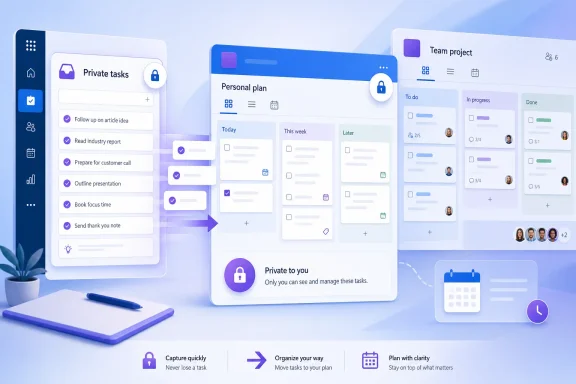 Private Tasks are becoming a real plan-backed workspace
Planner already has two concepts that are easy to confuse: the Private tasks collection in My Tasks, and personal plans created without attaching a Microsoft 365 group. The latter are full Planner plans accessible only to the individual until they are explicitly shared; Microsoft documents them as supporting regular Planner views including Grid, Board, Schedule, and Charts.
The current Private tasks view is different. Microsoft’s support guidance calls it a space for rapidly jotting down work that does not yet belong to a plan. That design is useful as a lightweight inbox, but it also leaves an odd divide inside Planner: users see a task in a central task view, while the task is not associated with the plan structure used for organization, filtering, and management elsewhere in the product.
Roadmap ID 569426 closes that gap by giving private tasks an automatic destination: the user’s private plan. In effect, Microsoft is turning the capture surface into a plan-backed task store without requiring the user to create a named plan or choose a Microsoft 365 group first.
For users, that should make private task handling more consistent. A task entered rapidly in Planner, a Planner-powered experience, or a related Microsoft 365 workflow will not require a later move merely to become part of a plan. For IT teams, it also means documentation and training that describe Private tasks as unorganized or not belonging to a plan will become outdated after the rollout.
Privacy remains individual, not team-level
The roadmap makes a point of stating that private tasks cannot be shared or assigned. That limitation is important because a private plan should not be mistaken for a private team plan.
Microsoft supports personal plans that are accessible only by one user and may later be shared by adding a Microsoft 365 group. It also supports private shared plans, where access is restricted to plan members. The forthcoming private-task storage model is narrower: these tasks are single-user items by design. A task that needs delegation, collaboration, comments from teammates, or shared accountability must still be moved or recreated in an appropriate shared Planner plan.
That restriction preserves the original role of Private tasks as a personal capture area. It also avoids a misleading workflow in which an employee enters a task as private and later discovers that task can be silently exposed to colleagues. Microsoft has not said that the September change will add a one-click promotion path from a private task into a shared plan, although its existing Planner documentation describes moving unorganized private tasks into plans.
The distinction matters for managers and project leads. A task living in a user’s private plan is not evidence of team capacity, a formal commitment, or work that can be reassigned during an absence. It is personal task management, even when the task was created from within an enterprise application.
The existing task view is meant to stay intact
Microsoft says existing tasks will continue to work and appear alongside the new private-plan tasks. That suggests the company is aiming to preserve the My Tasks experience rather than force users into a separate plan view to find older personal items.
Planner’s My Tasks area already aggregates several task sources: Private tasks, tasks assigned from Planner plans and Teams meeting notes, tasks from Loop components, and flagged Outlook email. The All view can combine those sources, while My Day surfaces tasks due today from My Tasks and personal plans.
The new storage model therefore appears to be a back-end and organizational change more than a retirement of the familiar Private tasks entry point. Users should still expect Private tasks to be a location for capture and review, but the record behind a newly created task will belong to a private plan from the start.
Microsoft has not published detailed migration behavior. The roadmap entry does not say whether older unfiled private tasks will be moved automatically into the private plan, whether they will remain in their current storage model indefinitely, or whether users will see a distinction between legacy and newly created tasks. Its statement that existing tasks will appear alongside new ones answers the immediate usability question, but not the data-transition question.
Admins should not assume new sharing or licensing behavior
The roadmap describes a web rollout for general availability in worldwide standard multi-tenant Microsoft 365 tenants. It does not list mobile, desktop, Government Community Cloud, GCC High, Department of Defense, or other sovereign cloud availability. It also does not identify an exact September deployment date, any feature-control setting, or an admin policy.
Nothing in the entry indicates that the change requires a Planner premium license. That is consistent with Microsoft’s existing positioning of personal plans: basic personal plans are available for individual task organization, while premium plans add capabilities such as Timeline, goals, custom fields, and more advanced project-management views. But Microsoft has not explicitly published a licensing statement for Roadmap ID 569426, so organizations should not treat the roadmap item alone as a licensing commitment.
The change also should not be read as an announced compliance or governance feature. Microsoft has said where future private tasks will be stored, but it has not detailed retention treatment, eDiscovery behavior, audit records, Microsoft Graph exposure, Power Automate handling, or data-loss-prevention implications. Those questions matter to enterprises that use Planner tasks as work records rather than personal reminders, and they remain unanswered in the public roadmap entry.
Administrators should avoid redesigning retention policies or automation flows around the new private-plan model until Microsoft publishes product documentation that specifies the underlying service behavior. A change in the visible location of a task does not, by itself, establish that its compliance or API characteristics have changed.
What Planner users should do before September
There is no immediate user action required. The feature remains in development, and Microsoft has provided only a month-level deployment target.
Organizations that train employees to use Private tasks as a temporary inbox should update their guidance once the rollout begins. The more accurate instruction will be that private tasks are personally owned Planner items stored in the user’s private plan, while still functioning as a fast capture surface in My Tasks.
Teams should also be explicit about the handoff point between personal and shared work:
- Personal reminders, draft follow-ups, and individual work queues can remain in Private tasks.
- Work that needs an owner other than the creator should be placed in a shared Planner plan.
- Project tasks that require visibility in team reporting should not be left in a user’s private plan.
- Existing private tasks should be reviewed after rollout to see whether Microsoft has moved them, left them in place, or presented a migration option.
Microsoft has not announced an exact rollout date beyond September 2026, nor has it published implementation detail beyond the storage and sharing limits. The immediate consequence is clear, however: Planner’s private-task inbox is being converted from a holding area into a persistent, personal plan-backed workspace—without making those tasks collaborative.
