

That naming error is more than cosmetic. It signals that the ranking was not checked against the current product record before it claimed to describe the 2026 market. The article also provides no selection criteria, supported credential formats, platform requirements, relying-party compatibility, recovery model, audit record, jurisdictional availability, or evidence of real-world deployment. Those are the details that determine whether an identity wallet can actually be used outside a demo.
The seven projects named by FinanceFeeds are not fabricated. Microsoft Entra Verified ID, Verida, Gataca, Dock, World App, Lissi, and Privado ID all have identity-related technology or wallet offerings. But calling them the seven best wallets collapses significant distinctions: some are enterprise issuance-and-verification services, some are development frameworks, some are consumer applications, and one is principally a system for proving that an account belongs to a unique human.
For Windows users, IT administrators, and organizations evaluating verifiable credentials, the useful conclusion is narrower: this is not a usable buyer’s guide. It is a list of vendors and protocols that require separate evaluation.
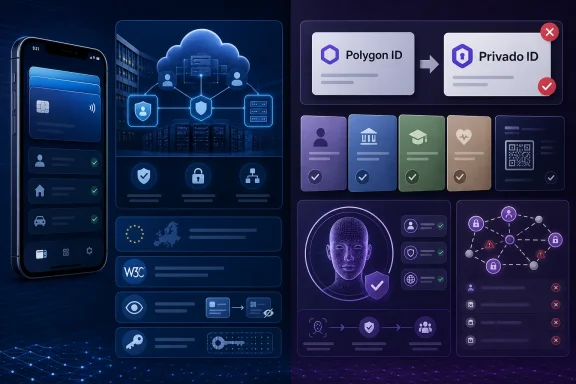
Polygon ID is now Privado ID, and it is primarily an identity stack
Privado ID’s current documentation says the service uses decentralized identifiers, verifiable credentials, and zero-knowledge proofs to allow a holder to demonstrate a claim without exposing the underlying data. That can support a strong privacy property — for example, proving eligibility based on age or residency without revealing an entire identity document.
But FinanceFeeds describes “Polygon ID Wallet” as though it remains a dominant, mass-market wallet integrated into “the broader Polygon 2.0 ecosystem.” The project’s own materials instead position Privado ID as a toolkit for issuers, verifiers, and developers building credential and wallet experiences. It has mobile and reference wallet components, but it is not a straightforward equivalent to Microsoft Authenticator or a government-issued EUDI wallet.
The article also claims support across Ethereum, Polygon, and Solana in its broad description of “top-tier” wallets. Privado ID’s documentation emphasizes blockchain linkage and EVM-compatible environments; that is not evidence that all seven listed products share the same multichain support, much less Solana compatibility. An identity credential system is interoperable only where its credential formats, presentation protocols, trust registries, and verifier policies line up. A blockchain name on a product page does not establish that.
Microsoft Entra Verified ID is enterprise infrastructure, not an independent identity escape hatch
Microsoft’s Entra Verified ID documentation confirms that Microsoft Authenticator can act as a user wallet: it creates decentralized identifiers, receives and presents verifiable credentials, and maintains an encrypted backup of a DID seed. Microsoft also documents support for the W3C credential model and its did:web trust method.
That is useful for enterprises already invested in Microsoft Entra ID, Azure, Conditional Access, and Authenticator. A company can issue a credential, request it during a sign-in or access workflow, and receive a cryptographically verifiable response rather than merely trusting a copied document upload. It can reduce repetitive document collection in tightly governed workflows.
FinanceFeeds overstates the independence of that arrangement when it says workers can carry “security clearances” under their control even after leaving an organization. A holder may retain a credential on their phone, but the issuer controls whether it remains valid and a verifier decides whether it accepts it. A former employee holding an old work credential does not create a continuing right to access an employer’s resources. Credential status, revocation, issuance policy, and verification rules remain central to the security model.
Microsoft’s architecture also does not erase the enterprise service layer. Entra Verified ID is an Azure service used to issue and verify credentials, and did:web binds trust to control of a web domain. That is a practical model for enterprises, but it is materially different from the article’s suggestion that the user has “100% control” without reliance on institutions.
Europe’s EUDI deadline has not made third-party wallets mandatory today
The FinanceFeeds article invokes “the full implementation of eIDAS 2.0 in Europe” and says European government services “now mandate” digital wallet acceptance. The European Commission’s own timeline says something more restrained.
Regulation (EU) 2024/1183 entered into force on May 20, 2024. The Commission says EU member states are required to provide European Digital Identity Wallets by the end of 2026, following the implementing regulations, while pilot programs and reference implementations have been used to test the technical framework. As of August 3, 2026, that means Europe is in the deployment period, not at a point where a private wallet vendor can simply declare universal EUDI acceptance.
Gataca and Lissi are genuine participants in that developing market. Gataca says its wallet stores verifiable credentials, supports selective disclosure, and is built around international standards. Lissi’s ID-Wallet is listed as supporting OpenID4VC, SD-JWT, and mDoc formats, and Lissi has been active in European identity pilots and financial-sector integrations.
Neither fact makes Gataca or Lissi an automatically accepted EU identity document everywhere. Member states decide how they provide their wallets, certification requirements are consequential, and relying parties still need functioning verifier infrastructure. Lissi itself has previously described its path to official EUDI-wallet status as dependent on regulatory clarification and decisions by individual member states. That is the honest state of a market moving from pilots toward deployment.
For organizations planning European support, the action is to track the EUDI Architecture and Reference Framework, OpenID4VC profiles, mDoc requirements, national wallet programs, and sector-specific obligations. Choosing a consumer app from a generic “best wallets” list does not solve any of those implementation tasks.
Verida, Dock, and Lissi solve different credential problems
Verida describes its mobile application as both a data wallet and a crypto wallet. Its documentation says users can create decentralized identities, manage keys, authenticate to decentralized applications, and work with credential data held in private encrypted storage. That makes it relevant to builders who want to join personal data storage, Web3 identity, and verifiable credentials.
The FinanceFeeds claim that Verida is the “primary choice” for consumers managing health records and social-media data alongside crypto assets is unsupported. Verida has the technical building blocks for private data and credentials, but no deployment figures, health-system partners, or independent reporting are supplied to establish that market position. Health credentials also carry regulatory, consent, retention, and clinical-data interoperability obligations that a generic encrypted wallet does not eliminate.
Dock has a legitimate decentralized-identity history. Its materials describe a wallet, DIDs, verifiable credentials, encrypted storage, and passkey or biometric access. Yet FinanceFeeds’ assertion that “many universities and certification bodies” issue diplomas directly to Dock wallets names no institutions, no credential programs, and no current usage figures. That claim should not be treated as established merely because academic credentials are a plausible use case for verifiable credentials.
Lissi’s current work is much easier to place. Its product and recent company material emphasize EUDI integration, financial institutions, and organizational identity-wallet functions. Its App Store description explicitly names employee credentials, qualifications, access badges, OpenID4VC, SD-JWT, mDoc, and EUDI pilot compatibility. That makes Lissi a credible option for a European organization pursuing those standards — not a universal recommendation for an individual looking for a general-purpose digital wallet.
World App proves personhood; it does not replace government identity
World App belongs in a discussion about online identity, but it should not be treated as interchangeable with a conventional DID credential wallet. World’s documentation describes World ID as a privacy-preserving proof of human system. A person can use it to demonstrate that they are a real, unique human without sending a relying application their name or email address.
That is a relevant capability as services attempt to distinguish people from bots and duplicated accounts. World says its proofs can be generated on the user’s device and that relying parties receive a proof rather than raw personal data. In practical terms, World App can address one-person-one-account, anti-abuse, and bot-resistance scenarios.
It does not prove professional qualifications, legal residency, an employment relationship, citizenship, a security clearance, or the authenticity of a university degree. Those require credentials from an issuer that a verifier recognizes. FinanceFeeds is right that proof-of-personhood has become more salient in an AI-heavy internet, but it confuses one identity attribute — uniqueness — with a portable, general-purpose identity system.
Standards are advancing, but hardware integration is not the story
The standards picture is healthier than the article suggests, although less dramatic. W3C published the Verifiable Credentials 2.0 family as Recommendations in May 2025, including mechanisms relevant to data integrity and selective disclosure. In March 2026, W3C published Decentralized Identifiers v1.1 as a Candidate Recommendation Snapshot, while DID v1.0 has already been a W3C Recommendation since 2022.
Those standards help software vendors describe credentials and identifiers in compatible ways. They do not mean that “W3C standards” have been integrated into mainstream mobile hardware, as FinanceFeeds claims. No evidence is offered for such a hardware-level shift, and the listed products do not all document the same secure-element, Secure Enclave, or Trusted Execution Environment design.
A phone’s biometric unlock and hardware-backed key storage can reduce some risks, but they do not answer the harder operational questions: What happens when the device is lost? Can credentials be migrated? Does restoring a backup preserve privacy? Can a credential be revoked? Which issuers does a verifier trust? Is the verifier tracking presentations? Does a user have a way to inspect what they are sharing?
The identity-wallet market is real, and 2026 is an important deployment year for European digital identity. But the practical winners will not be determined by a seven-item list. They will be determined by which credential issuers, relying parties, operating systems, regulators, and recovery systems actually work together — and by whether the wallet can prove a claim without quietly creating a new central point of control.