
That distinction turns Aion from a prospective Windows replacement into something more specific—and more constrained. The leaked materials describe an experimental agent-first interface in which Copilot is the launcher, task organizer, and route into web services, while a full Windows desktop remains somewhere else in Microsoft’s cloud. For Windows users and enterprise administrators, that is less a new version of Windows than a thin, managed endpoint with a cloud escape hatch.
Microsoft has not authenticated the documents or publicly commented on Project Aion. The materials may show a real internal experiment, but they do not establish that Aion remains funded, supported, or headed for release in August 2026.
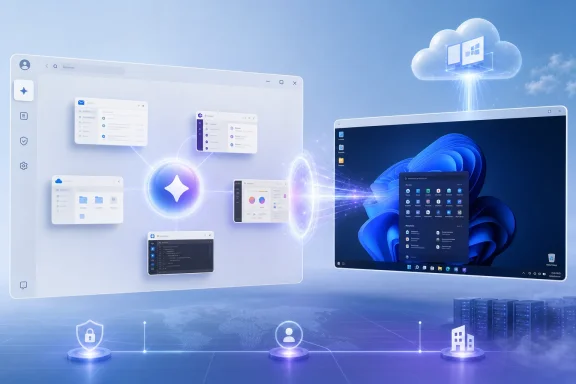 Project Aion’s core tradeoff: less Windows, more cloud
According to Windows Latest, Aion ran atop a reduced Windows code base internally called Win3. The reported rationale for dropping legacy Win32 compatibility was familiar: a smaller local system could boot more quickly, consume less power, and avoid decades of compatibility baggage. The interface itself was reportedly rendered through a modified Microsoft Edge-based web shell rather than the conventional Windows Explorer desktop.
That architecture explains the apparent app model. Edge, Teams, Outlook, OneDrive, Microsoft 365, Figma, and Visual Studio Code were presented as web destinations or web applications, not evidence that Aion had recreated the local Windows application platform. Windows Latest’s leaked demo coverage shows web content opening in lightweight floating windows, with Copilot conversations treated as persistent task objects that could be closed, saved, and revisited.
For a purpose-built device—a desk terminal, kiosk, shared frontline endpoint, or narrow enterprise appliance—that approach has a clear logic. A local browser shell, identity integration, web applications, and policy-controlled access to a remote desktop can be easier to update than a broad Windows installation carrying third-party software, drivers, and decades of Win32 expectations.
But the limitation is not cosmetic. Removing local Win32 means removing the software layer that still powers a huge share of line-of-business tools, administrative consoles, engineering applications, and specialty peripherals. Aion’s proposed Windows 365 handoff acknowledges that gap rather than solving it.
When a user needed a “real” desktop program, Windows Latest reported that the prototype offered to launch Windows 365 with the relevant file already opened. That could make an occasional transition less awkward, but it also shifts the cost and operational burden to Cloud PC licensing, provisioning, network quality, identity controls, and data-handling policy. An intermittent internet connection is an inconvenience on Windows 11; on an Aion-style endpoint, it could determine whether the user can reach their core applications at all.
The Win32 claim needs to be read backwards
The submitted account calls out “support for Win32 applications,” but the underlying reporting supports the opposite conclusion. Windows Latest says Win3 gave up legacy Win32 app support, while Windows Central likewise reports that Aion appeared limited to websites and web apps, with Windows 365 used when a legacy Windows experience was necessary.
That is a meaningful editorial distinction. Aion was not a lightweight Windows PC that happened to retain compatibility with desktop software. It was reportedly a web-and-agent shell that could broker access to a separate Windows environment. Local compatibility and remote access are different technical, commercial, and administrative propositions.
A Windows 365 session can preserve access to familiar apps, but it does not erase the issues IT departments would need to solve:
- Cloud PCs require reliable connectivity and sufficient latency for the workloads users actually perform.
- Organizations would need licensing and capacity planning for users who cannot complete tasks in web applications.
- File associations, printers, smart cards, USB devices, specialized drivers, offline work, and local data paths would need explicit testing rather than being assumed to work.
- Help desks would inherit a split support model: the local Aion shell, the web service, the identity layer, and the remote Windows desktop could each be the source of a failure.
The leaked material reportedly treats this handoff as seamless. In production deployments, “seamless” depends on the details Microsoft has not supplied: whether the handoff supports local peripherals, how it handles file synchronization, whether a task can move between devices, and how enterprises would audit what Copilot accessed before initiating a Cloud PC session.
Reports disagree on the Start menu and taskbar
The broader claim that Aion eliminated Windows’ familiar interface is directionally supported, but the reporting does not fully agree on the details. Windows Latest describes a system with no traditional Start menu, desktop icons, or pinned taskbar applications, with a Copilot dashboard replacing the normal entry point. Windows Central, drawing on leaked material published in July, describes a familiar-looking taskbar and a Start-menu-like surface whose Windows icon had been replaced by Copilot.
Those are not trivial differences, and the discrepancy should not be papered over. It may reflect different builds, different modes in the prototype, or two outlets using different definitions for a Copilot-branded launcher. Neither outlet has published a complete, verifiable build history, and Microsoft has not confirmed the materials.
What can be stated with more confidence is the design direction: Copilot was supposed to be the primary way users initiated a task, searched, opened web apps, found content, and continued prior work. Windows Central describes a multimodal command surface for starting workflows and interacting with the system. Windows Latest describes chat sessions becoming individual windows with automatically generated icons, rather than users beginning from a stable hierarchy of apps, folders, and shortcuts.
That is a much bigger change than relocating Start. A conventional desktop gives the user durable, visible objects and predictable application boundaries. Aion’s reported interface instead asks the user to express intent to an agent and accept a dynamically generated workspace. The gain is potentially less navigation; the risk is reduced predictability when the agent misunderstands a request, lacks permissions, or cannot complete the workflow.
“Spaces” would have made Copilot the work container
The leaked Aion concept reportedly included Spaces, containers that gathered messages, documents, websites, and web apps around a goal. In the travel-planning example relayed by Windows Latest and Mezha, the system assembled material from WhatsApp, Word, Expedia, Airbnb, and Turkish Airlines.
That is the part of the leak that most closely resembles Microsoft’s public agent strategy: preserving task context across multiple services rather than treating each application as a separate island. Aion was also reported to connect Copilot with Microsoft 365 data, including Outlook and SharePoint, and to use Context IQ to add colleagues and files to requests.
There is a practical warning embedded in that pitch. A tool that can gather corporate mail, SharePoint files, browser content, and cloud-desktop sessions around one user request has a larger permission and audit surface than a conventional launcher. The leaked material does not answer the questions that decide whether such a design is manageable at work: which data sources an agent can read by default, whether administrators can restrict cross-service context, how citations or source provenance appear to the user, and what records are retained when an AI-generated workspace becomes the place where decisions are made.
Microsoft’s public materials for Project Solara show that the company is actively thinking about agent-driven interfaces, but Solara is not confirmed to be Aion’s successor. At Build 2026 on June 2, Microsoft presented Solara as a platform for specialized agent-first devices, using the AOSP-based Microsoft Device Ecosystem Platform, an agent shell, Intune management, Entra ID, and privacy controls such as physical microphone mute hardware.
Solara’s public pitch is narrower in one important respect. Microsoft describes it as a platform for new device categories and reference designs, including a badge device and a desk companion, rather than a replacement operating system for the Windows PC. It also explicitly emphasizes enterprise manageability, security, and privacy protections—areas that the Aion leak gestures toward but does not document in enough depth to evaluate.
Aion is evidence of exploration, not a Windows roadmap
The superficial similarities between Aion and Solara are real: both center agents over traditional app launching, both reach beyond a conventional Windows desktop, both contemplate AOSP-based devices, and both use cloud services as part of the experience. But no Microsoft announcement calls Aion a predecessor, component, or product name for Solara.
Windows Latest has characterized Aion as shelved or unlikely to ship, while Windows Central says its current status is unknown. Those are assessments from the outlets, not a Microsoft statement. The available record supports a narrower conclusion: Microsoft built or at least demonstrated a functioning experimental concept in 2024, and the company has since publicly announced a separate agent-device platform in 2026.
For Windows users, Aion should not be read as evidence that a future Windows release will delete the Start menu or abandon Win32. The leaked prototype’s own Cloud PC fallback shows why Microsoft cannot simply remove desktop compatibility from mainstream Windows without breaking the workloads that make Windows indispensable.
For IT teams, the more immediate signal is architectural. Microsoft is exploring endpoints where AI mediates access to web apps, corporate data, and remote Windows sessions. If that direction reaches shipping products, the practical questions will not be whether Copilot has replaced a button. They will be whether organizations can control the agent’s data access, prove what it did, support users when the cloud handoff fails, and keep essential work available when a browser shell is not enough.