
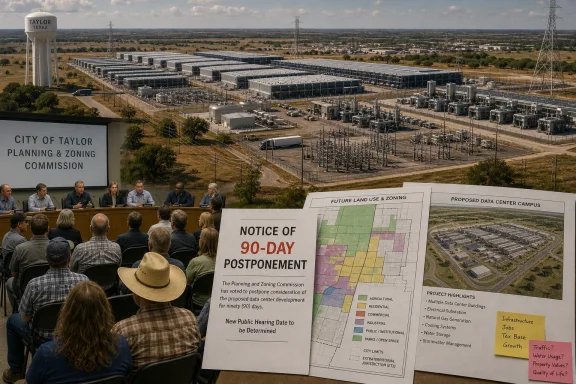
The pause is meaningful, but it is not a denial and it does not resolve the central issue for Taylor residents: Project Mustang is currently outside city limits in Taylor’s extraterritorial jurisdiction, while the application seeks voluntary annexation and Employment Center zoning. The city’s August notice describes a closed campus with data-center buildings, substations, gas infrastructure for power generation and auxiliary structures. That is a substantially different proposition from a conventional warehouse approval, even if Taylor’s existing code treats data centers as an industrial use.
For IT and infrastructure readers, the important development is that a city at the center of Texas semiconductor expansion is confronting the practical reality of hyperscale facilities: land use, grid capacity, water, noise, tax incentives and local control are becoming inseparable from the servers inside the fence.
 Project Mustang is a land-use decision with an energy-system consequence
Taylor’s public notice places Project Mustang on roughly 664.572 acres near FM 112, east of the present city boundary. The requested Employment Center plan would allow data-center buildings alongside substations and gas infrastructure intended to generate power. That last element explains why the proposal has drawn more scrutiny than a standard industrial campus.
A large data center can create enormous, steady electrical demand, but the proposed on-site generation means the project’s impact cannot be assessed solely by asking whether ERCOT has enough capacity. Residents and city officials also need to know what fuel the plant would use, how much generation it would provide, whether it would operate continuously or as backup, how emissions and noise would be controlled, and whether the campus would still require major transmission and distribution upgrades.
Those details are not yet set out in the city’s public hearing notice. The notice identifies gas infrastructure but does not publish a generating capacity, a power-plant operating profile, projected annual electricity demand, cooling method, peak water use, or a public estimate of permanent employment. That leaves the public debating a project’s footprint without the core numbers needed to measure it.
The Austin American-Statesman reported that Big Watt Digital and PowerHouse Data Centers are developing the project, and that a representative said the developers would pursue it even if it were not included in the city. The companies said in a joint statement that they intend to be good neighbors. No independently published project specification located in the city’s notice answers the practical questions that phrase raises: what safeguards, measured against what limits, and who enforces them after approval?
Taylor’s existing data-center rules were built around industrial zoning
Taylor acknowledges that data centers are not separately named in its land-development code. The city has said they are most similar to industrial uses permitted in Employment Center districts, and it has been working with consultant Freese and Nichols on amendments to its comprehensive plan and development code.
That is the policy gap at the center of the Mustang dispute. A modern data center is physically an industrial facility, but it also has a particular set of burdens and characteristics: exceptionally concentrated power demand, cooling requirements, backup generation, low permanent staffing, security buffers, utility construction and sometimes significant noise from cooling equipment. A code designed around general manufacturing or warehousing may address some of those issues, but it will not necessarily require the disclosures or protections residents expect from a project built around high-density computing.
Taylor’s official data-center page says the city is developing standards covering noise, light and setbacks, and asserts that it cannot simply exclude data centers where existing industrial zoning permits them. That distinction is important. A 90-day delay can give the city time to write forward-looking rules, but it cannot automatically rewrite rights that developers may already hold under existing zoning or under state law.
The city had scheduled the Planning and Zoning Commission hearing for August 18 and a City Council hearing for September 10. As of the latest city notice available, that September date remained listed. The American-Statesman’s account of the commission’s 90-day postponement therefore creates an immediate administrative question: whether the council hearing will be rescheduled, or whether the city will use a different procedural path once the zoning work is further along. Taylor should clarify that publicly rather than leaving residents to infer the project calendar from a notice that predates the reported delay.
Abbott’s data-center audit raises the stakes for on-site generation
Project Mustang’s proposed gas infrastructure arrives amid a sharp shift in Texas state policy. On August 3, Governor Greg Abbott directed the Public Utility Commission of Texas and ERCOT to audit data-center projects moving through ERCOT’s interconnection process before they advance. His directive calls for information on projected electricity demand, on-site generation, water sources and reuse, cooling technology, incentives, community impacts and ownership.
That audit does not itself decide Taylor’s annexation or zoning request. Local land-use approval and ERCOT interconnection are separate processes. But the overlap is hard to ignore: a developer asking Taylor to authorize a data-center campus with gas infrastructure will face growing pressure to disclose precisely the operational information that is currently thin in local public materials.
Abbott’s June 10 directive had already called for data centers to pay their own electric-infrastructure costs rather than shifting them to residential customers. It also committed the governor to pursue water-efficiency, usage reporting, setback, noise-reduction and incentive reforms in the next legislative session. Those are broadly framed state priorities, not a complete regulatory program, but they map closely to the concerns aired in Taylor.
The result is an uncomfortable timing problem. Taylor is trying to develop its own zoning framework while Texas is still defining how it will evaluate and connect major data loads. Approving a project first and establishing standards later risks turning the ordinance process into an exercise in regulating the next campus while grandfathering the most consequential one.
Samsung created the growth story — and exposed the planning deficit
The American-Statesman ties Taylor’s industrial acceleration to Samsung Electronics’ $17 billion semiconductor complex, announced in 2021. Samsung’s arrival made Taylor a much more visible destination for suppliers, manufacturers, developers and, increasingly, data-center proposals. The paper reported that Samsung already employs at least 1,000 people locally and expects to begin production later in 2026 after delays.
That context matters because the data-center debate is not simply a local fight over one industrial parcel. Taylor has been planning around an expected wave of jobs, suppliers, tax revenue and commercial activity connected to Samsung. But semiconductor projects and their surrounding development pipelines rarely move at the same pace as early announcements. The Statesman reported delays at Samsung, Soulbrain and Blueprint Data Centers, along with vacant commercial space and complaints from small-business owners that the promised customer influx has been slower than expected.
Residents are reacting to that mismatch. They see large developments, incentive agreements and rising costs arriving faster than new customers and permanent jobs. Developers and economic-development officials see long-term investments that can expand the tax base and support infrastructure. Both positions can be true, but they demand different proof.
A data-center approval should therefore be judged on a distinct record, not folded into a generic narrative that all Samsung-adjacent development is automatically beneficial. The city should distinguish construction employment from permanent operations jobs; separate projected tax revenue from awarded abatements; identify the utility work a project will fund; and spell out what protections apply to nearby homes.
The pause should produce a public standard, not another opaque negotiation
Taylor residents collected more than 1,400 signatures for a petition seeking a halt to new data-center approvals until a dedicated digital-infrastructure district could be created. City officials determined that Texas law did not permit the requested zoning change to be placed on the ballot, a position that has triggered litigation and deepened distrust.
That legal dispute does not eliminate the city’s responsibility to make the remaining decision process legible. If the council and commission cannot impose an outright moratorium, they can still explain what conditions they can require through annexation, development agreements, utility coordination and site-plan review.
Before Project Mustang returns for a vote, Taylor should publish a single project record that includes:
- The projected campus load, expected source of electricity, on-site gas-generation capacity and the facility’s expected reliance on ERCOT.
- The cooling design, annual and peak water demand, water source and any reuse or closed-loop systems proposed.
- The enforceable limits for noise, lighting, emissions, traffic, setbacks, landscaping and emergency response.
- The ownership structure, public incentives, estimated tax treatment and a clear accounting of permanent local jobs.
- The city’s authority to enforce each commitment if the project proceeds inside Taylor rather than outside it.
The commission’s reported 90-day delay gives Taylor a chance to turn broad assurances into standards that residents, developers and future applicants can inspect. If the next hearing returns with the same unanswered questions, the city will have spent the pause without solving the problem that brought hundreds of people to City Hall.