

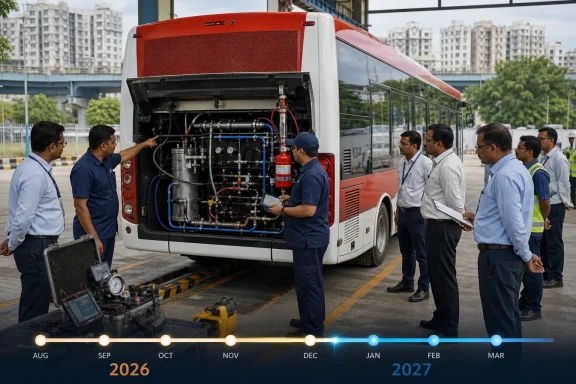
But the more consequential detail is the calendar. If PMPML’s delivery estimate holds from August 2026, the complete 500-bus rollout lands around January or February 2027 — beyond the end-of-2026 fleet-expansion timetable that its chairman and managing director, Mahesh Awhad, described earlier this year. The new buses may still materially improve service, but they should not be counted as a completed answer to Pune’s present capacity shortfall.
The system aims to act before a driver can
The Bridge Chronicle, which first reported the 500-bus order and the fire-suppression specification, says the system is installed around the engine and is designed to discharge a nitrogen-based suppressant automatically upon detecting smoke or unsafe engine conditions. PMPML officials reportedly watched a live demonstration during a prototype inspection, and CIRT — the Central Institute of Road Transport — participated in evaluating the vehicle.
That arrangement is materially different from a handheld extinguisher mounted in the passenger area. A portable extinguisher relies on someone recognizing the problem, stopping the vehicle safely, retrieving the equipment, approaching the fire and using it correctly. An automatic system is supposed to reduce that chain of human dependencies by responding at the source, within the engine bay.
For a city operator, that can mean the difference between a bus that is taken out of service after a contained electrical incident and a bus that must be evacuated, attended by the fire service, investigated and potentially written off. It may also limit the danger of flames reaching passenger areas or fuel-related components — but only if detection sensors, wiring and suppressant plumbing are maintained in working order throughout the vehicle’s life.
PMPML has not published the system’s manufacturer, fire-detection standard, suppression-agent capacity, service interval, inspection requirements, or whether the suppression equipment operates independently of the bus’s main electrical system. Those omissions matter. The headline feature is automatic activation; its real value will depend on whether depots can test sensors, replace depleted cylinders and identify disabled or faulted equipment before a bus leaves service.
Pune’s fire history makes this more than a feature upgrade
PMPML’s CNG fleet has faced a documented history of fire and maintenance concerns. The Indian Express reported in 2018 that a PMPML CNG bus fire was the 17th such incident in two years, with the operator acknowledging that many of the fires involved CNG buses and that investigations had pointed to technical issues. Earlier reporting by The Bridge Chronicle also documented an RTO inspection drive in which buses were found with concerns including electrical wiring and firefighting equipment.
Those incidents do not establish that every PMPML bus fire has the same cause, or that an engine-bay suppression system would have prevented each one. Some fires can begin after collisions, external impacts, fuel-system damage or faults outside the area protected by the system. The Bridge Chronicle itself reported a 2021 CNG-bus fire after a motorcycle collision, where a fire spread after the bike became trapped beneath the vehicle.
Still, the new equipment directly addresses a recurring risk pattern: an ignition source developing in or around the engine compartment, with smoke or heat offering an early trigger for intervention. The practical target is an incipient fire — one caught while it is still small enough for onboard suppression to contain.
PMPML’s own recent operating rules underline the point. In April, the Indian Express reported that the undertaking issued a fresh standard operating procedure for private bus contractors requiring onboard safety equipment, including fire extinguishers, emergency exits, CCTV and GPS, to remain functional. The 500 new buses may bring a more active safety measure into the fleet, but they do not remove the obligation to maintain the basic equipment already required across vehicles.
The delivery promise runs into PMPML’s larger bus shortage
The fire-suppression system arrives during a wider and much more difficult fleet expansion. In April, Awhad told the Indian Express that PMPML was operating about 1,961 buses despite estimating it needed more than 6,000 to meet a benchmark of 60 buses per 100,000 people. He outlined a plan to add 2,500 buses by the end of 2026: 1,000 acquired by PMPML, 500 under the Gross Cost Contract model, and 1,000 electric buses with central government support.
By late May, Awhad told The Times of India that PMPML operated 1,160 CNG buses and 233 diesel buses, and that 1,715 buses — 1,600 CNG and 115 electric — were expected during the calendar year. In June, The Bridge Chronicle and eSakal repeated the 1,715-bus figure in reporting on PMPML’s “Triple Five” service plan.
The 500 fire-suppression-equipped CNG buses could form part of that 1,600-bus CNG figure. PMPML has not formally identified them as such, however, and it has not said whether they will be owned outright, supplied under a GCC contract, or replace older vehicles rather than increase the active fleet.
The dates are where the published plans become difficult to reconcile. The current schedule places all 500 buses in operation five to six months from now. That is a useful near-term procurement milestone, but it extends into 2027. It cannot, on the information made public so far, be treated as evidence that PMPML’s larger 2026 acquisition target has been met.
This is not a minor accounting issue. New buses improve frequency only when they add reliable operational capacity. If they replace buses withdrawn for age, damage or maintenance, passengers may see a quality and safety improvement without seeing a proportional increase in route coverage or waiting-time reductions.
CIRT’s prototype review is the important checkpoint
PMPML Chairman and Managing Director Mahesh Awhad told The Bridge Chronicle that the prototype was inspected jointly with a CIRT team and that the manufacturer was asked to make changes before full-scale production begins. That is the strongest indication that the configuration is not yet frozen.
The value of that review depends on the nature of the changes. A fire-suppression system is only one part of a vehicle-level safety design. Sensor placement must detect an actual engine-bay event without causing persistent false activations. The agent discharge must reach protected zones. Heat, vibration, dust, moisture and routine engine maintenance must not disable the equipment. Drivers and depot personnel also need clear alerts showing whether the system has triggered, been isolated, lost pressure or requires replacement.
PMPML has not disclosed whether CIRT’s requested modifications concern the suppression system, the chassis, bodywork, electrical routing, emergency egress, or other elements of the prototype. Nor has it published acceptance-test results from the live demonstration. A demonstration can show that a designed system activates under a controlled scenario; it does not establish fleet reliability over years of high-mileage city service.
The lack of detail is understandable before production begins, but it limits how much can be concluded from the announcement. The verified commitment at this point is a planned deployment of 500 specified buses, not independently established performance of the final production vehicles.
What riders and administrators should watch next
The first test comes before the first passenger boards. PMPML needs to identify the manufacturer, the contract model, depot allocation, delivery dates, certification basis and the exact checks required before each bus enters daily service. It should also disclose whether the nitrogen system can be inspected through a visible status indicator and whether a discharge takes a bus out of service until a qualified technician resets it.
The second test is operational transparency. PMPML has announced ambitious aggregate fleet targets several times in 2026, while its current 500-bus delivery window runs into the following year. Publishing monthly counts for buses delivered, accepted, registered, assigned to depots and actually operating would distinguish a procurement announcement from an improvement riders can use.
For Pune commuters, the concrete gain is a potentially faster response to an engine-compartment fire. For PMPML, the harder assignment is making that safety equipment dependable across 500 buses while delivering enough vehicles, on a documented schedule, to reduce the service gap it has already acknowledged.