
The entry remains marked In development, with general availability currently listed for December 2026. That status matters: this is a roadmap commitment rather than a feature administrators can assume is already active in government cloud tenants.
Microsoft’s short roadmap description also leaves an important ambiguity. It says policy updates “sync faster” and frames the change as a reduction in the “policy sync status SLA on the Purview UI.” Microsoft’s own Purview documentation makes clear that policy-sync status is a device-management signal: an Updated result means a device received the latest Endpoint DLP policy version. It is not, by itself, proof that every downstream inspection, alert, analytics record, or service-side evaluation has completed.
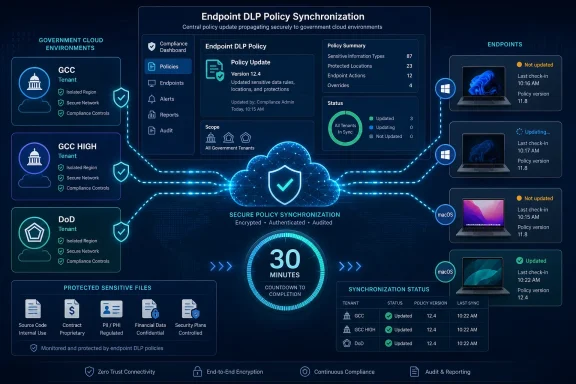 The government-cloud roadmap is a separate deployment signal
Roadmap 562994 applies specifically to GCC, GCC High, and DoD, and is tagged for general availability on the web-based Purview portal. It should not be treated as a new Windows client feature, an Intune policy cadence change, or a blanket guarantee that all Microsoft 365 DLP locations will begin enforcing new rules within 30 minutes.
A related Microsoft 365 Message Center notice, MC1317834, describes the same headline reduction—from two hours to 30 minutes—but identifies a different roadmap item, 558682, and gives a different rollout schedule. The Message Center notice says public preview is due to begin in late October 2026 and finish by mid-November, followed by worldwide general availability beginning in late November and completing in late December.
That division strongly suggests Microsoft is tracking at least two rollout paths: a worldwide service deployment under roadmap item 558682 and a government-cloud entry under 562994. Microsoft has not publicly spelled out the relationship between the two IDs, however. Administrators should therefore avoid copying the worldwide timeline into GCC, GCC High, or DoD change plans simply because the descriptions are nearly identical.
The present government-cloud record gives only “December 2026” as its availability target. It does not provide a preview date, a phased rollout window, or a completion date. For regulated organizations that must document the activation of security controls, that omission is more consequential than the headline latency reduction.
The change is about Endpoint DLP visibility and delivery
Microsoft’s current Purview guidance describes policy sync status as an Endpoint DLP device attribute. In the Purview portal, administrators can inspect onboarded devices under the Device onboarding area and see whether the latest policy version has synchronized successfully. A device reported as Updated has received the latest applicable policy; Not updated and Not available require troubleshooting or further investigation.
That makes the 30-minute target especially relevant to organizations that use Endpoint DLP to govern what people can do with sensitive files on Windows and macOS devices. Those policies can restrict or audit actions such as copying data to removable media, printing sensitive content, uploading files to unapproved cloud services, or moving information through browsers and other apps.
Until a modified policy reaches the endpoint, an administrator’s change exists in the management plane but may not yet affect the device that needs it. A two-hour maximum delay can be awkward during an active incident: a security team may add a blocked domain, tighten an exception, change a user or device scope, or turn an audit rule into a block rule, then wait for the portal to confirm endpoint synchronization.
Cutting that target to 30 minutes does not eliminate response risk, but it reduces the longest stated wait by 90 minutes. For teams operating formal incident-response procedures, that is enough to justify revising the expected time between approving a DLP change and validating that it has landed on affected endpoints.
The more useful operational measurement remains the device result, not the clock. A nominal 30-minute SLA does not mean every device will be updated exactly 30 minutes after a policy is saved. Offline machines, unhealthy Microsoft Defender for Endpoint deployments, missing prerequisites, and configuration failures can still prevent an individual endpoint from receiving the current policy. Microsoft’s troubleshooting guidance specifically separates device configuration status from policy-sync status, because a device can be onboarded yet still fail one of the conditions needed for healthy policy application.
It does not make every DLP outcome instantaneous
The roadmap language could easily be read as a universal acceleration of Microsoft Purview DLP. The available record does not support that interpretation.
Microsoft documents different processing and detection intervals for different DLP workloads. For example, its Teams DLP guidance tells administrators to allow about an hour for policy changes to work through the data center and synchronize to user accounts. DLP analytics also operates on periodic processing of audit and policy data. Those service-specific timings are separate from the Endpoint DLP policy-sync status shown in Purview.
In other words, the upcoming 30-minute goal should improve how fast Endpoint DLP policy versions reach and are reflected for devices. It does not promise that a newly changed Teams rule, a cloud-content scan, an alert, an analytics dashboard, or a compliance investigation will update on the same schedule.
Microsoft’s Message Center notice for the related worldwide rollout explicitly says the update changes timing rather than policy behavior, data processing, or data storage. No new DLP rule actions, sensitive-information types, licensing changes, endpoint-agent requirements, or policy authoring workflow changes have been announced with this rollout.
That is a welcome limitation as well as a caveat. Security teams should not expect a new enforcement model to appear unexpectedly, and administrators do not need to redesign existing policies to receive the faster synchronization target. Microsoft says the worldwide version is enabled by default and requires no action; Roadmap 562994 does not list any tenant-side preparation step for government clouds.
Update response procedures, but keep validation in place
For Endpoint DLP administrators, the right preparation is procedural rather than technical. Existing incident runbooks that assume “up to two hours” for a policy revision to propagate should be reviewed before the government-cloud rollout begins. Replace that broad expectation with a 30-minute target only after the feature is visibly available in the tenant and after testing has confirmed it for the organization’s own Windows and macOS estate.
A sensible validation sequence is straightforward:
- Security teams should record the exact time a high-priority policy change is published and check Purview’s device-level policy-sync status rather than assuming the edit is already active.
- Endpoint teams should investigate devices that remain Not updated or Not available, because the new service target does not cure client health, onboarding, or connectivity problems.
- Incident-response documentation should distinguish policy delivery from later evidence such as DLP alerts, audit events, and analytics, which may follow their own processing schedules.
- Change managers in GCC, GCC High, and DoD should retain the December 2026 target as provisional until Microsoft publishes a detailed rollout schedule or the feature reaches their tenant.
The headline improvement is modest by product-launch standards, but it addresses a real administration gap. DLP policies are most valuable when teams can make a narrowly scoped change during a data-handling incident and reliably determine when endpoints have received it. Microsoft’s planned shift from two hours to 30 minutes narrows that gap substantially; the remaining work for administrators is to verify delivery device by device rather than mistake a shorter SLA for immediate, universal enforcement.