
Wccftech first flagged the dedicated page after AMD added RX 9050 4GB support in Adrenalin Edition 26.8.1. The official specifications now settle the question left open by early board-partner listings: this is not merely an 8GB RX 9050 with half the VRAM installed. It has half the external memory bandwidth and half the cache used to reduce trips to that already narrower memory bus.
For anyone shopping prebuilt desktops, the practical message is simple: “Radeon RX 9050” alone is no longer enough information to judge the graphics hardware. The listing must explicitly state whether the system carries the 4GB or 8GB model.
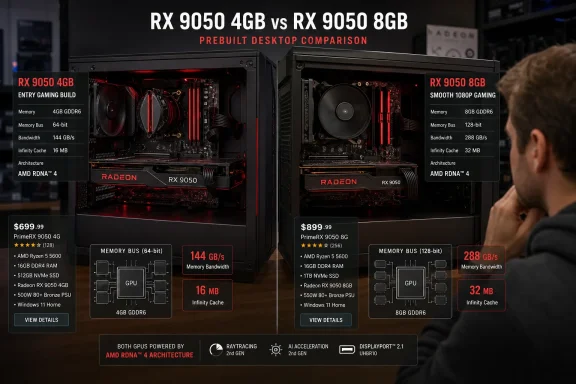 AMD’s official specifications show a memory-system downgrade
AMD lists the RX 9050 4GB with 18 Gbps GDDR6 memory, a 64-bit interface, and up to 144 GB/s of bandwidth. The standard RX 9050 product page lists the same nominal 18 Gbps memory speed, but a 128-bit interface and 288 GB/s bandwidth. On paper, the 4GB version loses exactly half of the bandwidth available to the 8GB card.
The company has also reduced Infinity Cache from 32 MB to 16 MB. Infinity Cache is on-chip memory designed to keep frequently needed data closer to the GPU, reducing the need to fetch it over the external GDDR6 bus. Less cache does not produce a fixed, universal percentage loss in game performance; workloads differ widely. But cutting cache at the same time as halving the memory interface removes two sources of relief when a game is demanding textures, geometry, frame buffers, and ray-tracing data.
The compute side does not change. Both cards are specified with 16 Compute Units, 16 ray accelerators, 32 AI accelerators, 64 texture units, 64 ROPs, a 1,920 MHz game clock, a boost clock of up to 2,600 MHz, and a 92W typical board power rating. On a retailer’s short specification list, those shared numbers could make the two cards look equivalent. They are not equivalent in the part of the design most likely to constrain modern games.
VideoCardz independently reported the same official comparison after the product page went live, including the 16 MB cache figure that had not been established by ASRock’s earlier board listing. Notebookcheck had previously reported that AMD reserved the 4GB configuration for prebuilt OEM systems while the 8GB model is the version intended for standalone sale in selected regions.
The product name creates a prebuilt-PC disclosure problem
AMD does label its new page “Radeon RX 9050 (4GB),” which is clearer than presenting it as an undifferentiated RX 9050. But the SKU remains an OEM product, where the system maker and retailer control how prominently component details appear on a storefront page, a shelf tag, or a spec sticker.
That puts the burden on buyers to inspect capacity and bus width rather than rely on the GPU family name. A desktop advertised with an RX 9050 4GB should be treated as a lower tier than one with an RX 9050 8GB, even if their processor-count and clock-speed fields match. A seller that only identifies the machine as carrying “AMD Radeon RX 9050” leaves out the information that determines the card’s memory capacity, bandwidth, and cache configuration.
AMD’s own product pages also make the sales distinction awkward. The regular RX 9050 page promotes 1080p Medium settings and carries performance figures for games including Cyberpunk 2077, Forza Horizon 6, and 007: First Light. The 4GB page provides specifications but does not replicate those performance claims. It is marked with an artist render and “Not available for purchase,” consistent with its system-only status.
The company has not published a price for the 4GB variant, a list of OEM desktop partners, or a broad availability schedule. It also has not supplied comparative performance figures demonstrating how far the 4GB model falls behind the 8GB card. That absence matters more than usual because the same RX 9050 name spans both configurations.
AMD’s driver notes acknowledge the 4GB limit
The most revealing detail is in the Adrenalin Edition 26.8.1 release notes. AMD added formal support for “AMD Radeon RX 9050 4GB,” but the same driver documentation warns that Cyberpunk 2077 recommends a minimum of 6GB of video memory. AMD advises RX 9050 4GB users who encounter problems to set graphics-intensive features to Low or Off.
That is not a general benchmark result, and it should not be read as proof that every current game is unplayable. It is, however, an official acknowledgment that a current flagship PC game can exceed the card’s available VRAM before settings are adjusted. The warning belongs in a driver issue list rather than in AMD’s product marketing, but it is a more useful guide to the card’s likely operating envelope than identical shader-count figures.
Neowin and VideoCardz both reproduced that driver note. It gives buyers a concrete starting point: the 4GB RX 9050 is aimed at light games, esports titles, older releases, and carefully reduced settings—not the 1080p Medium experience AMD advertises for the 8GB RX 9050 without qualification.
VRAM capacity is not the only constraint here. When a game needs data that will not fit in local graphics memory, system-memory transfers over PCIe can add stutter or uneven frame times even when an average frame-rate number looks acceptable. The 64-bit, 144 GB/s memory subsystem can also limit performance before capacity is exhausted in bandwidth-heavy scenes. The 16 MB cache reduction means the GPU has less local storage to soften those trips.
No 4GB performance review has established the real gap
There is a temptation to convert the 50% bandwidth cut into a predicted 50% frame-rate loss. The evidence does not support that. Game engines vary, and a title bottlenecked by shaders or CPU performance may show a smaller difference than one that is constrained by VRAM capacity and memory traffic.
What is established is the 8GB RX 9050’s position. Tom’s Hardware’s early testing of the retail 8GB card found it roughly 31% slower than Nvidia’s GeForce RTX 5050 across its selected 1080p game tests, while also noting that the 4GB version was OEM-only. Those results cannot be applied directly to the 4GB model, but they show the 8GB card was already an entry-level 1080p offering rather than a part with a large performance reserve.
TechSpot, meanwhile, has used 4GB-versus-8GB testing on older hardware to illustrate how modern games can react when memory capacity becomes restrictive. Its analysis of the RX 9050 split noted the 4GB model’s 144 GB/s ceiling and explained why removing two memory chips from a 128-bit Navi 44 design also removes half the bus width. That is the mechanism behind AMD’s specification change, not a cosmetic distinction between board configurations.
As of August 22, no independently published benchmark suite for the RX 9050 4GB establishes the real-world delta against the 8GB card. Buyers should therefore reject any precise performance claim for the 4GB model that is based solely on its matching core clocks or, conversely, on a simplistic bandwidth calculation.
What to verify before buying an RX 9050 desktop
The RX 9050 4GB should be evaluated as a prebuilt component, not as a retail upgrade choice. AMD says it is not available for separate purchase, so the relevant comparison is usually between complete desktop configurations.
Before buying, verify all of the following in the retailer’s detailed specification sheet or with the system vendor:
- The graphics card must be identified specifically as Radeon RX 9050 4GB or RX 9050 8GB, rather than simply Radeon RX 9050.
- The system should state 4GB GDDR6 and a 64-bit interface for the lower configuration, versus 8GB GDDR6 and a 128-bit interface for the standalone model.
- The price difference between systems should be judged against the whole configuration, including memory, SSD capacity, processor, power supply, and warranty, because AMD has not published an MSRP for the OEM-only 4GB GPU.
- Buyers planning to play modern demanding games should regard AMD’s own Cyberpunk 2077 guidance as a requirement to lower settings, not as a driver fix that restores missing VRAM.
AMD has now made the specifications public. The remaining issue is whether OEMs and retailers present the 4GB suffix as prominently as the RX 9050 badge. Until they do, a buyer can encounter two materially different RDNA 4 graphics configurations carrying almost the same product name.