
AMD’s Radeon RX 9050 is a 92 W, 8 GB RDNA 4 card priced at $279, while Nvidia’s GeForce RTX 5050 launched at $249 with 8 GB of GDDR6 and a 130 W board-power rating. That makes the RX 9050’s apparent efficiency advantage real, but the submitted claim that AMD is undercutting Nvidia by roughly 10% is backwards at list price: AMD is asking $30 more, or about 12% above the RTX 5050’s MSRP.
The more consequential limitation for U.S. buyers is availability. AMD’s own RX 9050 announcement, published with the Adrenalin Edition 26.7.1 driver on July 28, says the card is aimed at Asia-Pacific and Latin American markets. AMD has not announced a U.S. retail launch, and the separate 4 GB model is reportedly OEM-only. So the RX 9050 is not presently a straightforward shelf-for-shelf alternative to the RTX 5050 in the United States, whatever the benchmark charts suggest.
Early testing from Japanese outlet Hermitage Akihabara, subsequently reported by Tom’s Hardware and PC Gamer, does place the RX 9050 well behind Nvidia’s entry-level Blackwell card in most games. But the practical conclusion is sharper than “lower consumption does not pay for slower gaming”: at AMD’s stated $279 price, the RX 9050 has no price-performance cushion to spend in the first place.
AMD describes the RX 9050 as an affordable 1080p option for esports and modern AAA games. Its official specification is 16 Compute Units, 8 GB of GDDR6, a 1.92 GHz game clock, boost frequencies up to 2.60 GHz, and 92 W total board power. It supports the same broad RDNA 4 feature family as AMD’s larger Radeon 9000-series cards, including current FSR technologies, hardware ray tracing, and AV1 media support.
Nvidia’s official RTX 5050 specification is 2,560 CUDA cores, 8 GB of GDDR6 on a 128-bit bus, and 130 W board power. Nvidia set the desktop card’s starting price at $249 when it reached retail in the second half of July.
Those list prices matter more than a percentage framing pulled from an assumed street price. If a card is substantially slower but also substantially cheaper, buyers can reasonably decide that lower cost, lower heat, or lower power requirements justify the compromise. If it is slower and costs more, its market is much narrower.
There may be regional pricing that makes $279 competitive in some Asia-Pacific or Latin American markets; AMD has not published a country-by-country price list or specified which partners and countries will receive the card first. That omission prevents a clean worldwide value judgment. For a U.S. WindowsForum reader, though, an unavailable $279 suggested price does not outweigh an RTX 5050 that Nvidia has explicitly positioned for broad retail availability starting at $249.
The submitted report’s “10% cheaper” comparison therefore does not hold against the manufacturers’ announced U.S.-dollar pricing. It understates AMD’s actual problem: the RX 9050 has to beat local RTX 5050 prices by a meaningful margin before its efficiency becomes a purchase argument rather than a spec-sheet footnote.
The synthetic results point in the same direction. In 3DMark Time Spy, the RX 9050 scored 9,441 compared with 10,571 for the RTX 5050, a roughly 11% shortfall. In ray-tracing-oriented tests, the gap was far wider: the RX 9050 recorded 1,873 in Speed Way versus 2,520 for the RTX 5050, and 4,531 in Port Royal against 6,181.
That is consistent with the hardware positioning. The RX 9050 has 16 RDNA 4 Compute Units, or 1,024 stream processors, while the RTX 5050 carries 2,560 CUDA cores. Core counts across architectures do not translate directly into frame rates, but AMD’s product is plainly more heavily cut down than the branding initially suggested. Compared with the 32-CU Radeon RX 9060 XT, the RX 9050 has half as many Compute Units.
In conventional 1080p esports loads, the margin is less catastrophic than a single “30% slower” headline implies. Hermitage Akihabara’s Apex Legends result was 147.1 fps for RX 9050 and 192.4 fps for RTX 5050 at 1080p maximum settings. Rainbow Six Siege X produced 204 fps on the Radeon and 239 fps on the GeForce at 1080p Medium. Both outcomes are playable, and the Radeon’s lower power draw could suit a compact build where the goal is simply sustained high-refresh competitive gaming.
The problem arrives in the games that make buyers seek a new discrete GPU in 2026. Tom’s Hardware’s summary of the same testing says the RX 9050 fell behind across the remaining modern games, including substantially lower results in Cyberpunk 2077 and Onimusha. The average deficit cited in that report reached 31% at 1080p, 34% at 1440p, and 42% at 4K.
The 1440p and 4K numbers should not be interpreted as a recommendation to use either 8 GB card at those settings in the newest demanding games. They show the direction of the performance difference; they do not make the RX 9050 a credible native-4K product. AMD itself markets the card for 1080p.
That means the large displayed-frame-rate advantage in those results is not a direct measure of base rendering performance. Generated frames can improve perceived motion smoothness, but they do not replace the responsiveness or image quality provided by a higher native frame rate. Comparing a GeForce card using a higher multi-frame-generation multiplier with a Radeon card limited to two-frame generation answers a consumer feature question, not a neutral raster-performance question.
The Doom: The Dark Ages figures illustrate the issue. The RTX 5050 was dramatically ahead at 1080p in the reported table, then collapsed at 1440p and 4K while the RX 9050 pulled far ahead. Tom’s Hardware called that game an outlier, and PC Gamer separately reported possible specification-reporting oddities around the tested Radeon card’s render-output count.
Neither outlet has established that the RX 9050 test sample was defective. PC Gamer reported that a utility appeared to show 32 ROPs where AMD’s published specifications indicate 64, but it also acknowledged this could be a software-reporting error rather than missing hardware. Until a second independent lab reviews a retail RX 9050 using controlled native-resolution tests, without unmatched frame-generation modes, treating any exact 30% average as settled fact would be premature.
The broad finding is still credible: the RX 9050 loses most of the meaningful early comparisons, especially in ray tracing and more demanding games. The precise extent of the loss remains unconfirmed because the current reporting chain largely traces back to one Japanese review sample and one test configuration.
A 38 W maximum board-power difference is not nothing. It can reduce heat dumped into a small case, give a quieter cooler more room to operate, and lower the demands placed on a prebuilt PC’s power supply. Those are useful advantages for system builders working within hard thermal or electrical limits.
It is not, however, a rapid financial payback. Using the U.S. Energy Information Administration’s 2026 projected residential average of 18.2 cents per kWh, a 38 W difference saves about 0.69 cents for each hour of full-load gaming. At three hours of gaming every day, that works out to about $7.60 per year. Even at an unusually heavy six hours per day, the savings would be roughly $15 annually.
At that rate, recovering a $30 higher purchase price takes about four years of gaming three hours daily, and that calculation generously assumes the cards maintain their full rated power gap during every session. It also excludes the rest of the PC’s power consumption, which does not change merely because the GPU draws fewer watts.
The RX 9050 therefore has a credible role where its power budget solves an installation problem: a lower-capacity system, a quieter small-form-factor build, or a region where its actual retail price is sharply below the RTX 5050. It is not a sensible choice based on electricity savings alone.
That distinction needs to be watched in system listings. A machine advertised merely as carrying “Radeon RX 9050 graphics” can conceal a radically less capable memory configuration. Four gigabytes of VRAM and a 64-bit bus are severe constraints for a current desktop gaming PC, particularly in newer titles with high-resolution textures, ray tracing, or heavy streaming demands.
Buyers should insist on the complete specification: RX 9050 8 GB, 128-bit memory interface, board-partner model, and actual price. Do not assume an RX 9050 name in a prebuilt means the version that appeared in the early review testing.
AMD has made a low-power RDNA 4 card; it has not yet made a convincing RTX 5050 alternative at its stated price. For U.S. buyers, the immediate consequence is straightforward: do not pay a premium for an RX 9050 on the theory that 35–38 W of lower draw will make up the difference. The electricity math does not support it, and the available testing does not support surrendering that much gaming performance for $279.
Early testing from Japanese outlet Hermitage Akihabara, subsequently reported by Tom’s Hardware and PC Gamer, does place the RX 9050 well behind Nvidia’s entry-level Blackwell card in most games. But the practical conclusion is sharper than “lower consumption does not pay for slower gaming”: at AMD’s stated $279 price, the RX 9050 has no price-performance cushion to spend in the first place.
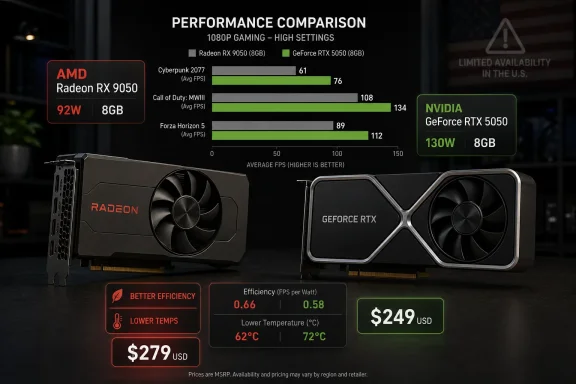 The price comparison changes the entire verdict
AMD describes the RX 9050 as an affordable 1080p option for esports and modern AAA games. Its official specification is 16 Compute Units, 8 GB of GDDR6, a 1.92 GHz game clock, boost frequencies up to 2.60 GHz, and 92 W total board power. It supports the same broad RDNA 4 feature family as AMD’s larger Radeon 9000-series cards, including current FSR technologies, hardware ray tracing, and AV1 media support.Nvidia’s official RTX 5050 specification is 2,560 CUDA cores, 8 GB of GDDR6 on a 128-bit bus, and 130 W board power. Nvidia set the desktop card’s starting price at $249 when it reached retail in the second half of July.
Those list prices matter more than a percentage framing pulled from an assumed street price. If a card is substantially slower but also substantially cheaper, buyers can reasonably decide that lower cost, lower heat, or lower power requirements justify the compromise. If it is slower and costs more, its market is much narrower.
There may be regional pricing that makes $279 competitive in some Asia-Pacific or Latin American markets; AMD has not published a country-by-country price list or specified which partners and countries will receive the card first. That omission prevents a clean worldwide value judgment. For a U.S. WindowsForum reader, though, an unavailable $279 suggested price does not outweigh an RTX 5050 that Nvidia has explicitly positioned for broad retail availability starting at $249.
The submitted report’s “10% cheaper” comparison therefore does not hold against the manufacturers’ announced U.S.-dollar pricing. It understates AMD’s actual problem: the RX 9050 has to beat local RTX 5050 prices by a meaningful margin before its efficiency becomes a purchase argument rather than a spec-sheet footnote.
One early test shows a large deficit, but it is not a complete review consensus
The performance figures circulating this week originate with a single early hardware review from Hermitage Akihabara using an ASRock RX 9050 Challenger and a Gigabyte RTX 5050 Windforce OC. Tom’s Hardware’s reporting on that test puts the RX 9050 about 20% behind in the selected 3DMark suite and approximately 30% behind in a broad game average, with the deficit widening in its summary at higher resolutions.The synthetic results point in the same direction. In 3DMark Time Spy, the RX 9050 scored 9,441 compared with 10,571 for the RTX 5050, a roughly 11% shortfall. In ray-tracing-oriented tests, the gap was far wider: the RX 9050 recorded 1,873 in Speed Way versus 2,520 for the RTX 5050, and 4,531 in Port Royal against 6,181.
That is consistent with the hardware positioning. The RX 9050 has 16 RDNA 4 Compute Units, or 1,024 stream processors, while the RTX 5050 carries 2,560 CUDA cores. Core counts across architectures do not translate directly into frame rates, but AMD’s product is plainly more heavily cut down than the branding initially suggested. Compared with the 32-CU Radeon RX 9060 XT, the RX 9050 has half as many Compute Units.
In conventional 1080p esports loads, the margin is less catastrophic than a single “30% slower” headline implies. Hermitage Akihabara’s Apex Legends result was 147.1 fps for RX 9050 and 192.4 fps for RTX 5050 at 1080p maximum settings. Rainbow Six Siege X produced 204 fps on the Radeon and 239 fps on the GeForce at 1080p Medium. Both outcomes are playable, and the Radeon’s lower power draw could suit a compact build where the goal is simply sustained high-refresh competitive gaming.
The problem arrives in the games that make buyers seek a new discrete GPU in 2026. Tom’s Hardware’s summary of the same testing says the RX 9050 fell behind across the remaining modern games, including substantially lower results in Cyberpunk 2077 and Onimusha. The average deficit cited in that report reached 31% at 1080p, 34% at 1440p, and 42% at 4K.
The 1440p and 4K numbers should not be interpreted as a recommendation to use either 8 GB card at those settings in the newest demanding games. They show the direction of the performance difference; they do not make the RX 9050 a credible native-4K product. AMD itself markets the card for 1080p.
Frame generation makes several headline numbers unsuitable for a clean GPU comparison
The early results also contain a methodological problem that readers should not ignore. PC Gamer noted that some published Cyberpunk 2077 results used each card’s respective upscaling and frame-generation stack. Nvidia’s RTX 5050 can use DLSS Multi Frame Generation modes beyond the two generated frames available through AMD’s FSR frame generation implementation in this test.That means the large displayed-frame-rate advantage in those results is not a direct measure of base rendering performance. Generated frames can improve perceived motion smoothness, but they do not replace the responsiveness or image quality provided by a higher native frame rate. Comparing a GeForce card using a higher multi-frame-generation multiplier with a Radeon card limited to two-frame generation answers a consumer feature question, not a neutral raster-performance question.
The Doom: The Dark Ages figures illustrate the issue. The RTX 5050 was dramatically ahead at 1080p in the reported table, then collapsed at 1440p and 4K while the RX 9050 pulled far ahead. Tom’s Hardware called that game an outlier, and PC Gamer separately reported possible specification-reporting oddities around the tested Radeon card’s render-output count.
Neither outlet has established that the RX 9050 test sample was defective. PC Gamer reported that a utility appeared to show 32 ROPs where AMD’s published specifications indicate 64, but it also acknowledged this could be a software-reporting error rather than missing hardware. Until a second independent lab reviews a retail RX 9050 using controlled native-resolution tests, without unmatched frame-generation modes, treating any exact 30% average as settled fact would be premature.
The broad finding is still credible: the RX 9050 loses most of the meaningful early comparisons, especially in ray tracing and more demanding games. The precise extent of the loss remains unconfirmed because the current reporting chain largely traces back to one Japanese review sample and one test configuration.
The electricity savings are too small to overcome a $30 starting disadvantage
Tom’s Hardware reports that the RX 9050 drew roughly 35 W less than the RTX 5050 under heavy load and about 8 W less at idle. AMD’s 92 W rating versus Nvidia’s 130 W rating supports the basic claim that Radeon is the more efficient card, even if actual consumption varies by board partner, workload, and clock behavior.A 38 W maximum board-power difference is not nothing. It can reduce heat dumped into a small case, give a quieter cooler more room to operate, and lower the demands placed on a prebuilt PC’s power supply. Those are useful advantages for system builders working within hard thermal or electrical limits.
It is not, however, a rapid financial payback. Using the U.S. Energy Information Administration’s 2026 projected residential average of 18.2 cents per kWh, a 38 W difference saves about 0.69 cents for each hour of full-load gaming. At three hours of gaming every day, that works out to about $7.60 per year. Even at an unusually heavy six hours per day, the savings would be roughly $15 annually.
At that rate, recovering a $30 higher purchase price takes about four years of gaming three hours daily, and that calculation generously assumes the cards maintain their full rated power gap during every session. It also excludes the rest of the PC’s power consumption, which does not change merely because the GPU draws fewer watts.
The RX 9050 therefore has a credible role where its power budget solves an installation problem: a lower-capacity system, a quieter small-form-factor build, or a region where its actual retail price is sharply below the RTX 5050. It is not a sensible choice based on electricity savings alone.
AMD’s 4 GB RX 9050 makes the retail picture more confusing
AMD’s launch has also revived a configuration that should concern prebuilt-PC shoppers: a 4 GB RX 9050. ASRock initially listed both 4 GB and 8 GB versions, with the 4 GB card appearing to use a 64-bit memory bus rather than the 8 GB model’s 128-bit bus. AMD has not positioned that 4 GB card as a retail upgrade product; reporting from PC Gamer says it is OEM-only.That distinction needs to be watched in system listings. A machine advertised merely as carrying “Radeon RX 9050 graphics” can conceal a radically less capable memory configuration. Four gigabytes of VRAM and a 64-bit bus are severe constraints for a current desktop gaming PC, particularly in newer titles with high-resolution textures, ray tracing, or heavy streaming demands.
Buyers should insist on the complete specification: RX 9050 8 GB, 128-bit memory interface, board-partner model, and actual price. Do not assume an RX 9050 name in a prebuilt means the version that appeared in the early review testing.
AMD has made a low-power RDNA 4 card; it has not yet made a convincing RTX 5050 alternative at its stated price. For U.S. buyers, the immediate consequence is straightforward: do not pay a premium for an RX 9050 on the theory that 35–38 W of lower draw will make up the difference. The electricity math does not support it, and the available testing does not support surrendering that much gaming performance for $279.
References
- Primary source: Foro3D
Published: 2026-08-01T17:47:52+00:00
RX 9050 vs RTX 5050: saving power does not pay for the loss in gaming
The AMD RX 9050 performs up to 30% worse in games than the RTX 5050. Its lower power consumption does not compensate for the loss of smoothness. For the average user, the savings on electricity do not justify sacrificing performance. The scales tip clearly toward NVIDIA.foro3d.com - Related coverage: tomshardware.com
AMD's new Radeon RX 9050 is roughly 30% slower than the RTX 5050 in games, early testing shows — the cheapest 8GB RDNA 4 GPU comfortably handles 1080p gaming but doesn't impress | Tom's Hardware
An underwhelming showing as expected.www.tomshardware.com - Related coverage: tomshardware.com
ASRock officially announces Radeon RX 9050 with 8GB VRAM — RDNA 4 card offers boost clock of up to 2600MHz (updated) | Tom's Hardware
It would be the first and only current-gen 4GB GPU.www.tomshardware.com
