
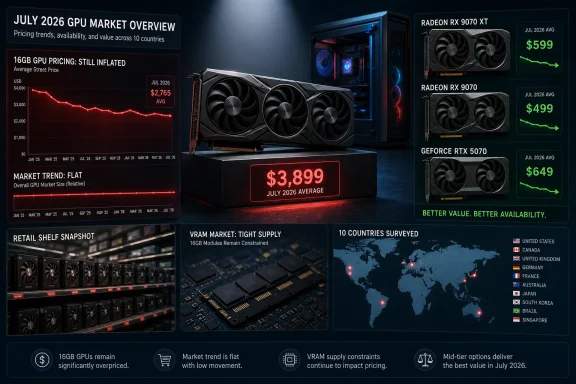
The headline figure is the GeForce RTX 5090. TechSpot found the cheapest readily available model in the United States at $3,980 in July, nearly double Nvidia’s $1,999 launch MSRP. PC Gamer’s late-July price watch and separate reporting from Tom’s Hardware point in the same direction: the flagship has become an outlier even in a market where nearly every 16GB-or-higher card carries a sizeable premium.
That makes the mid-2026 GPU market less about finding a universally good deal and more about avoiding the worst pricing traps. The cards that have become expensive are not always the slowest, and the cards that look attractive on a spec sheet are not necessarily priced where their original market positions suggested they would be.
 The Market Has Flattened at an Uncomfortable Level
TechSpot compared the lowest in-stock prices for readily available models in the United States, Australia, Germany, the United Kingdom, Canada, India, the Philippines, Brazil, Poland, and the Netherlands. Its July results show only a 2% average increase from April across the tracked cards, and essentially flat pricing once the RTX 5090 is removed.
That stability matters. It means a buyer who postponed a purchase in April has not necessarily been punished by a broad, across-the-board surge at retail. It also means waiting a few more weeks is unlikely to unlock a sudden return to launch pricing.
The problem is the baseline. November 2025 was the period TechSpot identifies as the low point for current-generation GPU prices. Most cards have become more expensive since then, while the industry’s memory constraints have kept the extra cost concentrated on configurations carrying more VRAM.
For Windows PC builders, this is a familiar but increasingly severe pattern: the price ladder between product tiers has broken. A card can be nominally “midrange” in performance and still demand the budget once associated with a higher tier, while a flagship can drift into workstation territory without gaining the protections or support expectations of a professional product.
Nvidia’s Cheapest Cards Are Not Moving Together
Nvidia’s entry models are the least dramatic part of the report, though not necessarily the most compelling products. TechSpot found the GeForce RTX 5050 averaging 6% over true MSRP across its 10 markets, with the United States and Canada among the least favorable places to buy. In the U.S., the cheapest RTX 5050 was still listed at $290 in July.
The 8GB GeForce RTX 5060 was comparatively stable. Its average price dropped 4% from April, and TechSpot says it is broadly available near its adjusted MSRP outside the U.S., where the reported $340 street price remains about 13% high. That makes it one of the less distorted Nvidia options, but it does not solve the longer-term concern around buying an 8GB card in 2026.
The stranger result is the GeForce RTX 5060 Ti 8GB. It fell 5% on average from April, reaching $360 in the U.S. according to TechSpot’s survey. With the RTX 5060 at $340, the price gap is now too small to ignore: TechSpot measures a 17% 1080p performance advantage for the Ti model, while its cross-market premium is only 16%.
That does not transform the RTX 5060 Ti 8GB into a forward-looking recommendation. Eight gigabytes of VRAM remains a hard compromise for a new gaming PC expected to handle demanding Windows titles for several years. But it does show how quickly a distorted market can alter the rational choice between two otherwise awkward products.
The 16GB RTX 5060 Ti tells the opposite story. TechSpot places the lowest U.S. price at $570, 33% above its $430 MSRP and 58% above the 8GB version. Prices across most other countries were relatively flat from April, but that is not reassuring when the card remains roughly 22% above true MSRP on average.
This is the basic memory-price penalty in action. The silicon may be from the same family, but extra VRAM now changes the economic category of the board.
The 16GB Tax Reaches Into the High End
The RTX 5070, with 12GB of memory, remains one of Nvidia’s more defensible current choices on price alone. TechSpot found it averaging just 6% above true MSRP, with July pricing easing in several regions. At $600 in the U.S., it is still more expensive than its original positioning implied, but it has avoided the sharper inflation affecting 16GB models.
The RTX 5070 Ti has not been so fortunate. Its pricing barely moved from April to July, but it remains about 20% above true MSRP across the surveyed markets. The RTX 5080 follows the same pattern, sitting 18% high on average despite relatively steady quarter-on-quarter pricing.
Those cards are no longer simply expensive enthusiast parts; they are being reshaped by component economics. Nvidia’s GeForce RTX 50-series uses GDDR7 on its Blackwell-based models, and reports from VideoCardz, PC Gamer, and Tom’s Hardware say rising graphics-memory costs are now filtering through the GPU-and-memory bundles sold to add-in-board partners.
The exact scale and timing of future retail increases remain uncertain. Nvidia has not publicly announced a uniform new GeForce price list, and the reports concern supply-chain pricing rather than a guaranteed sticker-price change at every retailer. Still, the mechanism is credible: board partners cannot easily absorb a materially higher cost for the GPU package, memory chips, power delivery, cooling, logistics, and retailer margin all at once.
The RTX 5090 is where that logic becomes absurd. TechSpot found the card 94% above true MSRP on average, with sharp increases in nearly every region between April and July. Tom’s Hardware also reported late-July price jumps for high-end RTX 50-series boards at major U.S. retailers, including RTX 5080 models listed beyond the RTX 5090’s original MSRP.
At around $4,000, the RTX 5090 may still appeal to users running local AI models, GPU compute tasks, or specialized production workloads that benefit from 32GB of VRAM. But as a gaming upgrade, it has become a luxury product with workstation-like pricing and consumer-market trade-offs.
Radeon 9070 Cards Have Become the Practical Escape Route
AMD’s Radeon RX 9060 XT cards are not immune. TechSpot reports that both the 8GB and 16GB versions rose about 5% on average from April, with the 16GB model now 18% above true MSRP. The 8GB RX 9060 XT has been hit particularly hard in the U.K. and Canada, eroding the value proposition it was designed to offer against Nvidia’s mainstream lineup.
At similar retail prices, the RTX 5060 Ti 8GB can be difficult for Radeon buyers to dismiss because Nvidia retains advantages in ray tracing, CUDA-adjacent Windows software workflows, DLSS, and broader application support. The uncomfortable irony is that the GeForce card’s poor VRAM specification looks less damaging when AMD’s 8GB alternative is no longer meaningfully cheaper.
The RX 9060 XT 16GB remains more coherent. TechSpot calls it the least expensive 16GB GPU currently available, averaging 22% less than the RTX 5060 Ti 16GB. It is still inflated, but its starting price leaves it in a better place.
The real standouts are the Radeon RX 9070 and RX 9070 XT. TechSpot’s data puts the RX 9070 only 4% above true MSRP and the XT model 8% above, unusually controlled figures amid broader memory inflation. In the survey, the RTX 5070 Ti costs 42% more than the RX 9070 XT on average across the 10 markets.
That does not mean Radeon wins every workload. Nvidia retains meaningful advantages for some creator tools, AI applications, ray-traced games, and feature-specific upscaling preferences. But for a typical Windows gaming tower focused on raster performance, 16GB of VRAM, and avoiding inflated upper-midrange Nvidia pricing, AMD’s 9070-series cards are now the clearest market exception.
Canada, the U.S., and the U.K. Are Feeling the Squeeze
TechSpot’s country-level index identifies Canada as the most inflated market once the RTX 5090 is excluded, followed by the United States and United Kingdom. Germany, the Netherlands, and Poland generally look less punishing by comparison, while Australia’s average pricing was slightly below TechSpot’s adjusted MSRP benchmark.
That does not make cross-border shopping a simple remedy. Taxes, warranty coverage, regional model differences, shipping charges, and currency conversion can erase an apparent deal quickly. For IT departments and system integrators, it reinforces the need to price the actual locally available SKU, not a U.S. launch MSRP or a favorable price headline from another region.
Intel’s Arc B-series illustrates why the low end is not automatically safe. TechSpot reports shrinking Battlemage availability in several countries and about a 5% average price increase since April for both the Arc B570 and B580. The B580 is now roughly 17% above true MSRP, often near RTX 5060 pricing despite having been positioned lower.
A low sticker price is useful only if supply, drivers, feature compatibility, and real alternatives remain intact. As Arc inventory dries up, Intel’s value argument becomes harder to sustain.
Retail Inventory May Be Masking the Next Increase
TechSpot’s most important warning is not the July snapshot; it is the possibility that the snapshot is lagging the supply chain. The outlet says retailers reported 10% to 15% higher acquisition costs for 16GB GeForce cards in recent weeks, with smaller increases affecting lower-memory models. It also reports warnings from some add-in-board partners that further increases could arrive.
Those claims are consistent with the recent reporting on rising GDDR6 and GDDR7 costs, including TrendForce’s report that AMD had notified partners of higher GPU-and-memory bundle pricing effective in July. But they should not be read as a promise that every card will jump tomorrow. Retailers may still be selling inventory purchased months earlier, and slow GPU turnover can delay a supplier-price change from reaching shelf prices.
For buyers who genuinely need a graphics card now, the practical move is to shop the current market rather than wait for an imaginary correction. The RX 9070 and RX 9070 XT are the strongest value positions in TechSpot’s data; the RTX 5070 is Nvidia’s least distorted mainstream option; and the RTX 5060 Ti 16GB is difficult to justify at its present premium.
For everyone else, the sensible response may be to keep the existing GPU running. The July numbers suggest the market has paused, not healed—and once older retailer inventory is gone, flat pricing may prove to have been the best part of 2026’s GPU market.
