
The problem is not merely that the article’s recommendations are optimistic. It presents the GeForce RTX 6090, RTX 6080 Ti, RTX 6070 Ti, Radeon RX 10900 XTX, RX 10800 XT, RX 10700 XT, Intel Arc Celestial Pro, and “NVIDIA RTX Pro Gaming Edition” as established products with settled performance characteristics. NVIDIA, AMD, and Intel do not list those names as current consumer gaming cards. Several of them resemble rumored future naming schemes; others mix workstation branding with gaming language.
Independent reporting from Tom’s Hardware, TechSpot, ComputerBase, and VideoCardz has treated the GeForce RTX 6090 as a future-generation rumor, not a shipping product. NVIDIA’s official GeForce product pages instead identify the RTX 5090 as its current flagship, while the company’s RTX 5080 page lists 16GB of GDDR7 memory and DLSS 4.5 support. That distinction matters when a reader is about to spend four figures on an upgrade.
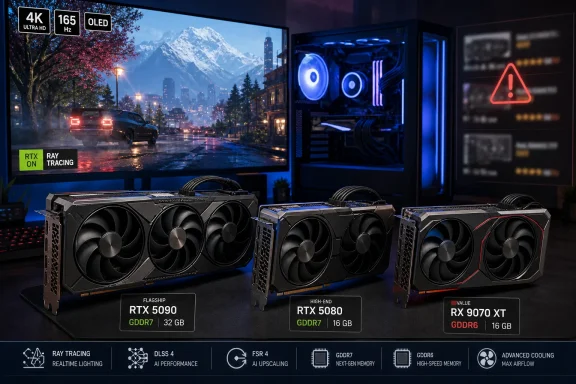 The real 4K hierarchy begins with RTX 5090
The GeForce RTX 5090 remains the fastest gaming GPU available for 4K play, particularly when a game leans heavily on ray tracing or path tracing. NVIDIA specifies 32GB of GDDR7 memory for the card, a capacity that is useful not just for high-resolution textures but for the growing number of games whose “ultra” presets can push well beyond the memory footprint expected a few years ago.
It is also the clearest answer for users targeting a 4K 120Hz or 144Hz display, especially in titles that support DLSS and frame generation. Native rendering remains the cleanest benchmark, but at 4K the modern experience is increasingly shaped by reconstruction technologies: DLSS can render a lower internal resolution and reconstruct a sharper output image, while frame generation can improve displayed frame rate where the underlying GPU performance is already high enough to maintain acceptable latency.
That does not make the RTX 5090 a universal recommendation. Pricing has become the central problem. Tom’s Hardware and PC Gamer reported this week that retail pricing for RTX 5090 models has climbed dramatically above NVIDIA’s original $1,999 suggested price, with some listings above $4,000. At those prices, the RTX 5090 is less a straightforward gaming purchase than a niche option for buyers who also need CUDA acceleration, AI workloads, professional rendering, or simply want the highest available performance regardless of value.
For Windows enthusiasts replacing an RTX 3080, RTX 4080, or Radeon RX 6800 XT, the performance leap can be compelling. But an RTX 5090 build also needs planning beyond the PCIe slot: case clearance, cooling, a quality power supply, adequate CPU throughput, and a monitor that can expose the additional performance all matter. Spending flagship money to play at a capped 60Hz can be rational for image-quality-first players, but it changes the value calculation substantially.
RTX 5080 is the high-end choice that needs a price check
The GeForce RTX 5080 is the more sensible NVIDIA card for many 4K buyers—provided its street price remains close enough to reality. It has 16GB of GDDR7 rather than the RTX 5090’s 32GB, but it retains the Blackwell-generation feature set, including advanced DLSS support and strong ray-tracing performance.
For 4K gaming, that makes it a capable card rather than an automatic “max every setting” purchase. In conventional rasterized games, it can provide excellent results at 4K. In the heaviest path-traced games, however, owners should expect to use DLSS and carefully choose settings rather than assume that native 4K with every visual toggle enabled will hold high refresh rates.
That is not a defect unique to the RTX 5080. It is the condition of PC gaming in 2026. “4K gaming” can mean a locked 60 frames per second in a single-player game, 120 fps on an OLED panel, competitive settings in multiplayer titles, or a cinematic preset with full ray tracing. Those are materially different workloads. A card that feels exceptional in Forza Horizon 5 may need reconstruction and frame generation in a new Unreal Engine 5 release.
Tom’s Hardware’s current GPU hierarchy places the RTX 5080 well below the 5090 but still among the best 4K options. The issue is market behavior, not feature completeness: recent retail increases have pushed some custom RTX 5080 cards above what the product’s performance tier comfortably justifies. Buyers should compare specific board-partner prices against the Radeon RX 9070 XT and RTX 5070 Ti rather than treating the RTX 5080 badge as a blank check.
Radeon RX 9070 XT is the value-led route to 4K
AMD’s Radeon RX 9070 XT is the card that makes the strongest case for a realistic 4K build without entering RTX 5090 territory. AMD lists 16GB of GDDR6 memory, 64 RDNA 4 compute units, a 304W total board power rating, and a recommended 750W power supply. It also supports PCIe 5.0, DisplayPort 2.1a, and HDMI 2.1b—important details for buyers pairing the card with a modern high-refresh 4K display.
The RX 9070 XT’s core strength is traditional rendering performance. In games that do not make extreme ray tracing the focal point, it can deliver the kind of native or near-native 4K performance that makes it a compelling upgrade for Windows users coming from midrange RTX 30-series, RX 6000-series, or older hardware. Tom’s Hardware identifies it as the least expensive route into 4K 60 fps native gaming in its mid-2026 testing.
The caveat is software. AMD’s FSR ecosystem is widely supported, and FSR is useful, but reviewers at Tom’s Hardware continue to rate NVIDIA’s newest DLSS implementation ahead in image quality and smoothness at comparable settings. That does not mean AMD hardware cannot run ray-traced games well; it means the RTX 5080 and RTX 5090 have a more comfortable margin in the titles that turn ray tracing and path tracing into primary visual features.
For a buyer focused on a 4K 60Hz television, a 4K 120Hz monitor with sensible settings, or a broad library of raster-heavy games, the RX 9070 XT is often the most balanced answer. It is not the fastest card available. It is the one that best demonstrates why the fictional RX 10900 XTX does not need to exist for AMD to be relevant at 4K today.
Intel has a role in gaming, but not in this 4K shortlist
The Intel Arc Celestial Pro named by Analytics Insight is not a current retail gaming product. Intel’s current desktop gaming lineup is the Arc B-series, led by the Arc B580 and B570. Intel itself positions the B-series for 1440p gaming, supported by XeSS upscaling and frame generation—not as a flagship 4K class.
That does not diminish Intel’s progress. The Arc B580 can deliver playable results in selected games at 4K when users lower settings and enable XeSS, but it is not a peer to the RTX 5090, RTX 5080, or RX 9070 XT for a no-compromise 4K target. A budget card producing an acceptable result at 4K after compromises is different from a card designed to sustain the resolution across demanding new releases.
Intel’s actual higher-end 2026 offering is the Arc Pro B70, a workstation-focused card announced for professional graphics and AI inference workloads. It is not a “Celestial Pro” gaming flagship, and workstation cards should not be assumed to be gaming substitutes simply because they carry large memory capacities or high prices. Driver certification, application support, memory configuration, and pricing priorities differ substantially between professional and consumer products.
The same caution applies to the supposed “NVIDIA RTX Pro Gaming Edition.” NVIDIA sells RTX PRO workstation hardware, including Blackwell-generation products, but that is not the name of a GeForce gaming SKU. A workstation GPU can be outstanding for CAD, local AI, video production, and rendering while still being a poor-value gaming purchase.
Build around the display, not a marketing tier
A useful 4K buying decision starts with the target display and the games a system actually runs. A 60Hz monitor or television allows a buyer to prioritize stable frame pacing and visual quality. A 120Hz or 144Hz OLED display pushes the decision toward stronger ray-tracing performance, upscaling quality, and CPU capability. Competitive games can also be more CPU-limited than GPU-limited, even at 4K.
Windows users should also check the rest of the platform before upgrading:
- A quality 750W supply is AMD’s stated recommendation for the Radeon RX 9070 XT, while flagship GeForce configurations may demand more capacity and more careful connector planning.
- A current motherboard BIOS, Resizable BAR or Smart Access Memory support, and updated graphics drivers can affect both performance and stability.
- DisplayPort and HDMI capabilities must match the monitor’s resolution, refresh rate, HDR requirements, and variable-refresh-rate support.
- Upscaling and frame generation should be evaluated in the specific games played most often, rather than assumed to behave identically across every engine.
The honest 4K GPU list in August 2026 is shorter than Analytics Insight’s roundup suggests. The RTX 5090 is the performance leader, the RTX 5080 is a feature-rich high-end option whose value depends heavily on street price, and the Radeon RX 9070 XT is the strongest mainstream-value candidate for serious 4K play. Everything else in the submitted list is, at best, a rumor, a category error, or a name without a purchasable product behind it.
