
In an interview published by CRN, Hicks said Red Hat partners can use OpenShift’s container platform to get more out of AI hardware while customers face constrained component supply and rising prices. The shortage premise is not merely channel messaging: AMD warned in its August quarterly filing that an industry-wide memory shortage and higher memory prices could raise the cost of data-center buildouts. Nvidia, meanwhile, reported $89 billion in quarterly data-center revenue on August 26, illustrating the demand pressure behind the capacity race.
For Windows-centric enterprise IT teams, the immediate relevance is not that they should replace their server estate with Red Hat. It is that AI projects increasingly span Windows applications, Active Directory-backed identities, VMware-era virtual infrastructure, Linux GPU nodes, Kubernetes clusters, and cloud services. When accelerator supply is constrained, the operational problem becomes deciding which workloads get the hardware already on hand—and proving that expensive equipment is actually being used well.
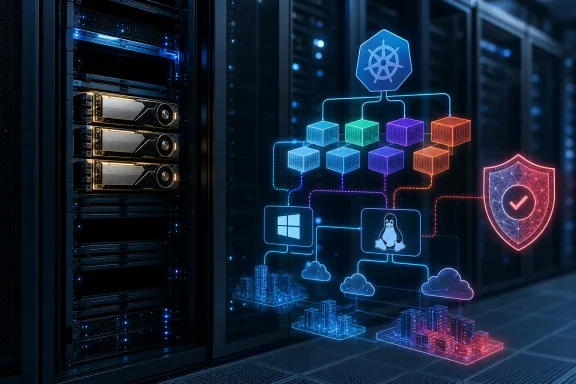 OpenShift can schedule scarce GPUs, but it cannot cure procurement delays
Hicks’s central argument is based on a real OpenShift capability. Red Hat’s current OpenShift AI documentation describes hardware profiles that let administrators define targeted configurations for workbenches and model-serving workloads, including accelerator counts, CPU and memory limits, node selectors, and tolerations. In practical terms, that gives an organization a way to stop treating every GPU-equipped server as an undifferentiated pool.
That is valuable when teams have competing demands: a data-science group wants training capacity, an application team needs stable inference, security wants isolated environments, and finance wants an explanation for why a high-cost GPU server is sitting idle. Kubernetes scheduling, quotas, node labeling, and hardware profiles can turn those disputes into explicit policy instead of a first-come, first-served scramble.
But the distinction matters in purchasing meetings. Containerization improves the utilization of capacity that has arrived and been installed. It does not address the more fundamental bottlenecks cited by vendors: accelerator availability, DRAM and high-bandwidth memory supply, server assembly lead times, data-center construction, power delivery, cooling, and network gear. A partner that sells OpenShift as an answer to a six-month hardware delay risks setting the customer up for disappointment.
The credible pitch is more specific: use the delay to inventory workloads, set resource policies, right-size models, identify inference workloads that can run on existing or alternative accelerators, and make the eventual hardware deployment repeatable. That work can start before a new rack lands. It is also the work many internal IT teams lack time or Kubernetes expertise to perform alone.
The partner opportunity is services work, not a shortage windfall
CRN reports that Hicks sees openings for partners in data-center optimization, deployment choices between cloud and on-premises infrastructure, patching, and broader AI platform integration. Those are plausible engagements, but “opportunity” should not be confused with guaranteed new product revenue.
A component squeeze changes the order of operations. Customers facing delayed on-premises hardware may increase short-term use of cloud GPU capacity, defer training projects, trim model ambitions, or redeploy existing systems. Each path creates architecture and operations work: assessing data gravity, estimating cloud egress and inference costs, establishing identity and network controls, configuring model-serving pipelines, and deciding when a workload has to remain in a customer-controlled environment.
For Microsoft-heavy shops, that can include connecting existing Windows and .NET applications to models served from Linux-based OpenShift AI clusters, then maintaining consistent authentication, logging, secrets management, and network segmentation across both sides. The hard part is usually not getting a model endpoint to respond. It is building a supportable service around it, with capacity limits, monitoring, rollback procedures, and ownership once the implementation partner leaves.
Red Hat’s platform may be a fit where an organization already operates OpenShift or needs a consistent Kubernetes layer across data center and cloud environments. It is not automatically the right answer for every organization with a few GPUs. Small deployments may gain more from a managed cloud service, a tightly scoped inference appliance, or a simpler virtualization and automation plan than from adding a full enterprise Kubernetes stack.
Partners should be especially cautious with utilization claims. Higher GPU utilization is not inherently better if it creates queueing delays for production inference, pushes latency-sensitive applications onto overloaded nodes, or starves a security testing environment of capacity. A useful engagement defines service classes first—production inference, internal experimentation, fine-tuning, batch processing—and then assigns placement and quota rules that reflect business priority.
VMware migrations are creating a separate conversation
Hicks also linked the AI infrastructure discussion to continued VMware migration activity. That linkage is commercially sensible: an organization rethinking virtualization has an opening to revisit server consolidation, automation, Linux operations, containers, and where AI workloads should reside. It does not mean that a VMware migration automatically becomes an AI modernization project.
Virtual machines and containers solve related but different problems. Virtualization migrations are typically driven by licensing, support, operational familiarity, hardware compatibility, and recovery requirements. AI infrastructure introduces additional concerns around accelerator drivers, GPU sharing, model lifecycle management, data pipelines, and isolation between workloads. Combining both projects without clear boundaries can enlarge scope and increase risk.
The better sequence is to identify dependencies. A customer moving off VMware may need to preserve Windows Server workloads, domain controllers, legacy line-of-business applications, and backup processes while introducing a separate OpenShift footprint for containerized services and AI. In that situation, Red Hat’s value is in operating the AI and container layer consistently, not in pretending every virtual machine should be converted immediately.
CRN also reported partner interest in Red Hat as an alternative for customers dissatisfied with VMware changes. The practical test is whether a proposed design includes a credible landing zone for existing workloads, documented migration tooling, operations training, and a rollback plan. “Hybrid cloud flexibility” is too vague to substitute for those details.
AI Factory integrations do not remove integration responsibility
Red Hat has expanded its AI Factory offering with Nvidia, combining Red Hat AI Enterprise and Nvidia AI Enterprise in a co-engineered platform. Red Hat says the offering is supported on infrastructure from Cisco, Dell Technologies, Lenovo, and Supermicro, and that it provides Day 0 support for new Nvidia hardware architectures.
Those relationships give partners a clearer stack to assemble, and they reduce some compatibility uncertainty for customers buying validated configurations. They do not eliminate the design work. A validated hardware-and-software combination still needs rack capacity, power, storage throughput, network configuration, firmware management, observability, data governance, and a decision on how workloads will be isolated from one another.
Red Hat’s own documentation reflects this operational reality. Deploying Nvidia GPUs on OpenShift AI requires the Nvidia GPU Operator; AMD deployments require the AMD GPU Operator and driver configuration. Hardware profiles and accelerator profiles must also be configured before workloads can be placed appropriately. These are manageable tasks, but they are not zero-touch infrastructure.
That means a strong partner proposal should include more than a bill of materials for servers, switches, and subscriptions. It should show how accelerator software will be maintained, which team owns driver and operator updates, how resource quotas will be approved, and how capacity consumption will be measured. Without those answers, a customer may receive an expensive AI platform that is technically installed but difficult to operate.
Lightwell is Red Hat’s concrete security offer, with limits customers should understand
The security portion of Hicks’s argument has a more tangible product behind it. Red Hat and IBM commercially launched Lightwell in July as an initiative intended to provide remediated, signed, and certified open-source application dependencies without requiring customers to take disruptive full-stack upgrades. Red Hat says Lightwell Network launched with more than 6,500 remediated application-layer dependencies across major ecosystems including Java and Python.
This addresses an increasingly familiar enterprise problem: an application can depend on an upstream package with a serious vulnerability, while upgrading to the upstream release risks breaking compatibility, certification, or production behavior. Backporting and validating a fix can be safer than a wholesale version jump—provided the remediation is available for the specific dependency and is properly tested in the customer’s environment.
Hicks told CRN that powerful AI models raise the prospect of vulnerabilities being found and exploited faster, creating pressure to improve open-source patching. The claim is directionally credible, but Lightwell should not be mistaken for a universal defense against AI-assisted attacks. It covers application-layer dependencies through a commercial service, not every component in a Windows, Linux, container, network, identity, or cloud estate.
There is also a significant availability constraint. Red Hat describes Lightwell Network as broadly available through an annual subscription, while Lightwell Clearinghouse Premier remains in limited availability for preselected critical-infrastructure customers. Organizations evaluating the service should verify package coverage, supported ecosystems, integration with existing artifact repositories, service-level commitments, pricing, and the process for validating a supplied remediation before it enters production.
For partners, that limitation is an opportunity only if they do the difficult part: build a defensible vulnerability intake process around the product. That means software bills of materials, dependency inventory, severity and exploitability triage, test environments, change approvals, and evidence that a patched component was actually deployed. Selling a subscription without those operational controls merely moves the backlog.
The shortage message from Red Hat is therefore useful when stripped of its marketing gloss. Scarce AI hardware makes efficient scheduling, workload classification, and lifecycle management more valuable. It does not turn platform software into a supply-chain cure, and it does not make security remediation automatic. Enterprises that use the procurement delay to establish those controls will be in a better position when hardware arrives; those that wait for the next GPU shipment will still be starting from scratch.
