
As reported by Sonic State and detailed on reFX’s product page, Rippler combines modal physical modeling with conventional subtractive synthesis. It is a notable departure from the preset-focused identity many producers associate with reFX’s Nexus: the new plug-in is built for shaping resonators, exciters, oscillators and modulation paths directly.
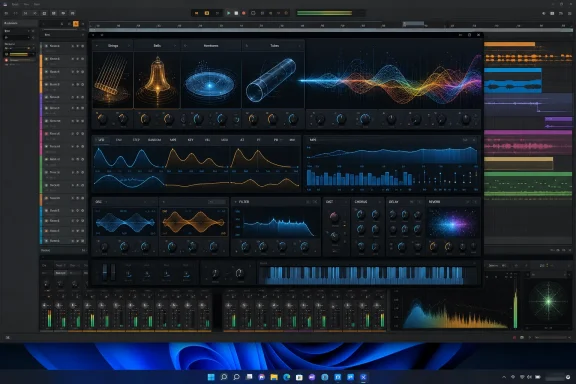 A Resonator-First Synth for Windows DAWs
Rippler begins with an Exciter, which can use included samples, imported audio or sidechain input, plus a noise generator. That signal reaches two resonators modeled after acoustic structures including strings, bells, membranes, plates, marimbas, vibraphones and open or closed tubes.
The two resonators can operate in serial or parallel, with bi-directional energy coupling intended to create more reactive, evolving sounds. Two conventional oscillators and two filters can then reinforce or radically alter the modeled source, giving the plug-in a route from convincing plucks and percussion to synthetic pads, basses and abstract effects.
reFX includes 441 factory presets and 32 exciter samples. A manual resonator mode provides user-defined partials and real-time morphing between configurations, which may be the more compelling feature for sound designers rather than preset browsers.
Modulation, MPE and an Effects-Heavy Design
Rippler offers four LFOs, four envelopes, random generators, MIDI and MPE controllers, macros, custom modulation curves and an arpeggiator. MPE support allows per-note pitch, pressure and slide data for controllers that expose those dimensions, while aftertouch is also supported.
The effects architecture is unusually broad for a plug-in of this size. reFX lists 13 effect types, including distortion, chorus, phaser, compression, magnetic processing, delay, bucket delay, reverb and particle effects, arranged across Layer A, Layer B and master processing chains.
For Windows users, the practical requirement is a 64-bit VST3 or AAX host, an Intel or AMD processor with SSE 4.2 support, at least 8GB of RAM, and an internet connection for downloading and online activation. reFX recommends 16GB of RAM. The company lists FL Studio, Ableton Live, Cubase, Nuendo, Pro Tools, Bitwig Studio, Studio One, Sonar and Reaper among compatible hosts.
The Immediate Catch: It Is Not a Standalone Instrument
Rippler is a plug-in, not a standalone application, so it needs a compatible DAW. Installation and licensing are handled through the reFX Cloud app, and reFX is also offering a 30-day trial.
For producers on Windows who want acoustic-inspired synthesis without relying on large sampled libraries, Rippler’s appeal will rest on whether its resonator workflow proves faster and more expressive than assembling similar sounds from samples, wavetable synths or modular effects chains.
Update: Attack Magazine details Rippler’s dual-layer architecture and sequencer (July 31, 2026)
Attack Magazine reports that Rippler is structured as two independent synth layers, allowing users to blend or stack separate physical-modeling and subtractive-synthesis signal paths in one patch. Each layer has its own exciter, two resonators, oscillators, filters and effects chain, before both are combined for master processing.
The report also specifies 12 resonator models, including beam, drumhead and djembe variants in addition to the string, bell, membrane, plate, marimba, vibraphone and tube designs previously outlined. It says the manual resonator option also functions as an additive-synthesis generator.
Attack Magazine adds that Rippler provides 27 filter types, covering conventional filter modes alongside vintage, ladder-style and formant/vowel options. Its four envelopes include ADSR, AHD, DADSR and DAHDSR configurations.
For hands-on performance and pattern programming, the plug-in’s arpeggiator also includes a sequencer with modifier lanes that can raise or lower pitch and velocity from the played pattern. That expands Rippler’s appeal beyond modeled one-shot sounds, giving Windows-based producers a more self-contained route to layered rhythmic and evolving patches.
