

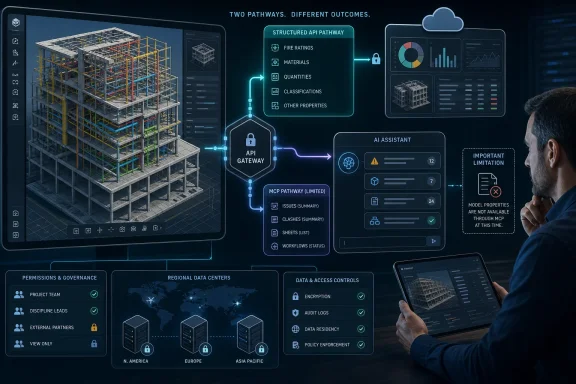
But the two headline capabilities should not be treated as interchangeable. As reported by SMBtech, Revizto is positioning the release as an “Open Data and AI Layer” for customers that want to use Claude, Microsoft Copilot, ChatGPT, or a private model against live project information. Revizto’s own implementation documentation shows that the new API can expose model and object-level data, while the MCP server does not yet expose those model and object properties to AI tools.
That distinction changes the immediate value of the launch. A developer can use the API to build an automated check for a fire-door rating, material property, classification, quantity, or model-author field. A project manager using the MCP connector can query coordination records and summarize issues or clashes in natural language. The advertised combination is clearly the destination, but it is not the full day-one configuration.
The API fills the model-data gap
The most consequential component is the Model and Object Properties API. Revizto already had APIs for issues, clashes, 2D metadata, user management, and other workflow data; object-level model properties were the missing layer for teams trying to make BIM information useful in reporting, compliance, cost, procurement, and facilities workflows.
Revizto says the new endpoints provide programmatic access to 3D model metadata and individual object properties, including information such as quantities, material specifications, system types, fire ratings, synchronization timestamps, and model-author details. That gives a firm a route to pull data from published models into a data warehouse, Power BI report, estimating system, asset-information register, or bespoke validation application without asking a coordinator to open the model and export another spreadsheet.
John Holland Group Senior Digital Engineering Manager Nathan Beplate described the endpoints as the missing piece for scalable compliance and quality auditing. That is a credible use case, especially for firms handling repeated checks across large portfolios: project teams often have model data, but extracting it consistently enough to prove compliance remains labor-intensive.
The API is also a more durable part of the announcement than the AI connector. Structured API calls can be logged, versioned, tested against defined rules, and run on a schedule. An organisation that needs to identify missing required properties before a handover date can establish a repeatable validation process rather than depending on a conversational prompt and an AI-generated summary.
Revizto’s Developer Portal is central to that arrangement. Account owners and account administrators can enable preconfigured apps, including the MCP server, or register custom OAuth 2.0 applications. Existing access-code integrations remain supported, but Revizto directs new integrations to OAuth app registration. The portal also provides a meaningful control point: a custom app can be switched off across the account, blocking existing and new authorization attempts.
The MCP connector is useful now, but its scope is narrower
Revizto’s MCP server is a remote HTTPS service that lets approved AI clients request information through a standard connection method. It supports connectors for Claude, ChatGPT, Microsoft 365 Copilot and Copilot Studio, Codex, Cursor, VS Code, Gemini-compatible clients, and other tools that can connect to remote MCP servers.
Once enabled by an account owner or administrator and authorized by a user, the MCP server follows that person’s Revizto account, license, and project permissions. Revizto says the available tools can read coordination data including issues, comments, clashes, sheets, reports, workflows, stamp templates, licenses, projects, and users. The immediate workflows are therefore familiar ones: prepare a coordination brief, count critical unresolved issues, summarize recurring clash categories, or identify bottlenecks in an issue log.
The important limitation is buried in Revizto’s setup guidance. Model and object properties, object search, changed-element data, object-property reads, and issue-to-object reasoning are listed as unavailable through MCP for now. Screenshots and images, event subscriptions and webhooks, project and account logs, and model import and export are also outside the current MCP feature set.
That means a request such as “find all critical fire doors missing certification” is not a simple MCP demonstration today if it requires inspection of fire-rating or certification properties at the object level. The data may be reachable through the new API, but the AI assistant cannot yet retrieve it through the Revizto MCP connector. Teams wanting that workflow immediately will need an integration that queries the API directly, applies defined rules, and optionally hands the resulting exception list to an AI assistant for explanation or report drafting.
The limitation does not make the MCP release cosmetic. Coordination data is valuable on its own, and using natural language to interrogate issue, clash, report, and workflow data can eliminate a fair amount of meeting preparation. It does mean buyers should separate AI-assisted coordination reporting, which is available now, from AI-assisted BIM property auditing, which Revizto has marked as coming soon.
“Your data never leaves your environment” needs a careful reading
Revizto’s product messaging emphasizes data sovereignty, customer choice of AI provider, and keeping data in the customer’s environment. The company is correct that it is not forcing customers into a Revizto-owned generative-AI model. Customers choose the AI client, and the company says the project data remains hosted in its assigned Revizto region.
The implementation is still a connection to an external AI client and, depending on the selected tool, its provider. Revizto’s own MCP terms state that connecting an AI client authorizes the MCP server to make customer data available to that AI client and its AI provider. The terms place responsibility on the customer to decide what data is exposed, ensure it has the rights to share it, and evaluate the AI provider’s data practices.
In other words, Revizto is providing a governed access path, not eliminating the need for an AI data-sharing assessment. A company using a private model in infrastructure it controls may keep a substantially tighter data boundary than one connecting a cloud-hosted public AI service. The choice of AI client, its retention settings, its regional processing terms, and its own connector controls still matter.
Revizto’s documentation explicitly tells customers to connect only trusted AI tools, confirm which tools are approved internally, and keep write actions review-based by asking the assistant to show proposed changes before they are applied. Its MCP terms go further: they warn that AI outputs may be inaccurate, incomplete, outdated, misleading, or unreliable, and that AI clients may take unintended actions.
That is particularly relevant in construction. A bad summary of an issue log is inconvenient; an unverified assertion about fire compliance, design coordination, asset readiness, or a safety-critical change can move a team in the wrong direction. MCP is best treated as an interface for retrieving and organizing information, while established review and sign-off processes remain responsible for project decisions.
Permissions are inherited, but governance still expands
Revizto’s permission model is one of the stronger parts of the release. The Developer Portal documentation says an integration only accesses information the authorizing Revizto user is already permitted to see. The MCP documentation likewise says administrative actions require administrative-level Revizto access.
That avoids a common integration failure in which a broadly privileged service account quietly gives an external tool access to every project. It also creates a different operational concern: the effective scope of an AI connector is determined by the user who authorizes it. Firms should avoid treating the connector as a generic team utility without first reviewing whether the authorizing account has access to projects, commercial information, owner records, or personal data that the intended users should not be able to query through an AI interface.
The account-level activation requirement is useful here. The MCP application is deactivated by default, and only account owners or administrators can activate it. Standard users can see active applications but cannot create, edit, or manage them. That provides a sensible approval gate, although it is only effective if account administrators understand which AI provider and which type of connector are being approved.
There is another boundary worth noting. Revizto supports multiple regional MCP endpoints, including North America, Canada, Ireland, London, Frankfurt, Singapore, Sydney, Tokyo, Zurich, and others. Its documentation says an AI assistant can combine information from multiple authorized regional connections in one conversation while the Revizto data stays in its original region. For multinational firms, that can make cross-project reporting easier, but it also means a single AI conversation may draw from several regional data sources. That capability should be reviewed against data-residency obligations and project-specific confidentiality rules before it is enabled.
The launch turns model data into an integration decision
Revizto’s broader strategy is clear: it is trying to become the system that stores coordination context while letting customers select the reporting tools, automation platforms, and AI models around it. The new API gives technical teams a cleaner foundation for that work, and MCP lowers the barrier for querying workflow data without building a dedicated front end.
The company’s 2026 digital construction report is being used to frame the release around data ownership and AI adoption concerns. However, Revizto’s own published material is inconsistent on one headline statistic: SMBtech reported that 98 percent of Australian CIOs were concerned about data ownership and control, while a Revizto article promoting the 2026 report says 96 percent of CIO respondents had that concern. The two-point gap does not alter the broad finding, but it is a reminder that vendor-sponsored survey figures are context for a product strategy, not an independent security assessment.
No public pricing, API entitlement tier, throughput limit, or model-property MCP delivery date is stated in the launch material or current setup documentation. Customers should therefore confirm whether API access is included in their existing Revizto agreement, what rate limits apply to portfolio-scale extraction, and whether the MCP server is available under their subscription before planning a rollout.
For now, the sensible deployment order is clear: enable the Developer Portal for a controlled pilot, build deterministic API checks for model-property and compliance workflows, restrict MCP authorization to approved AI tools and narrowly scoped users, and require human review for every output that affects a project decision. Revizto has made its project data far more accessible; the immediate challenge for AECO IT teams is making sure accessibility does not outrun control.