
RingCentral’s July 28 security bulletin says it stopped unauthorized activity, brought in a third-party forensic firm, and is directly contacting affected customers. It also says that customers who have not been contacted are not affected, and that the core RingCentral platform remained operational. Separately, reporting by BleepingComputer and The Register connects the incident to the ShinyHunters extortion operation and a subsequent public data release.
The immediate risk is not a RingCentral service outage or a newly disclosed software flaw. It is a much more familiar identity attack: a caller who already knows the target’s name, business phone number, work email address, and physical location, then claims to be from RingCentral, the internal help desk, Microsoft, or an outsourced IT provider.
For Windows and Microsoft 365 shops, that combination creates a clear defensive task: treat RingCentral-related calls, emails, and password-reset requests as an active impersonation risk, especially when they involve Entra sign-ins, MFA re-registration, Teams, Outlook, OneDrive, or account recovery.
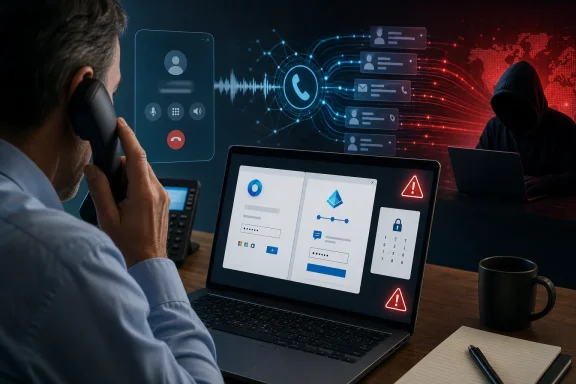 The confirmed incident leaves important scope questions unanswered
RingCentral has confirmed the underlying security incident. Its public bulletin describes a “sophisticated social engineering campaign,” says the company remediated the unauthorized activity, and states that it is notifying affected customers directly. Those are meaningful assurances about service continuity, but they do not identify the systems accessed, the authentication controls defeated, the data categories involved, or the number of people affected.
That gap is now harder to square with the public evidence. Have I Been Pwned’s inclusion of a RingCentral breach dataset points to a much broader pool of exposed contact information than RingCentral has quantified publicly. The service’s breach listings are not equivalent to a regulator’s final incident determination; they establish that a dataset was obtained and processed, not every detail of the intrusion path. Still, 1.6 million unique email addresses is substantial enough that affected organizations should not rely solely on whether a RingCentral notification has reached a particular inbox.
There is another distinction that matters to administrators. A RingCentral customer account holder is not necessarily the only person whose information may appear in company systems. Business communications platforms collect contacts, support details, billing records, provisioning information, sales leads, and user administration data. Someone who has never held a RingCentral login could still plausibly appear in records associated with a customer relationship.
RingCentral’s statement that the core platform was not affected should also be read narrowly. It addresses operational availability and the company’s description of the impacted environment. It does not erase the risk created when names, addresses, email addresses, and phone numbers are exposed together. Those details are sufficient to improve a social-engineering script even when passwords, payment data, and call content were not included.
The phone-call entry point is alleged, but the technique is established
ShinyHunters told The Register that it gained access by voice-phishing a RingCentral employee and obtaining credentials. RingCentral has not publicly confirmed that account of the initial compromise, so the specific entry method remains an attacker claim rather than a confirmed forensic finding.
The broader technique, however, is well documented. Google Threat Intelligence and Mandiant have tracked several criminal clusters using calls impersonating corporate IT staff to direct employees to convincing, victim-branded credential-harvesting pages. The targets enter a password and a time-based one-time code; the attacker uses the credentials before the code expires, and in some cases enrolls an attacker-controlled device into the victim’s MFA process.
This is why an MFA requirement by itself is no longer an adequate control description. SMS codes, app-generated one-time passwords, and push approvals can all be defeated when a user is persuaded to approve or disclose something during a live, urgent call. The attack does not need malware on the employee’s Windows PC, a vulnerability in Microsoft 365, or a cryptographic break. It exploits the fact that a support request over the phone feels routine.
Google’s guidance for the ShinyHunters-linked activity recommends phishing-resistant authentication such as FIDO2 security keys and passkeys. Those methods bind authentication to the legitimate site’s origin, which sharply reduces the value of a lookalike credential page. An employee can still be socially engineered into clicking a link, but a passkey will not authenticate to a fraudulent domain merely because a caller says it is an internal sign-in portal.
For Entra administrators, the practical lesson is to separate authentication from support authorization. A help desk should never need a user’s password, a temporary code, a push approval, or a passkey action to verify the user. The moment a caller requests one of those, the interaction has become a suspected account-takeover attempt.
The leaked data can make Microsoft 365 attacks look routine
The timing is especially troublesome because BleepingComputer reported this month on a phishing campaign abusing RingCentral branding to target Microsoft 365 accounts. Researchers observed the Greatness phishing service using RingCentral-themed messages to route victims into adversary-in-the-middle credential capture or device-code phishing flows.
There is no public evidence establishing that the RingCentral breach dataset was used in that particular campaign. The overlap should not be presented as proof of a direct connection. But it demonstrates the operational danger: RingCentral is already a familiar communications brand in enterprise environments, and attackers are already using that familiarity to pursue Microsoft 365 credentials.
A caller working from the leaked contact information does not need to make an elaborate pitch. They can say they are responding to the RingCentral breach, claim a customer’s account requires a Microsoft sign-in reset, identify the employee by name, and confirm a known phone number or address. They can then redirect the victim to a counterfeit Entra or Microsoft 365 sign-in page, or ask the victim to read out a code “to validate the repair.”
That scenario works because the victim sees accurate information and a plausible business context. It is also difficult for conventional email defenses to stop: the decisive moment may happen on a personal mobile phone, a desk phone, or a VoIP client, outside the filtering path where most anti-phishing tooling operates.
Windows admins should watch for the follow-on signals in Entra and Microsoft 365:
- New MFA methods, passkeys, phone numbers, authenticator registrations, or device enrollments should be investigated when the user did not initiate them.
- Sign-ins from unfamiliar locations, VPN providers, browsers, or device types immediately after a help-desk interaction deserve rapid review.
- New OAuth consents, mailbox forwarding rules, inbox rules, application registrations, and unusual Microsoft Graph activity can indicate that the caller’s goal was persistent cloud access rather than a single login.
- Password resets attributed to support activity should be correlated with service-desk tickets and outbound callback records, not accepted as self-explanatory.
The most important operational change is procedural: a person who receives an inbound “support” call should hang up and contact the support organization through a known company directory, a signed-in support portal, or a previously verified number. Returning a call through an independently located channel defeats the caller’s control of the conversation.
RingCentral customers need a contact-data response, not only password resets
Organizations often respond to a breach notice with a password reset and an MFA reminder. That is sensible when credentials are known to be exposed, but it is insufficient when the most valuable leaked material is contact and identity data.
RingCentral has not said publicly that passwords or authentication secrets were included in the affected data. Administrators should therefore avoid telling users that RingCentral credentials are confirmed compromised unless the company notifies them directly. Resetting credentials can still be prudent for accounts with reused passwords, but the central exposure is the likelihood of highly targeted impersonation.
Security teams should notify employees, reception staff, executive assistants, support desks, and finance teams that RingCentral-related calls may cite correct personal or company information. Front-line staff are often the first people who receive these calls, and they may have the least visibility into a breach notice sent to an IT administrator.
Organizations that use RingCentral alongside Microsoft 365 should also check their operating model. Document the exact approved paths for account recovery, MFA resets, device enrollment, and emergency access. Then make the rule simple enough to repeat: no legitimate support representative will ask a user to disclose a password, provide a time-based code, approve an unexpected prompt, install remote-access software, or follow an unsolicited sign-in link.
For privileged users, the response should go further. Global Administrators, Exchange Administrators, SharePoint Administrators, help-desk personnel, and users able to modify conditional-access policies should use FIDO2/WebAuthn-based sign-in wherever their identity provider supports it. Their accounts should be protected by separate administrative identities, tightly controlled recovery methods, and alerts for authentication-method changes.
RingCentral’s notification language is now the issue to watch
RingCentral’s present public position is uncomplicated: customers affected by the social-engineering incident are being contacted directly. The company has not publicly reconciled that assurance with the 1.6 million-account figure reported through Have I Been Pwned, nor disclosed how the exposed records map to customers, contacts, employees, former users, or third parties.
That does not prove that RingCentral failed to notify affected people. There may be duplicate records, outdated information, records relating to customer-held contacts, or other factors that alter the final notification population. But it means the company’s “if you are not contacted, you are not affected” statement should not be treated as a security control.
The concrete consequence is that RingCentral-branded impersonation must now be part of the incident response plan at organizations that use RingCentral, Microsoft 365, or both. The breach did not need to take down the phone platform to create a lasting security problem: it placed the raw material for credible voice phishing into circulation, and the next fraudulent call may arrive with enough correct details to sound like routine IT support.
