
The announcement was distributed through EIN Presswire, where Rishabh says the designation recognizes Azure-certified expertise, customer success, and production delivery of Data and AI solutions. Microsoft’s own partner documentation supports the core claim: Data & AI (Azure) is one of six Solutions Partner designations, awarded through a partner capability score spanning performance, skilling, and customer success.
What neither Rishabh nor Microsoft has publicly provided is the score, qualifying track, qualifying Azure workloads, named customer deployments, or the date on which the company became enrolled. Those omissions do not invalidate the designation. They do mean buyers should treat it as a useful procurement signal—not as independent validation of every platform and service named in the press release.
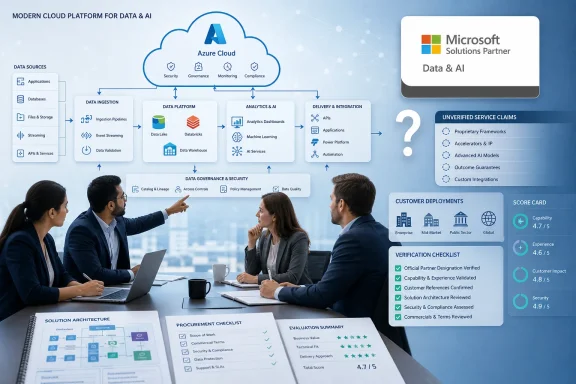 What Rishabh Software has actually earned
Microsoft’s Data & AI (Azure) designation is an organizational credential under the Microsoft AI Cloud Partner Program. It is separate from Microsoft’s “Solutions Partner with certified software” branding, which applies to individual software offers that satisfy distinct interoperability, marketplace, technical, and customer-success requirements.
To qualify, a partner needs at least 70 of 100 possible points and cannot have a zero in any of five metrics: net customer additions; intermediate certifications; advanced certifications; usage growth; and deployments. The score is calculated from data in Partner Center rather than from a one-off partner self-assessment.
Rishabh’s release is therefore correct in saying the status reflects more than employee certifications alone. Microsoft ties the badge to customer associations, Azure consumption growth, and deployments in addition to staff credentials. For a customer evaluating a consulting firm, that is more material than an old-style competency based mainly on examinations and headcount.
The qualification system also has separate Enterprise and SMB tracks. Microsoft classifies an Azure partner as SMB when at least 80 percent of its customers fall into that segment; otherwise it uses the Enterprise track. Thresholds vary by track, and Microsoft does not publicly disclose which one Rishabh Software used.
That distinction is more than administrative. A designation identifies a company that has met a program threshold appropriate to its recorded customer base. It does not reveal whether its demonstrated work resembles a buyer’s own environment—for example, a multi-region regulated-data estate, a Fabric consolidation, an Azure Databricks deployment, or a narrowly scoped Power BI project.
The Azure data badge does not test only data-and-AI workloads
The central limitation of the announcement is in the fine print of Microsoft’s qualification model. For the three Azure designations—Data & AI, Infrastructure, and Digital & App Innovation—the performance and customer-success measures use all eligible Azure services, not a narrowly restricted list of data-platform or AI services.
Microsoft’s published rules say net customer additions are counted through eligible Azure customer tenants associated with the partner through Cloud Solution Provider, Digital Partner of Record, or Partner Admin Link relationships. An Enterprise-track customer needs at least $1,000 in Azure Consumed Revenue in one of the preceding two months; the corresponding SMB threshold is $500. Each net new customer can contribute 10 points, up to 30.
The deployment measure likewise counts distinct Azure workloads, excluding virtual machines and VM licenses. Usage growth is based on Azure consumption growth across associated customer tenants. In other words, the designation’s customer-success components demonstrate Azure delivery and consumption activity, but they do not by themselves establish that all of that activity was Microsoft Fabric, Azure AI Foundry, Azure Machine Learning, Azure Databricks, Purview, Power BI, or custom AI-agent work.
That is why the release’s four service categories need separating from the credential itself:
- Rishabh says it delivers cloud-native data platforms, modern pipelines, and Fabric-powered architectures, but it has not named a qualifying Fabric customer or deployment.
- It says it builds custom AI agents, predictive models, computer-vision systems, and Copilot integrations, but it has not identified the Azure services, models, guardrails, data boundaries, or production customers involved.
- It promotes Power BI, enterprise reporting, governance, and Purview implementations, but no public case study in the announcement establishes the scale, regulated-industry requirements, or operating model of those engagements.
The credential still carries value. Its skilling criteria are deliberately data-and-AI focused, and Microsoft’s current requirements include Azure administration and architecture credentials alongside certifications in such areas as Azure databases, Fabric analytics and data engineering, SQL AI development, Azure AI apps and agents, machine-learning operations, and Azure Databricks data engineering.
But certification requirements are a capability floor. They are not a published audit of an individual customer’s data quality, model accuracy, security controls, FinOps discipline, recovery objectives, or success after go-live.
“Priority support” is a partner benefit, not a customer entitlement
Rishabh’s release says customers benefit from certified specialists, Microsoft reference architectures, priority support, and access to Microsoft co-sell and go-to-market resources. This combines several different things under a customer-facing promise that Microsoft’s program materials do not make as directly.
Microsoft does say Solutions Partner benefits can include marketing and go-to-market resources, support, advisory services, Azure credits, subscriptions, and licenses. But those are benefits issued to the enrolled partner organization, usually at the partner global-account level. They are not an automatic right for every customer who hires that partner.
“Priority support” is particularly imprecise. Microsoft describes technical pre-sales, deployment services, and technical-support benefits for partners; it does not state that a Solutions Partner designation automatically places the partner’s customers into a priority Azure support tier. A customer’s own Azure support experience depends on its Microsoft support plan, its contractual arrangement, the severity of the incident, and how Rishabh structures any managed-service or escalation commitment.
The same caution applies to co-sell. Microsoft co-sell resources can help a partner position eligible offerings and pursue joint sales opportunities, but co-sell status is not a promise that Microsoft will supply deal teams, funding, account introductions, or faster technical support for a particular client. The release does not say whether Rishabh has a marketplace offer, a co-sell-ready solution, or any Azure specialization beyond the broad Solutions Partner designation.
For IT leaders, the practical procurement question is straightforward: ask Rishabh to put the operational benefit in writing. That means named support hours, escalation paths, response and restoration targets, responsibility for Azure support tickets, data-governance deliverables, and which Microsoft product licenses or support benefits—if any—will actually be passed through to the customer.
The badge is valid through an enrollment cycle, not a permanent certification
Microsoft does not continuously strip a designation the instant a score declines. Once enrolled, a partner retains its designation through its anniversary date, and the program checks whether it remains qualified during the renewal process. The partner must satisfy the threshold on at least one day during its qualification eligibility window.
For an organization that has not yet enrolled in a particular designation, that window includes the current month and the preceding five full calendar months. An enrolled partner uses a window tied to its anniversary and renewal period. Microsoft also notes that performance and customer-success data typically refresh by the 20th of each month, while certification data generally refreshes within 10 days of completion.
This structure matters because the designation is a point-in-time achievement tied to changing personnel, customer associations, Azure consumption, and certification validity. Rishabh’s release does not disclose its anniversary date or the duration of its current Data & AI enrollment. Buyers negotiating a multi-year Azure modernization program should therefore validate the company’s current designation when signing, rather than relying indefinitely on an August 2026 announcement.
Rishabh also describes this as its second Solutions Partner designation after Modern Work. Microsoft recognizes those as distinct solution areas, so the pairing gives Rishabh a broader Microsoft portfolio than an Azure-only consultancy. It does not, however, create a Microsoft Cloud-wide designation; Microsoft reserves that umbrella badge for partners that attain all six available Solutions Partner designations.
What an Azure buyer should ask for before treating this as delivery proof
The status is a reasonable positive signal for organizations shortlisting Azure consulting partners. It confirms that Rishabh has cleared Microsoft’s combined threshold for staff skills and recorded Azure customer activity, and it should give the company access to partner-facing program benefits that can support its practice.
It is not enough to establish whether Rishabh is the right operator for a high-risk data or AI program. The EIN Presswire announcement provides no customer references, no architecture diagrams, no service-level commitments, no delivery geographies, no security attestations, and no detail on who operates the platform after launch. No independent outlet or Microsoft announcement located in research published those missing particulars.
A serious evaluation should request recent, comparable references; the specific Azure services used; the partner-association model; proof of current enrollment; a sample landing-zone and data-governance design; model-monitoring and incident-response procedures; and an explicit statement of which support obligations belong to Rishabh versus Microsoft.
The Data & AI (Azure) badge gives Rishabh Software a credible new line on a partner scorecard. The work that determines whether customers get a reliable Fabric estate, governed data platform, or production-grade AI service still has to be demonstrated project by project.
