
TweakTown’s August 7 report and independent coverage from Tom’s Hardware confirm the core claim: these are RTX 2080 Ti boards physically altered from their stock 11GB configuration to expose 22GB of memory. The more important finding is that this is not a one-off workshop experiment suddenly arriving on eBay. The same $499, 22GB RTX 2080 Ti proposition was reported in February 2024, while eBay feedback tied to the current listing includes buyers who say they are running larger local models such as Qwen 32B.
That history makes the current listing a useful signal of a persistent niche market rather than proof that a new generation of cheap AI hardware has appeared. A nearly eight-year-old Turing card can still be valuable when VRAM capacity is the hard limit, but its appeal comes with a reliability and feature-support trade-off that the listing’s “AI Mapping GPU” label does not explain.
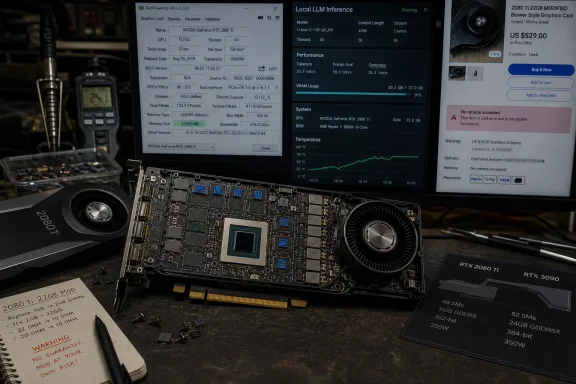 The modification is real hardware work, not a software unlock
NVIDIA shipped the GeForce RTX 2080 Ti with 11GB of GDDR6 across an unusual 352-bit memory bus. The 22GB versions achieve their capacity by replacing the board’s eleven 1GB GDDR6 packages with eleven 2GB packages, then changing the board-level memory configuration so that firmware recognizes the doubled capacity.
Tom’s Hardware recently documented an RTX 2080 Ti upgrade service that uses exactly that process: removal and replacement of memory chips, followed by moving memory-strap resistors on the PCB. Earlier work by modder VIK-on had established that the TU102 GPU could address more than 11GB, although the 2021 proof-of-concept was not a finished, stable 22GB retail-style card.
The technical case is therefore credible. NVIDIA’s own product documentation establishes that a stock RTX 2080 Ti is a PCIe 3.0 x16 product with 11GB of GDDR6, and NVIDIA’s CUDA database identifies it as a Turing, compute-capability 7.5 GPU. The seller’s photos show a GPU-Z result reporting 22,528MB, which corresponds to 22GiB.
But a GPU-Z screenshot establishes only that one card reported that memory configuration at one moment. It does not establish the quality of the replacement chips, the duration or conditions of stress testing, memory-error rates under sustained inference, or whether every mixed-brand board sent to buyers has the same PCB revision and cooling arrangement.
Those questions are especially relevant because the eBay offer does not promise a particular manufacturer. A customer may receive a Gigabyte, MSI, Asus, Leadtek, or another available blower-style card. Different RTX 2080 Ti board layouts, power delivery designs, memory cooling solutions, and VBIOS behavior make that a significant variable in a product whose central feature is a PCB-level modification.
The listing has one conspicuous error and one larger risk
The live eBay page classifies the card’s compatible slot as “PCI Express 3.0 x1.” That is plainly wrong: NVIDIA’s RTX 2080 Ti user guide specifies a PCI Express 3.0 x16 interface, as do original board partner specifications. It is likely a generic item-specifics error rather than evidence that the card uses a x1 physical connector, but it is still a warning against treating every field in the listing as verified technical documentation.
More materially, the listing labels the product as used, offers no returns, and sells a modified board whose original manufacturer warranty expired long ago. eBay’s Money Back Guarantee may cover an item that fails to arrive or materially differs from its listing, but it is not equivalent to a warranty covering intermittent GPU memory errors, thermal behavior after weeks of use, or a later incompatibility with a machine-learning stack.
The seller’s marketplace record is stronger than the usual anonymous GPU listing. At the time checked, Zhou’s store showed 99.6% positive feedback, more than 35,000 items sold since joining eBay in 2014, and 38 feedback entries associated with this item. Several verified-purchase comments specifically say the card works for AI tasks; one buyer reports using Qwen 32B successfully. Those are encouraging field reports, but they remain buyer feedback, not controlled validation of the modification across the 98 completed sales displayed by eBay.
For a Windows user, the sensible acceptance test needs to be more rigorous than opening GPU-Z. Run NVIDIA’s diagnostics and a long memory-intensive workload immediately inside the eBay protection window. Confirm the 22GB allocation in the intended application, exercise the GPU for hours rather than minutes, watch temperatures and clocks, and test the actual model, CUDA build, PyTorch version, ComfyUI workflow, or inference server planned for the card. A return policy of “none” means a buyer who waits until a project deadline to test it may have very little practical recourse.
22GB fixes capacity limits, not Turing’s age
The attraction is straightforward. Many local LLM and image-generation workloads fail or fall back to system memory when the model, context window, weights, cache, and runtime overhead exceed available VRAM. Doubling a 2080 Ti from 11GB to 22GB can change a model from impossible to runnable on a single consumer GPU.
That does not give the card 2026-era AI features. NVIDIA’s current TensorRT-RTX support matrix lists the RTX 2080 Ti’s Turing architecture as supporting FP32 and FP16, while BF16, weight-only INT8 and INT4 GEMM acceleration, FP8, FP6, and FP4 are unavailable. Those omissions affect both software compatibility and performance as inference engines increasingly target lower-precision paths optimized for newer Ampere, Ada, and Blackwell hardware.
The difference is already visible in NVIDIA’s own documentation. TensorRT-RTX can target compute capability 7.5, but it requires the application or engine builder to specify that target; it is not among the newer architectures supported by default. The RTX 2080 Ti remains within NVIDIA’s current compute-capability table, and CUDA 13 retained Turing support while dropping offline compilation support for pre-Turing architectures. Still, “supported” should not be mistaken for “preferred.”
For quantized LLM inference, 22GB may be more useful than a much faster card with 12GB or 16GB that cannot hold the workload. For modern diffusion pipelines, video generation, model training, or tools designed around BF16 and newer quantization kernels, the 2080 Ti’s age becomes more costly. The card retains its original 616GB/s memory bandwidth and original compute hardware; the VRAM mod adds capacity, not bandwidth, Tensor Core throughput, PCIe generation, or newer data types.
This is why the common comparison with a 24GB RTX 3090 only goes so far. Tom’s Hardware put used 24GB Titan RTX cards near $800, Quadro RTX 6000 cards near $900, and RTX 3090 cards near $1,200 when it surveyed the eBay market. The 22GB modded 2080 Ti remains cheaper even at $529, but the RTX 3090 brings faster GDDR6X memory, 936GB/s bandwidth, an Ampere architecture, and BF16 support. The price gap buys real capability, not a spec-sheet luxury.
Blower cooling favors density, with a cost
The “Turbo” form factor is another deliberate choice. A dual-slot blower card exhausts heat out of the chassis and permits denser multi-GPU arrangements than the oversized open-air coolers common on gaming cards. That matters for an AI workstation with several GPUs installed close together.
It also means the cards are likely louder and less forgiving than a large triple-fan gaming design, particularly under an extended inference load. Buyers should not assume the blower shroud guarantees workstation-grade validation; this remains a consumer GeForce board, used hardware, and an aftermarket memory modification assembled from whatever compatible cards the seller has in stock.
The listing’s broad brand lottery also complicates case-fit and power planning. The original RTX 2080 Ti was a high-power card, and the modification does not reduce the need for adequate airflow, a quality power supply, and an x16-length PCIe slot. The eBay metadata’s mistaken x1 entry should be ignored for physical planning.
A real budget option, with a narrow buyer profile
The current 22GB RTX 2080 Ti offer is credible enough to be taken seriously: the modification method is established, the seller has a substantial transaction history, eBay displays dozens of item-specific feedback entries, and real buyers report using the cards for local AI. The evidence does not support calling it an equivalent substitute for a 24GB RTX 3090, a modern RTX Pro card, or a warrantied workstation GPU.
It is best understood as a capacity-first purchase for a technically confident user who needs a single-GPU local LLM or CUDA box to cross the 11GB-to-22GB threshold at the lowest possible upfront cost. The $30 increase from the widely reported $499 figure is modest, but the lack of returns is the actual price change: the buyer, rather than NVIDIA, the board partner, or the modder, absorbs the long-term reliability risk.
References
- Primary source: TweakTown
Published: August 7, 2026 at 6:20 PM UTC
Loading…
www.tweaktown.com - Related coverage: tomshardware.com
Loading…
www.tomshardware.com - Related coverage: tomshardware.com
Loading…
www.tomshardware.com - Related coverage: tomshw.it
Loading…
www.tomshw.it - Related coverage: lowyat.net
Loading…
www.lowyat.net - Related coverage: tweaktown.com
Loading…
www.tweaktown.com - Related coverage: en.overclocking.com
Loading…
en.overclocking.com - Related coverage: morethantech.it
Loading…
morethantech.it - Related coverage: overclockers.ru
Loading…
overclockers.ru - Related coverage: ebay.com.au
Loading…
www.ebay.com.au - Related coverage: insiderllm.com
Loading…
www.insiderllm.com - Related coverage: insiderllm.com
Loading…
insiderllm.com - Related coverage: pcgamer.com
Loading…
www.pcgamer.com - Related coverage: developer.nvidia.com
Loading…
developer.nvidia.com