
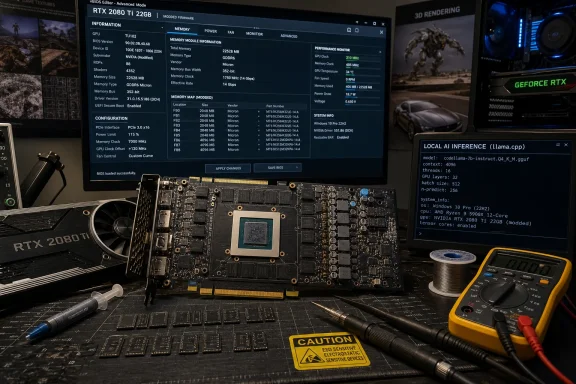
As reported by Wccftech, the Dubai-based repair shop has demonstrated the modified RTX 2080 Ti for games, creative workloads and local AI models. Its service page describes replacing the card’s original 1GB GDDR6 chips with 2GB parts, applying a modified VBIOS, replacing thermal materials, and completing stress testing before return.
The important caveat is that GPU Solutions’ own FAQ says its RTX 2080 Ti 11GB-to-22GB and RTX 3070 8GB-to-16GB VRAM upgrades are temporarily suspended because memory-component prices have risen sharply. The service listing remains online, but it does not publish a final upgrade price; the displayed AED 0 is a quote-request placeholder, not a free service.
 More VRAM Does Not Create a New GPU
A 22GB framebuffer can remove a meaningful constraint for workloads that genuinely exceed 11GB: large texture pools, GPU rendering scenes and local LLM inference are obvious examples. It does not, however, alter the RTX 2080 Ti’s Turing-era compute performance, ray-tracing capability, encoder features, power efficiency or PCIe 3.0 platform.
For Windows gamers, that distinction matters. Extra memory may prevent texture-quality reductions or VRAM exhaustion in a specific title, but it will not turn a 2018 flagship into the equivalent of a modern high-end card. Local AI users may find the capacity upgrade more compelling, provided their chosen CUDA application and model fit the card’s older architecture and performance envelope.
Firmware and Driver Support Are the Real Test
The physical work is only part of the project. A usable modification requires firmware configuration so the GPU, Windows and NVIDIA’s driver stack identify the expanded memory correctly. GPU Solutions says its 2080 Ti process includes VBIOS configuration for 22GB detection.
That requirement is why VRAM modifications cannot be generalized across every card. The shop’s own materials identify compatible PCB layouts as a prerequisite, while prior community modifications have shown that an electrically successful memory expansion can still be limited by driver recognition or firmware support.
The Economics Favor Caution
GPU Solutions lists a 12-day turnaround, AED 50 pickup-and-delivery charge within the UAE, and a 90-day warranty covering its workmanship and replaced memory components. International customers would also need to account for shipping, insurance, customs paperwork, duties and the risk of sending an aging GPU overseas.
The sensible next step is therefore a written quote that specifies the exact board model, memory-part availability, validation process, warranty scope and return-shipping terms. Until the provider resumes VRAM-upgrade bookings—and until the all-in price is known—the 22GB RTX 2080 Ti remains an intriguing niche option rather than a straightforward alternative to buying a newer GPU.
Update: Additional details (August 2, 2026)
eTeknix reports that the modification also requires changing the PCB resistor configuration so the RTX 2080 Ti can detect and address the higher-density memory correctly, in addition to replacing the 1GB GDDR6 packages with 2GB parts.
The outlet says the service previously cost about $234, before higher memory-component costs moved GPU Solutions to case-by-case quotes.