
Redwood announced the release alongside its placement as a Leader in Gartner’s 2026 Magic Quadrant for Service Orchestration and Automation Platforms. Gartner’s public abstract confirms that the report was published on August 5 and that Redwood was among the vendors evaluated. CRN’s coverage of the report also lists Redwood among the Leaders, corroborating the central recognition claim.
For existing RunMyJobs customers, however, the practical news is the 2026.3 feature release, not the quadrant graphic. It adds operational UI improvements, connector and API changes, a longer Insights Premium history-retention option, and a new MCP interface intended to let compatible AI assistants inspect and trigger RunMyJobs operations. The release is on Redwood’s normal short-lived feature-release track: Redwood says 2026.3 is supported until 2026.4 arrives, expected in October 2026.
 The Gartner claim is real, but one score changed in the telling
Redwood says it has been named a Gartner Leader for the third consecutive year and placed furthest for Completeness of Vision. Gartner’s publicly available page identifies the report, its August 5 publication date, its analysts, and Redwood’s inclusion, but does not publish the underlying quadrant placement or vendor scores in the public abstract. Readers therefore have to rely on Redwood’s account for the “furthest” positioning unless they have access to the full research.
The more immediate discrepancy concerns the companion Critical Capabilities report. The PR Newswire announcement says Redwood ranked first in four of five use cases and tied for first in the remaining category. Yet Redwood’s own currently published Critical Capabilities landing page says the company ranked first in five out of five use cases, and lists individual scores for IT Workload Automation, IT Workflow Orchestration, Data Orchestration, Business Technologist, and DevOps Automation.
Those are not interchangeable descriptions. A sole first-place score and a shared first-place score can make a difference in a procurement comparison, especially where a buyer is using Gartner research as a gating criterion. Redwood has not publicly explained why its release announcement describes one tied category while its report page says five outright first-place finishes. Administrators and procurement teams should request the underlying report or a scorecard before treating either phrasing as a decision-ready comparison.
The release also follows a familiar pattern in analyst-recognition announcements: Gartner’s evaluation becomes the headline, while version-specific limitations are left to product documentation. The more consequential information for an operations team is in those release notes.
RunMyJobs 2026.3 adds an MCP server, with a documented scope gap
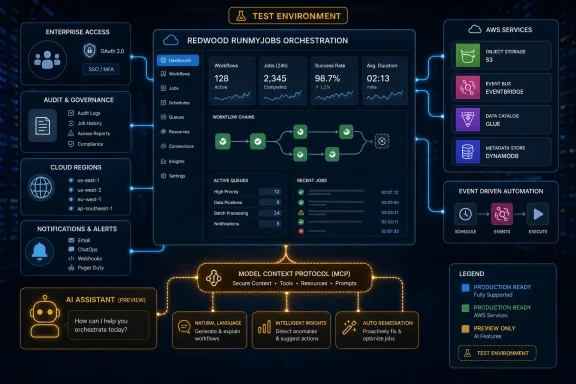
The headline technical addition is a Model Context Protocol server. MCP is an interface pattern that lets an AI client call external tools with structured context, rather than relying only on a model’s built-in knowledge or a conversational integration. In this case, Redwood is positioning MCP as a governed path from an assistant such as Microsoft Copilot, SAP Joule, or Claude Code into existing RunMyJobs workflows and operational controls.
Redwood’s announcement says the MCP server is generally available with “50+” production-ready tools across nine AWS regions. Its 2026.3 release notes describe something more specific: 58 tools across six AWS regions, covering jobs, alerts, process servers, queues, events, messages, and credentials. Redwood’s broader product pages repeat the nine-region figure, but the version-specific release notes are the more useful source for an administrator planning an actual rollout.
That difference does not prove either description is false. It could reflect a staggered regional rollout, different definitions of an available region, or documentation that has not been synchronized. But it does mean the announcement should not be treated as an implementation specification. If regional residency, disaster recovery, or a corporate cloud boundary is part of the deployment requirement, teams need Redwood to identify the exact RunMyJobs region and MCP availability before enabling the integration.
The tool count also matters more than it may first appear. An MCP server that can work with job execution, alerts, queues, event handling, and credentials is not simply a natural-language dashboard. It can potentially expose the controls that determine whether a failed payroll run is retried, whether a downstream chain is released, or whether an operator is given access to sensitive execution details.
Redwood says its MCP connection supports OAuth 2.0 and audit tracing. Those are necessary safeguards, but they do not answer the core local questions for an enterprise deployment: which identities can invoke each tool, whether actions require approval, how credentials are masked in model context, how logs are retained, and whether the AI client can initiate changes or only propose them. Those controls should be tested in a non-production RunMyJobs environment before an organization connects a broadly available Copilot or coding-assistant tenant to production workflow operations.
The most ambitious AI features are still previews
The announcement groups MCP availability with Operations Agent, Workflow Builder, and Agent Studio under the same “autonomous operations” message. The release notes draw a much clearer line: all AI features are available only in the Modern UI, require access to Redwood’s Preview program to activate, and are not intended for production use. Redwood specifically recommends deploying preview features only in a test environment.
That caveat applies to the features likely to draw the most interest from automation teams:
- Workflow Builder can generate a draft JobChain from a plain-English description or a Markdown file, using objects already present in the RunMyJobs environment.
- Agent Studio adds an Agent Runner job type intended for reactive analysis, failure diagnosis, and triage using Anthropic, OpenAI, or compatible model services.
- Operations Agent monitors jobs and chains for failures and issues contextualized notifications through existing Slack or email alert paths.
These are potentially useful assistance features, especially for teams maintaining a large backlog of job-chain changes or responding to recurring batch failures. They are not an approval to let an LLM author, alter, or execute business-critical workflows unattended.
Workflow generation is a good example of the distinction. Producing a draft from documentation can speed up an experienced engineer’s work, but a workflow is executable business logic. It may embody dependency order, retry behavior, exception handling, SLA timers, segregation-of-duties rules, and data-transfer assumptions that a prose description does not capture. A generated chain should go through the same peer review, test run, access review, and change-control process as a hand-authored chain.
The same applies to Operations Agent. A contextual alert is useful; a system that automatically retries, skips, reroutes, or edits a workflow following an incomplete diagnosis carries a different risk. Redwood’s documentation describes notifications and triage-oriented behavior, not a broadly released autonomous-remediation feature. That is a more conservative and more credible reading of what 2026.3 delivers today.
AWS integration is useful only if it removes a real handoff
RunMyJobs 2026.3 also adds native connectivity for Amazon S3, EventBridge, and AWS Glue. For a hybrid estate, those integrations can reduce the number of scripts, polling jobs, and custom REST calls that connect legacy business processing to cloud data pipelines.
The operational benefit depends on the workflow design. An S3 arrival can become a trigger; EventBridge can carry an event into an orchestration chain; and Glue can become a managed step in a larger process that includes SAP, databases, file transfers, or on-premises servers. That can give operations staff one SLA and one audit trail across work that would otherwise be split between cloud-native monitoring and a separate scheduler.
But “native” does not eliminate the work that determines whether an integration is safe and supportable. Teams still need to define AWS IAM roles, event filtering, failure handling, idempotency, retry limits, and observability boundaries. A Glue job retried after a timeout can be harmless, expensive, or destructive depending on whether the workload can safely run twice. An EventBridge rule that is too broad can trigger unexpected chains. A file-arrival process needs protection against partial uploads and duplicate notifications.
The release notes contain less glamorous but more immediately deployable changes as well. Administrators gain color-coded workflow and job labels in the Modern UI, advanced search on parameter names, queues, and job servers, automatically generated Swagger documentation for the inbound REST extension, and an updated Platform Agent using OpenSSL 3.0.21. Redwood also says Insights Premium can retain 15 months of job history through automatic partition detachment into a historical store.
Those changes may be more valuable to a mature RunMyJobs estate than a preview agent. Better search, durable history, clearer labeling, and corrected behavior around queues, recurrence schedules, log downloads, and stuck workflow states are the kinds of improvements that reduce time spent during incidents.
What RunMyJobs customers should do before October
For customers running the preceding 2026.2 feature release, Redwood’s support policy lists August 2026 as its end-of-maintenance point. That makes 2026.3 a relevant upgrade candidate, particularly where the documented fixes address local issues. It does not make every new AI capability production-ready.
A sensible upgrade plan is to apply the ordinary release validation first: test existing job chains, Platform Agents, connectors, inbound REST integrations, and monitoring behavior in a representative environment. Then assess MCP as a separate security integration, with narrowly scoped service identities and a clearly defined set of allowed tools. Keep Workflow Builder, Agent Studio, and Operations Agent confined to preview or test environments until Redwood changes their status and the organization has completed its own governance review.
Redwood’s Gartner recognition may help it get onto more enterprise shortlists. The release documentation supplies the more important conclusion: RunMyJobs 2026.3 is a real automation-platform update with a potentially significant MCP integration, but the “agentic” portion remains a controlled evaluation exercise rather than a license to hand production operations to an AI assistant.
