
VideoCardz first documented the August 13 report, with TweakTown and Notebookcheck following it. All three accounts trace back to the same Reddit post by a person writing on behalf of a friend, not three independently verified failures. That distinction is the essential one: this is a real report of a destroyed AM5 system, supported by photographs and a described configuration, but it is not evidence that MSI’s current X870 firmware has defeated AMD’s 2023 voltage safeguards.
The Ryzen 7 7800X3D was installed with a 360 mm MSI liquid cooler, Lexar DDR5-6000 memory, an MSI Ventus RTX 4070, a Samsung 990 Pro SSD, and an MSI A750GL PCIe 5 power supply. The original poster said the PC shut down while gaming, then power-cycled without booting. After disassembly, they found damage to both the CPU and motherboard socket.
The hardware has since been delidded, reportedly after the failure. That decision has erased much of the evidence that would be needed to establish a root cause—and likely erased the practical path to a warranty investigation as well.
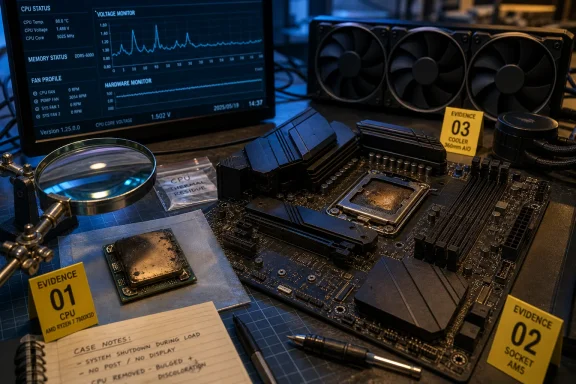 One hardware failure, not three confirmations
The coverage gives the impression of a fresh cluster because the same event appeared across three major PC-hardware sites within about 24 hours. But each outlet cites the same Reddit account and the same photos. Notebookcheck adds that the user had a three-month-old system and describes the BIOS as current; TweakTown and VideoCardz repeat the owner’s statement that only EXPO had been enabled.
No publication identified the exact MSI BIOS build, its embedded AMD AGESA version, the original motherboard serial number, processor lot information, or sensor logs captured before the shutdown. There is no reported HWiNFO record of CPU VDDCR_SOC voltage, no motherboard debug-code history, no event log, no oscilloscope data, and no vendor teardown.
That is not a minor missing detail. In 2023, the early Ryzen 7000 and Ryzen 7000X3D burnout controversy was specifically tied to processors operating beyond specification on AM5 boards. AMD said it had distributed AGESA changes that put limits on certain power rails, including a 1.30 V ceiling for SoC voltage. Board makers subsequently issued BIOS updates adopting that guardrail; Gigabyte’s public statement at the time explicitly identified the CPU-reported SVI3 SoC voltage as the measurement to use, rather than an arbitrary board sensor.
The latest report does not demonstrate that the SoC rail exceeded that limit. It does not demonstrate a transient spike, either. TweakTown’s suggestion that memory training or boost behavior may have permitted a brief voltage event is a theory, not a finding from this machine.
“Latest BIOS” is not a test result
A current BIOS is still the correct baseline for AM5, particularly for a Ryzen 7 7800X3D. But the phrase “latest BIOS” is not sufficiently specific to diagnose a processor failure. MSI can release beta and production BIOS versions, a user may update a board after a problem began, and motherboard firmware includes several layers of settings beyond the visible version string.
The report also gives no indication whether BIOS settings had been reset after flashing, whether EXPO loaded a vendor-specific memory preset beyond rated JEDEC defaults, whether Memory Context Restore had been changed, or whether the board was running an automatic performance mode. MSI advertises one-click processor and memory tuning in its Click BIOS interface, which makes confirming the actual active settings more important than simply asking whether the user manually overclocked the CPU.
AMD lists both EXPO memory overclocking support and Precision Boost Overdrive support for the 7800X3D. EXPO therefore should not be treated as an exotic configuration. Still, it is a memory overclocking profile: enabling it can alter memory-controller-related operating parameters from default settings, and the platform’s behavior depends on the board BIOS, memory kit, CPU sample, and firmware implementation.
That does not make EXPO the cause here. It means “EXPO was the only setting changed” is a useful fact, but it is not the same as a controlled test showing that EXPO or an SoC voltage limit failed. The system’s single 16 GB DDR5-6000 module, as reported by the owner, also makes the configuration unusual enough that exact BIOS settings and memory training behavior would matter if an investigation were possible.
The postmortem destroyed the best evidence
The damaged 7800X3D was delidded after it stopped working. The poster says the parts were sourced from China and returning them was considered impractical, so the chip was opened “out of curiosity” rather than submitted for analysis. That may be understandable for an owner facing international shipping costs, but it sharply limits what can be concluded from the photographs.
A swollen integrated heat spreader or visibly lifted package region establishes that something physically abnormal occurred. It does not establish the sequence. The processor could have failed first and damaged the motherboard; a motherboard fault, contaminated or bent socket contact, mounting issue, power-delivery fault, or external electrical event could have damaged the processor; or a prior defect may have worsened over time until the final shutdown. The owner themselves acknowledged in the thread that they did not know which component failed first.
AMD’s published processor warranty guidance is particularly unforgiving of this kind of lost evidence. Its terms require an evaluation of the processor and exclude physical damage attributed to external causes, alteration, repair, improper installation, or improper testing. AMD also describes burnt or heat-damaged processors among the cases that can fall outside ordinary warranty coverage. Whether this specific CPU was a retail boxed part eligible for global service is not established, but after delidding it, a meaningful vendor determination became far less likely.
That is the practical lesson for system builders. If an AM5 processor or socket shows scorching, package deformation, unexplained shutdowns followed by boot loops, or visible contact damage, stop testing the system. Photograph the CPU, socket, cooler mount, BIOS settings, and serial information before altering anything. Preserve the board, CPU, memory, and power supply together. Opening a failed processor may satisfy curiosity, but it turns a potentially diagnosable warranty case into an unsolved teardown.
What 7800X3D owners should actually do
There is no evidence in this incident alone that owners should disable EXPO, replace a working Ryzen 7 7800X3D, or avoid MSI X870 boards. A three-month-old machine failing in this manner deserves scrutiny; it does not justify a platform-wide verdict.
Owners should, however, make sure their board is running a current stable BIOS from the manufacturer’s support page rather than assuming a newer chipset guarantees updated firmware. After any BIOS flash, load defaults, enable only the settings you need, and document the resulting configuration. If EXPO is enabled, check the CPU-reported SoC voltage with a trusted monitoring tool such as HWiNFO rather than relying on a generic motherboard readout; AMD’s 2023 guidance centered on a 1.30 V SoC ceiling for affected AM5 safeguards.
Avoid piling on automatic overclock modes, PBO presets, manual voltage changes, and memory profiles all at once. That is sound diagnostic discipline, not proof that stock-style EXPO setups are unsafe. If a board becomes unstable, starts restarting under load, or exhibits unexplained boot loops, revert settings and begin a support case before swapping parts between systems.
The unanswered question is now narrow and concrete: whether MSI or AMD can examine an intact, similarly configured failure with the exact BIOS build and power data preserved. This report cannot answer it, because the only CPU at its center has already been physically altered and no vendor analysis has been made public.
Update: Owner says an RMA request is now underway (August 15, 2026)
TechSpot reports that the Reddit poster has since said an RMA request is underway for the failed Ryzen 7 7800X3D. That is the first indication that AMD may have an opportunity to review the incident through a formal support process.
Any warranty outcome remains uncertain. The processor was reportedly delidded before the RMA was started, potentially limiting AMD’s ability to inspect the original physical condition and determine whether the CPU, motherboard socket, installation, or another component initiated the failure.
TechSpot also repeats speculation that a transient event during EXPO memory training could be involved. No logs, vendor findings, or electrical measurements have been published to support that theory, so it should not be treated as an identified cause.
