
For Windows gamers, this is not simply another suffix in an already crowded Ryzen mobile lineup. A well-executed eight-core X3D laptop CPU could improve the part of gaming performance that spec sheets often obscure: consistent CPU-limited frame rates and frame pacing. That is especially relevant when a premium notebook is paired with a fast discrete GPU, a 240 Hz or higher refresh-rate display, and games that are sensitive to memory latency rather than sheer core count.
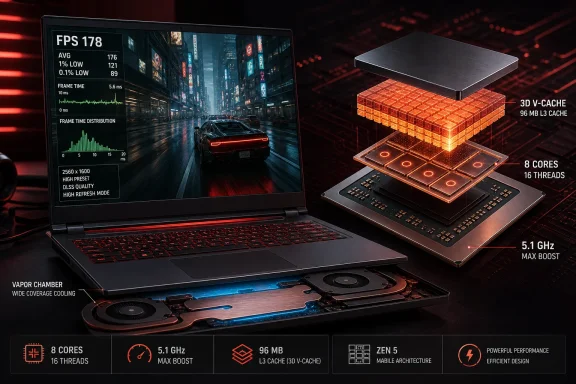 Background: Why 3D V-Cache Matters in Gaming Laptops
AMD’s 3D V-Cache approach adds a large slab of L3 cache to the CPU’s core complex through vertical stacking. In the company’s second-generation design, AMD places the additional cache beneath the processor cores, allowing the cores to sit closer to cooling and potentially sustain stronger clocks than the original implementation. The technology uses through-silicon vias and direct copper-to-copper bonding to connect the cache die and CPU die. AMD’s 3D V-Cache technology overview
The practical result is not that every application suddenly becomes dramatically faster. Large L3 cache is valuable when a workload repeatedly accesses data that can remain close to the CPU instead of spilling out to slower system memory. Games are often good candidates because simulation, game-world streaming, AI routines, draw-call preparation, and other CPU-side tasks can generate latency-sensitive access patterns.
That is why AMD’s X3D products have developed a particularly strong gaming identity. The benefit is most pronounced in titles that are CPU-bound or that expose memory-latency limitations, rather than in GPU-bound scenarios where the graphics processor is already the limiting component. Raising resolution, enabling aggressive ray tracing, or selecting maximum-quality visual presets can move a game toward GPU limitation, shrinking the observable difference between CPUs.
A gaming notebook complicates that equation. Desktop CPU comparisons can hold the graphics card, cooling, memory configuration, and power delivery relatively steady. Laptops cannot. Two systems carrying the same mobile processor can produce markedly different results because OEMs choose different power limits, cooling capacity, memory specifications, GPU wattage, BIOS policies, and display configurations.
That variability is precisely why a mobile X3D part is intriguing. Rather than depending entirely on higher voltage and clock speed to improve gaming performance, AMD can use cache capacity to accelerate appropriate workloads. In theory, that provides an avenue toward stronger gaming results without demanding the kind of sustained power budget associated with simply adding more CPU cores or chasing ever-higher frequencies.
The Rumored Ryzen 7 9800HX3D Specification
The rumored Ryzen 7 9800HX3D is described as an eight-core, 16-thread Zen 5 processor with a maximum boost of up to 5.1 GHz and 96 MB of L3 cache. The cache figure strongly suggests a familiar arrangement: 32 MB of native L3 cache on an eight-core CCD, supplemented by a 64 MB 3D V-Cache die. That proposed layout aligns with AMD’s second-generation cache technology, which supports an eight-core Zen 5 CCD and a 64 MB L3 cache die. Tom’s Hardware AMD
The rumored branding is itself worth treating carefully. Reports say the processor may previously have appeared under the Ryzen 7 9755HX3D name before the 9800HX3D designation emerged. That does not prove either name is final; mobile processor branding can change between early planning, partner roadmaps, firmware references, and retail launch. What it does indicate is that AMD could be positioning the chip to mirror the name recognition of its desktop Ryzen 7 X3D products. Tom’s Hardware TechSpot
The reported 5.1 GHz boost clock is notable, but it should not be read as a promise of an all-core sustained frequency. AMD defines maximum boost as the highest frequency a single core can reach during bursty, single-threaded activity under appropriate conditions. In a notebook, sustained clocks during a long gaming session will depend on chassis cooling, temperature targets, power limits, firmware tuning, and the concurrent load from the GPU.
Likewise, the 96 MB L3 claim does not describe total on-chip cache. AMD’s product listings commonly distinguish L1, L2, and L3 cache, while marketing materials may use “total cache,” which includes multiple cache levels. The leak’s 96 MB figure appears to refer specifically to L3 cache, while a final product page would be needed to establish the full cache hierarchy and any differences from the expected design.
What Is Known, and What Is Still a Rumor
At this stage, the discussion should be divided into two categories.
Reported but unconfirmed details include:
- The Ryzen 7 9800HX3D product name.
- An 8-core / 16-thread CPU configuration.
- Zen 5 CPU architecture.
- A maximum boost clock of up to 5.1 GHz.
- 96 MB of L3 cache.
- Potential mass production in Q4 2026.
- A possible public debut around CES 2027.
- A market position below AMD’s top Ryzen 9 HX3D systems. Tom’s Hardware TechSpot
Established context includes:
- AMD already sells mobile X3D processors, including the earlier Ryzen 9 7945HX3D and the newer Ryzen 9 9955HX3D.
- AMD’s current Ryzen 9000HX lineup includes a 16-core Ryzen 9 9955HX3D with 144 MB total cache and a configurable 55 W to 75 W power range.
- Second-generation X3D packaging is designed to improve thermal headroom by relocating the cache below the core complex die. AMD Ryzen 9 7945HX3D specifications AMD’s Ryzen 9000HX announcement
This distinction matters because claims that the Ryzen 7 9800HX3D would be AMD’s first mobile X3D processor are inaccurate. The more compelling interpretation is that it could be AMD’s first major attempt to create a broader, eight-core X3D tier for gaming notebooks, rather than reserving the technology for expensive 16-core Ryzen 9 flagships.
An Eight-Core Design Could Be the Point, Not the Compromise
On paper, eight cores may look modest next to a 12-core Ryzen 9 9850HX or a 16-core Ryzen 9 9955HX3D. But gaming is not a simple core-count contest. Most modern games benefit from ample parallel processing capacity, yet many still depend heavily on the performance of a smaller number of threads and on how quickly the CPU can retrieve frequently used data.
For that reason, an eight-core X3D configuration could be strategically coherent. It may sacrifice some throughput in heavily multithreaded tasks—such as CPU rendering, certain compilation workloads, professional simulation, or extensive video encoding—but direct more of its silicon budget toward gaming responsiveness. A buyer who spends most of their time in esports titles, large open-world games, strategy games, simulation titles, or demanding multiplayer releases may value that trade differently from a creator who needs maximum multicore output.
AMD has already demonstrated this segmentation in desktop products. X3D chips are marketed around gaming performance, while higher-core non-X3D or dual-CCD models can better suit workloads that scale cleanly across many threads. The mobile Ryzen 7 9800HX3D, if it arrives with the proposed configuration, would apply a similar product logic to gaming laptops.
There is also an economic argument. A flagship 16-core X3D notebook processor is likely to appear mainly in the most expensive systems, frequently alongside top-tier discrete graphics, oversized cooling assemblies, and premium displays. An eight-core alternative may enable manufacturers to build machines that still prioritize CPU gaming performance but do not require the complete flagship platform.
That does not necessarily mean “affordable.” The word needs restraint in the gaming-laptop market. A notebook combining a new X3D processor with a high-wattage GeForce RTX-class GPU, robust cooling, fast memory, and a high-refresh panel could still land well above mainstream pricing. But it could create a more accessible step below the most uncompromising Ryzen 9 HX3D configurations. TechSpot
The Likely Sweet Spot: CPU-Bound Gaming
The Ryzen 7 9800HX3D’s strongest potential would be in laptop gaming scenarios where CPU limits have room to surface:
- Competitive titles played at 1080p or 1440p with high frame-rate targets.
- Games using 240 Hz, 300 Hz, 360 Hz, or faster displays.
- Strategy and simulation workloads with large numbers of entities or complex world simulation.
- Open-world games that are demanding on streaming and CPU-side scheduling.
- High-end notebook GPUs that can otherwise outrun the CPU at lower resolutions.
- Games where improved cache behavior reduces frame-time spikes rather than just improving an average FPS number.
The emphasis on frame times is essential. Average FPS is easy to advertise but incomplete. A system that averages 160 FPS while regularly suffering frametime spikes can feel less responsive and less polished than a system with a lower average but steadier delivery. Cache capacity can help in certain games, but it cannot eliminate every source of stutter—shader compilation, background applications, storage access, poor game optimization, and thermal throttling can all remain factors.
The Mobile Thermal Challenge
The promise of X3D becomes more nuanced in a laptop because cooling is inseparable from performance. Gaming notebooks are finite thermal systems. The CPU, discrete GPU, memory, storage, voltage regulators, and display all share a limited physical envelope, and the CPU is frequently operating beside a GPU consuming far more power under load.
AMD’s second-generation 3D V-Cache design addresses an important historical concern by placing the stacked cache underneath the CPU cores. According to AMD, this arrangement puts the Zen 5 cores closer to the cooling solution, enabling higher clock speeds and lower temperatures than the prior placement. AMD AMD’s Ryzen 9000HX announcement
That is encouraging, but it should not be overextended into a blanket guarantee. The actual thermal behavior of a Ryzen 7 9800HX3D notebook will depend far more on the final laptop than on the processor logo alone.
A few variables will decide whether the chip fulfills its potential:
- Sustained CPU power limit: OEMs can set aggressive or conservative package-power targets, shaping clocks, noise, and temperatures.
- GPU power allocation: In a gaming laptop, CPU and GPU behavior must coexist. A manufacturer might prioritize GPU power for 4K or ray-traced gaming, where that is the correct performance decision.
- Cooling hardware: Vapor chambers, fan size, heatsink mass, thermal interface materials, exhaust design, and chassis thickness all affect sustained operation.
- Memory configuration: Dual-channel DDR5 capacity, speed, timings, and laptop soldered-versus-upgradeable designs can influence CPU-limited performance.
- Firmware maturity: BIOS tuning, Windows power plans, dynamic boost behavior, and driver updates can materially affect both benchmark results and real-world consistency.
The 9800HX3D could therefore create a wider performance gap between good and mediocre notebook implementations. A carefully engineered model could deliver excellent gaming behavior with sensible fan noise and strong sustained clocks. A thinner or less well-tuned system could surrender much of that advantage through heat and conservative power management.
How It Could Fit Beside the Ryzen 9 9955HX3D
AMD’s existing Ryzen 9 9955HX3D illustrates what an extreme mobile X3D design looks like. AMD lists the chip with 16 cores, 32 threads, a boost clock up to 5.4 GHz, 144 MB total cache, and a 55 W to 75 W configurable TDP. It sits in the highest-performance notebook category, aimed not only at gaming but also at creators and users whose workloads scale across many cores. AMD’s Ryzen 9000HX announcement
The rumored Ryzen 7 9800HX3D would not replace that part. It would target a different definition of premium: a CPU designed around the fact that eight high-performance cores and a very large cache can be enough to drive excellent gaming performance, especially when paired with a capable GPU.
This creates a potentially cleaner hierarchy:
| Segment | Likely priority | Processor approach |
|---|---|---|
| Ryzen 9 HX3D flagship | Gaming plus workstation-class multicore capability | 16 cores and large cache |
| Ryzen 9 HX | High multicore performance without stacked cache | More cores, conventional cache arrangement |
| Rumored Ryzen 7 9800HX3D | Gaming-centric balance | 8 cores plus 96 MB L3 cache |
| Conventional Ryzen 7 HX | Broad high-performance notebook use | Eight or more cores without X3D cache |
Such an arrangement would make sense for buyers because it would reduce the false assumption that the highest core count is automatically the best gaming option. It would also offer laptop makers a way to distinguish models beyond the usual GPU, display, and chassis tiers.
Intel Competition and the Importance of Differentiation
Intel remains a formidable player in high-performance laptops, especially in systems designed around high clocks, hybrid core arrangements, broad OEM availability, and strong platform integration. AMD does not need the Ryzen 7 9800HX3D to defeat every competing CPU in every benchmark to make the product strategically valuable.
Instead, it needs a recognizable advantage in the gaming workloads that matter to premium notebook buyers. 3D V-Cache is a tangible differentiator because it changes the CPU’s memory hierarchy, not merely its frequency label or core count. In an increasingly crowded mobile market, that gives OEMs a simple message: this is the processor intended for gamers who care about CPU-bound performance and smoother high-refresh play.
There is a Windows-specific dimension as well. Modern Windows gaming laptops juggle numerous background processes, overlays, launchers, anti-cheat services, capture tools, RGB utilities, and power-management layers. A fast CPU helps, but the system experience also depends on software quality. A cache-rich processor can improve performance headroom in some games, yet it cannot compensate for poor OEM software, aggressive preinstalled utilities, outdated graphics drivers, or a thermal profile that favors silence over sustained performance.
That makes laptop reviews more important than ever. The final judgment should come from complete-system testing—not early CPU leaks, not isolated desktop comparisons, and not a single average FPS chart.
Risks, Unknowns, and the Details That Need Verification
The Ryzen 7 9800HX3D story is compelling, but there are several specific risks to keep in view.
Naming and launch timing may change
The name has reportedly shifted from 9755HX3D to 9800HX3D, which makes it sensible to avoid treating branding as final. The Q4 2026 production claim and CES 2027 launch window are also leak-based rather than AMD commitments. Tom’s Hardware
There are no independent benchmarks yet
No reliable performance conclusion can be drawn without tested retail hardware. The performance delta against a Ryzen 9 9850HX, Ryzen 9 9955HX3D, or competing Intel mobile platform will vary by game, GPU, memory setup, power profile, display resolution, and cooling design.
Cache does not guarantee universal wins
X3D’s central advantage is workload-specific. CPU-sensitive games may benefit substantially; GPU-limited games may show small or negligible movement. Users buying a notebook primarily for Blender rendering, software development builds, encoding, or multi-VM workflows may still prefer more cores over extra cache.
Pricing could undermine the category
The processor can only broaden X3D’s mobile appeal if it appears in notebooks priced meaningfully below flagship Ryzen 9 HX3D systems. If OEMs deploy it exclusively in halo designs with maximum-spec GPUs and luxury displays, it may remain a niche product despite its more balanced CPU configuration.
Battery life is not the primary mission
An HX-class X3D gaming notebook should be judged as a performance machine first. Battery capacity, display behavior, GPU switching implementation, idle tuning, and OEM firmware will matter much more to unplugged endurance than the processor’s cache alone. Buyers expecting ultraportable behavior should not infer it from an eight-core count.
What Windows Gamers Should Watch For
If AMD confirms the Ryzen 7 9800HX3D, the most important announcements will not be limited to the CPU itself. The notebook designs around it will determine whether the chip becomes a genuine turning point for gaming laptops.
The strongest systems would ideally pair the processor with:
- A high-performance discrete GPU with a clearly stated maximum graphics power.
- Two DDR5 memory channels, preferably with sufficient capacity for modern games and background workloads.
- A cooling design capable of sustained combined CPU-and-GPU load.
- A high-refresh display where improved CPU performance is visible.
- A MUX switch or equivalent modern graphics-routing implementation.
- Sensible Windows power profiles and minimal intrusive OEM software.
- User-accessible BIOS controls or at least transparent fan and performance modes.
- Fast NVMe storage with enough capacity to prevent performance compromises caused by a nearly full SSD.
The practical benchmark set should also go beyond average FPS. Look for 1% lows, frame-time plots, fan noise measurements, surface temperatures, battery behavior, charger size, and sustained performance after the first few minutes of a game. These details expose whether a laptop’s engineering matches the ambition of its processor.
A Potentially Important New Tier for Gaming Notebooks
The rumored Ryzen 7 9800HX3D is interesting not because it would be AMD’s first mobile X3D processor—it would not be—but because it could bring the X3D formula to a more focused and potentially more broadly useful gaming-laptop segment. AMD has already established the extreme end of the market with the Ryzen 9 7945HX3D and Ryzen 9 9955HX3D; an eight-core Zen 5 X3D part could be the product that makes the strategy feel less like a flagship experiment and more like a coherent platform category. AMD Ryzen 9 7945HX3D specifications AMD’s Ryzen 9000HX announcement
If the reported 8-core, 16-thread, 5.1 GHz, and 96 MB L3 configuration holds, the Ryzen 7 9800HX3D could be an unusually well-targeted mobile processor: enough cores for modern Windows gaming, a large cache reserve for latency-sensitive workloads, and potentially lower system cost and thermal complexity than 16-core X3D alternatives. That combination will not eliminate the need for excellent notebook engineering, but it could give manufacturers a powerful new foundation for high-refresh, GPU-rich gaming systems.
For AMD, the opportunity is clear. Desktop X3D processors have shown that cache can be a competitive gaming weapon. The Ryzen 7 9800HX3D could determine whether that advantage becomes a defining feature of the next generation of premium gaming notebooks rather than a specialty reserved for the most expensive machines.
