
The critical number in the report is 95°C under all-core load. That is AMD’s published maximum operating temperature, or Tjmax, for the Ryzen 7 9800X3D—not an arbitrary point at which the processor suddenly becomes unsafe. Reaching it means the Q-Tec unit had exhausted the thermal margin available for the CPU’s boost behavior; it does not, on its own, prove the test system was failing or that the processor was being damaged.
Wccftech says the chip continued operating near 5.0 GHz in Cinebench while sitting at that ceiling. That is consistent with modern Ryzen behavior: Precision Boost dynamically trades frequency against temperature, power and current limits. A cooler that drives the processor to 95°C may still produce a working, stable machine, but it gives the CPU little room to sustain its best all-core clocks when the workload lasts longer than a game scene or a short benchmark run.
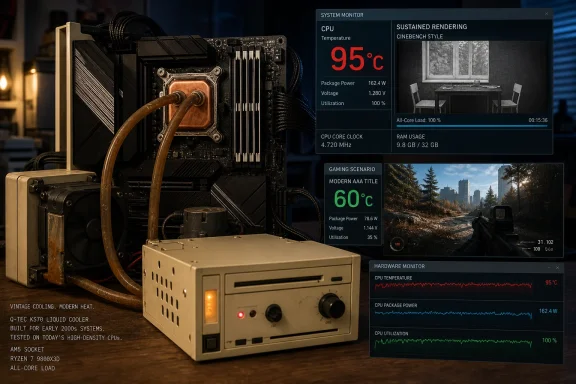 The Q-Tec KS70 was built for a different PC era
The KS70’s design explains why the experiment is interesting and why it should not be mistaken for an upgrade path. Contemporary coverage from 2004 described the Q-Tec as a compact kit for Pentium 4 and Athlon XP systems: a copper CPU block connected by tubing to a pump-and-radiator assembly installed in a spare 5.25-inch drive bay.
That installation method was practical when full-tower and mid-tower cases commonly had several optical-drive bays. It is now a mechanical liability. Most current ATX cases omit 5.25-inch bays, while compact cases have long since abandoned them in favor of front-mounted fans, radiators, storage mounts or simply unobstructed airflow.
Der8auer reportedly solved the socket mismatch with a 3D-printed AM5 mounting adapter and ran the hardware outside the case. That keeps the project in the category of a controlled enthusiast demonstration. It does not establish how the KS70 would behave installed in the confined drive bay for which it was designed, with heat from a graphics card, motherboard VRMs and storage devices circulating through the chassis.
The difference matters especially because the small radiator and its two fans would have been designed around processors whose total heat output and package geometry belonged to another generation. AMD rates the Ryzen 7 9800X3D as a 120 W desktop part, and its Zen 5 cores plus 3D V-Cache package concentrate demanding thermal conditions beneath an AM5 integrated heat spreader. “Liquid cooling” describes the transport medium, not a guaranteed level of heat dissipation.
Gaming temperatures are not a cooler qualification test
Wccftech reported that the 9800X3D stayed around 60°C during gaming, with CPU utilization generally below 30%, while reaching its stated 5.2 GHz maximum boost. That is plausible, but it is also the least demanding way to test a CPU cooler on a processor selected primarily for gaming performance.
Many games do not fully load all eight cores and 16 threads continuously. They can generate sharp bursts of work on a few cores, and GPU limitations often reduce CPU package power further. A cooler’s thermal mass can absorb those transient bursts even when its radiator cannot remove comparable heat indefinitely.
Cinebench R23 reverses those conditions by holding every core under a sustained rendering load. In Wccftech’s account, that pushed the 9800X3D to approximately 95°C and reduced its clock behavior to around 5.0 GHz. The test therefore demonstrates a narrow but important point: the vintage cooler can support a gaming-oriented workload, but it cannot provide the thermal margin expected for repeated all-core rendering, compiling, encoding or similar CPU-heavy tasks.
Calling the KS70 “flawless” in gaming overstates the evidence. A gaming session with a CPU below 30% utilization proves the system can run that workload; it does not establish coolant-pump reliability, long-duration stability, noise levels, coolant condition, leakage risk or performance during a hot summer day. Those variables matter more with a discontinued two-decade-old sealed cooling system than with a current retail cooler supported by a warranty.
AMD’s 95°C limit changes the reading of the test
The 95°C result needs context that Wccftech’s framing largely skips. AMD lists 95°C as the 9800X3D’s Tjmax and recommends liquid cooling for optimal performance. Modern Ryzen processors are designed to respond to available cooling capacity, rather than treating a temperature near Tjmax as immediate evidence of malfunction.
The concern is sustained performance margin, not a 95°C reading by itself. If a CPU reaches its temperature cap under a repeatable all-core workload, Precision Boost has less room to increase frequency or voltage. In practical terms, users may see lower multicore benchmark scores, more fan noise, or both, compared with a capable modern tower air cooler or current AIO.
The available report does not provide the data necessary to quantify that gap. Wccftech did not publish ambient room temperature, CPU package power, Cinebench score, coolant temperature, fan speed, noise measurement, test duration, thermal-paste details, BIOS settings, Precision Boost Overdrive status, or a matched modern cooler comparison using the same system configuration.
Those omissions are not minor details. A 95°C reading could result from an intentionally permissive motherboard power configuration, poor block mounting pressure from the custom bracket, aged coolant or pump performance, a particular fan curve, or simply the limited capacity of the compact radiator. Without a modern control cooler and benchmark scores, there is no defensible percentage for how much performance the Q-Tec hardware left on the table.
An old liquid loop carries risks the benchmark does not measure
The more relevant lesson for PC builders is not that every old cooler is unusable. It is that a vintage liquid-cooling kit is a restoration project, not a component to trust by default in a daily workstation or gaming PC.
A pump can spin yet deliver reduced flow. Plastic tubing, seals and O-rings can age even when a system has spent years in storage. Coolant can evaporate, contaminate or lose its corrosion protection. A reused unit also has no meaningful warranty path if a brittle fitting leaks over a current AM5 motherboard and graphics card.
Anyone attempting a similar experiment should test the loop independently before bringing it near expensive hardware: inspect fittings and tubing, run the pump for hours outside the system, check for seepage, monitor flow if possible, and use a modern temperature-monitoring tool during both games and sustained workloads. A CPU that reaches its thermal limit is one issue; a decades-old liquid loop that leaks is a far costlier one.
At publication, no other independent outlet appears to have reported Der8auer’s specific KS70-on-9800X3D test, so the exact clocks and temperatures remain attributable to Wccftech’s account. The broader conclusion is clear anyway: the Q-Tec KS70’s survival is impressive, but its performance belongs to the era for which it was built. On a Ryzen 7 9800X3D, it is a compelling bench experiment—not evidence that a 5.25-inch-bay cooler should replace modern cooling in a machine that must handle sustained work.