

The distinction is more than technical. Financial-data licenses, source attribution, entitlement checks and auditability are the hard parts of deploying outside intelligence in an AI assistant. Microsoft’s own documentation shows that S&P Global is already listed both as a federated Copilot connector and, in a more specific form, as an S&P Global Energy plugin for Copilot Cowork. The newly reported expansion appears to widen that relationship across more S&P Global information and more Copilot surfaces, rather than introduce S&P Global’s first integration with Microsoft 365.
Breakingthenews.net said the arrangement covers “AI-ready” S&P Global data, insights and analytics and includes a Copilot in Excel connector plus a Copilot Cowork plugin. Neither S&P Global nor Microsoft had published a matching detailed announcement in the materials available Wednesday, so key commercial details remain unconfirmed: which S&P Global datasets are included, which subscriptions qualify, where the rollout begins, and whether customers must buy an additional Microsoft 365 Copilot license or an upgraded S&P entitlement.
Two Copilot integration paths are involved
Microsoft’s product documentation indicates that the reported partnership spans two technically different distribution models: federated connectors for Microsoft 365 Copilot and partner plugins for Copilot Cowork.
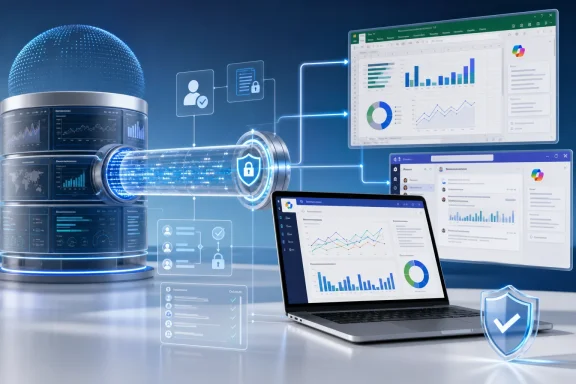
A federated Copilot connector retrieves information from an outside provider in real time through the Model Context Protocol, or MCP. Microsoft says the content remains in the source system, is accessed using the individual user’s identity and permissions, and is not indexed into Microsoft 365. S&P Global is now listed among the financial-services sources available through that federated-connector framework, alongside providers such as Moody’s, Morningstar, PitchBook, LSEG and FactSet.
Microsoft currently identifies three supported experiences for federated connectors: Microsoft 365 Copilot Chat, Copilot in Excel and the Researcher agent. That lines up with Breakingthenews.net’s reference to an Excel connector. A finance analyst could, in principle, use Copilot in Excel to ask for current market intelligence or structured reference data while working in a workbook, but the response is still bounded by the permissions held in the user’s S&P Global account.
Copilot Cowork uses a separate plugin model. Microsoft says a Cowork plugin can package skills, external connectors, or both, and is distributed through the Microsoft 365 App Store. Its available-partner list already includes “S&P Global Energy — AI Ready & Structured Data,” while its broader connector gallery includes S&P Global as a publisher whose connector surfaces S&P information in Copilot, SharePoint, Outlook and Teams.
This means IT teams should not treat “S&P Global in Copilot” as one uniform feature. The connector route is designed for live, read-only access to source data in selected Copilot experiences. A Cowork plugin can add specialized workflows and tools to an agentic experience, potentially shaping how Copilot conducts financial research or gathers context across several steps.
“Automatically connect” still requires tenant and user controls
The supplied report says licensed S&P Global information will automatically connect to Microsoft 365 tools. Microsoft’s administration documentation describes a more qualified process.
For federated connectors, administrators can enable or disable the technology tenant-wide, enable individual sources, and limit availability to specific Microsoft Entra ID groups. Users then authenticate with their own credentials when they first connect to the source. Microsoft says the service only retrieves material the user already has permission to access in the original system.
For Cowork plugins, the tenant administrator can deploy a plugin across the organization or to named groups. A deployed plugin can be automatically acquired for the selected users, but external connectors inside it may still require each person to complete a one-time sign-in or consent flow. An admin cannot authenticate to S&P Global on a user’s behalf.
That undercuts any assumption that an S&P Global subscription alone makes the intelligence instantly available inside every employee’s Copilot session. A successful deployment will need three separate approvals:
- The organization needs the relevant S&P Global entitlement for the data or workflow in question.
- The user needs a Microsoft 365 Copilot license for the Copilot experiences Microsoft identifies as supported.
- The Microsoft 365 administrator needs to approve, deploy or enable the connector or Cowork plugin under the tenant’s app-governance rules.
For regulated firms, the user-level permission model is the important safeguard. It avoids a simple bulk export of S&P Global content into a corporate Microsoft 365 index, which could otherwise create difficult questions over data retention, access reviews and redistribution restrictions. Microsoft says its federated connectors retrieve data live, do not store it in Microsoft 365, and are auditable through Microsoft Purview.
Those controls do not remove the need to test answers for licensing and attribution requirements. S&P Global’s data products include research, benchmarks, ratings-related information, commodity intelligence and other material with different access terms. A connector can enforce who may retrieve source content; it does not automatically establish that a generated summary may be copied into a customer report, broadly forwarded or used in a regulated decision workflow.
The partnership extends an integration already in market
S&P Global’s relationship with Microsoft Copilot is not new. In April 2025, S&P Global announced AI agent capabilities using Commodity Insights data in Microsoft 365 Copilot through its AI Ready Data offering. The company said at the time that its Commodities integration required no coding and gave Copilot users access to commodity-sector reports, news, commentary, analyses and outlooks.
S&P Global’s 2025 annual-report material also described an expanded Microsoft relationship for its Energy business, using a Microsoft-certified custom connector to surface AI Ready Data in Copilot and other Microsoft applications. Microsoft’s current Cowork plugin catalog reflects that earlier energy-specific presence.
What appears new in Wednesday’s report is the stated scope: S&P Global is positioning a wider mix of its intelligence products for Microsoft 365 Copilot and agentic workflows, instead of presenting the work solely as a Commodity Insights or Energy integration. That matters for financial-services and corporate-strategy teams that use S&P Global Market Intelligence, but the public report does not specify whether products such as Capital IQ, ratings data, mobility information, indices or private-markets datasets are included.
The same uncertainty applies to availability. Microsoft’s connector gallery contains an S&P Global listing, but a listing does not identify a universal deployment date, regional availability, licensing tier or all supported data products. Organizations should avoid promising business users access to a particular S&P screen, dataset or analytic until S&P Global identifies the exact connector capabilities and the data entitlement model.
What Microsoft 365 administrators should verify first
This is a data-governance project before it is an AI rollout. Administrators assessing the expanded S&P Global relationship should begin by identifying which integration path their users actually need: federated data access in Copilot Chat, Excel and Researcher, or an agentic Cowork workflow with a plugin.
They should then validate that the S&P Global account model maps cleanly to Microsoft Entra ID identities. Microsoft’s federated approach depends on user credentials and source-system permissions, so shared accounts, inconsistent email domains and weak entitlement hygiene can become operational blockers. This is especially relevant when a firm has different S&P Global subscriptions across investment research, commodity trading, risk, procurement and corporate development teams.
Microsoft says federated connectors can be staged to specified Entra groups, which makes a small pilot the sensible first move. Put a limited analyst group through realistic tasks: retrieve a data point, trace it to the S&P Global source, compare the answer with the provider’s native interface, and test what occurs when a user lacks the underlying entitlement. Audit logs should be reviewed during that pilot, rather than after the connector has reached a broad user population.
Copilot Cowork requires a parallel review. Microsoft allows admins to deploy plugins through the Microsoft 365 admin center, scope them to groups and block them entirely. But Microsoft also notes that Information Barriers are not currently supported for plugin and skill management and sharing. Firms that rely on Information Barriers should treat that limitation as a deployment constraint, not a footnote.
The immediate consequence is governed access, not a new data repository
The value proposition is clear: market intelligence becomes reachable from the documents, spreadsheets and research workflows where decisions are made. S&P Global’s Sally Moore described the goal as embedding trusted data where clients work and enabling agentic capabilities that turn insight into action, in comments reported by Breakingthenews.net.
The more consequential fact is the architecture Microsoft documents. S&P Global data fetched through a federated connector remains external, is requested in real time and follows the source provider’s permissions. That makes the expansion easier to defend in organizations that cannot simply ingest licensed market data into a general corporate AI corpus.
Customers now need the missing operational details from S&P Global and Microsoft: the exact products covered, release timing, supported regions, price and entitlement requirements, and the treatment of source links and citations in Copilot output. Until those arrive, the appropriate action is to inventory existing S&P Global licenses and prepare a controlled Microsoft 365 Copilot pilot—not to assume that a partner announcement has already granted every Copilot user access to institutional-grade financial intelligence.
Update: S&P Global confirms Kensho-powered, cited retrieval for Microsoft 365 Copilot (August 13, 2026)
S&P Global has now formally confirmed the expanded Microsoft collaboration, replacing the earlier third-party report with details from the company itself. The integration uses the S&P Global AI Data Portal’s Deterministic Retrieval solution, also called the Kensho LLM-ready API, to provide Microsoft 365 Copilot with real-time S&P Global content designed to be accurate, verifiable and accompanied by source attribution.
The announcement confirms support for a Copilot in Excel connector and a Copilot Cowork plugin, building on the existing Energy AI Ready Data integration. S&P Global says the expanded capability is intended for company research, financial analysis, transcript intelligence, peer benchmarking and competitive analysis within Microsoft 365.
For administrators and regulated users, the company’s emphasis on licensed-content connectivity rather than a standalone AI repository reinforces the earlier governance distinction: the intended model is contextual retrieval with traceability, not broad ingestion of market intelligence into a general Microsoft 365 data store.