
News Corp Australia’s report that The Salvation Army Australia is using an AI chatbot to save “thousands of hours” points to a real enterprise deployment, but the available record leaves the headline’s most important figure untested. The assistant, called Goldie, has been described publicly as a Moveworks-based tool that helps staff search for information, obtain answers and complete routine work; no public case study currently identifies the number of hours saved, the measurement period, the number of employees using it, or Goldie’s answer-accuracy rate.
That omission matters more here than it would for an ordinary office automation pilot. The Salvation Army works with people seeking housing, financial assistance, family-violence support and other high-stakes services. Its public-facing contact operations handle more than one million calls a year across 10 contact centres, according to Genesys’ customer account of the charity’s earlier contact-centre modernisation. A bot that retrieves internal policy quickly could remove significant administrative friction. A bot that retrieves an outdated policy, exposes information to the wrong employee, or is mistaken for a source of casework advice could do the opposite.
The useful lesson is not that Australian organisations should avoid AI assistants because models can be wrong. It is that accuracy is an operating-design problem, not a chatbot feature. The practical solution is to constrain what the assistant can answer from, distinguish reliable retrieval from generative guessing, and keep people accountable for decisions that affect clients.
The public evidence points to Goldie being an employee-facing assistant rather than a replacement for frontline crisis support. Posts from attendees at a Melbourne event hosted by 89 Solutions in July described The Salvation Army’s Moveworks assistant as helping teams “search, answer and action” everyday tasks so staff can focus on the organisation’s mission. Zane Kuramoto, then associated with The Salvation Army Australia’s customer-experience and emerging-technology work, was named as the speaker discussing the deployment.
That distinction is vital. An internal AI assistant answering staff questions about leave, IT support, processes, templates or approved internal guidance has a much more manageable risk profile than a public chatbot advising a person in financial distress. The system’s audience is trained employees, access can be tied to workplace identity, and bad answers can be escalated through established internal channels.
Moveworks itself markets its platform as an enterprise assistant connected to internal systems including Microsoft OneDrive, SharePoint, Outlook, Google Drive, Slack and ServiceNow. Its web deployment documentation says authentication can be handled through identity providers such as Microsoft Entra ID and Okta, with checks intended to confirm both the identity of the user and their authorisation to access the assistant. Those controls are useful, but they do not establish that a particular Salvation Army deployment uses every connector, permission model or governance control the platform offers.
The Salvation Army’s own history gives a reason to separate employee assistance from public automation. Its earlier Genesys implementation was focused on a contact-centre operation where callers may be navigating housing, addiction, violence or financial hardship. The organisation can automate queues, callbacks and information discovery without treating an AI output as a substitute for a qualified person handling a vulnerable client’s situation.
There is no disclosed baseline such as average time spent looking for internal information before Goldie, no reported number of resolved requests, no split between IT, HR and operational use, and no indication of whether the figure reflects elapsed employee time, support-team handling time, or a vendor-estimated productivity benefit. There is also no published explanation of whether the hours are annualised, cumulative since rollout, or projected.
That is not a technicality. AI productivity figures are frequently calculated by multiplying an assumed time saving per interaction by a large volume of interactions. That can be a reasonable planning estimate, but it is different from verified capacity released for real work. If staff use the saved minutes to check answers, work around failures or ask a colleague to validate an uncertain response, the gross time saving is not the net operational gain.
The same issue applies to accuracy. A chatbot can appear successful if it produces a fluent answer quickly, even when the answer does not resolve the user’s task. Organisations should measure whether the answer was accepted, whether the employee still opened a ticket or contacted a person, whether the source cited by the assistant was current, and whether an answer resulted in a correction, complaint or escalation.
For Windows and Microsoft 365 administrators, this is familiar territory. A polished chat interface over SharePoint and OneDrive does not improve the quality of the underlying knowledge base. If a retired procedure remains searchable beside the current one, retrieval-augmented generation can make the old answer easier to find and more convincing to read. A language model’s confidence is not a version-control system.
The National AI Centre similarly warns that AI can generate incorrect, incomplete or misleading results that are difficult to identify, especially when systems operate at scale or interact with the public. Its guidance identifies direct customer interaction, decisions about people, minimal human oversight, sensitive data and continuous operation as conditions that require stronger safeguards.
The Australian Cyber Security Centre adds a security dimension that is often lost in productivity announcements. AI systems can be manipulated through prompt injection: malicious text embedded in an email, document, support ticket or web page that attempts to steer the model into leaking data, ignoring its instructions or giving an unsafe answer. A system connected to collaboration repositories, knowledge bases and workflow tools must be treated as an identity-and-data-access project, not a simple chat rollout.
For a charity, the stakes also include trust. The Australian Charities and Not-for-profits Commission advises organisations using AI to allow time for outputs to be checked for accuracy and unintended bias, particularly where poor data or flawed design could harm people or weaken the human connection central to charitable work.
None of this means Goldie is unsafe. It means a credible deployment needs evidence beyond an hours-saved headline.
That is a more conservative arrangement than allowing a general-purpose model to compose an answer from broad internal data, but it is the design most likely to produce dependable results in policy-heavy environments. It also makes auditing possible. When an employee challenges a response, an administrator should be able to identify the exact document, version, permissions and workflow that produced it.
A workable operating model includes several controls:
What the record does not yet support is treating “thousands of hours saved” as an independently verified productivity result, or assuming that Goldie’s success proves an AI assistant is accurate enough for client-facing advice or consequential decisions. The missing numbers are the story: usage, task scope, source controls, error rate, escalation rate and the method used to count time saved.
For Australian companies adopting Microsoft Copilot, ServiceNow, Moveworks or custom retrieval systems, that is the benchmark worth copying. Publish the boundaries, measure the failures as carefully as the wins, and make the assistant useful enough that employees save time without being asked to trust an answer they cannot verify.
The useful lesson is not that Australian organisations should avoid AI assistants because models can be wrong. It is that accuracy is an operating-design problem, not a chatbot feature. The practical solution is to constrain what the assistant can answer from, distinguish reliable retrieval from generative guessing, and keep people accountable for decisions that affect clients.
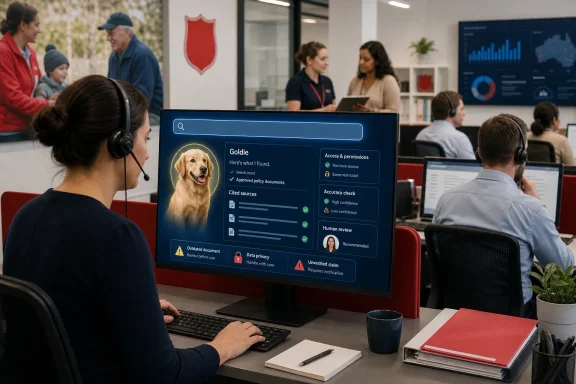 Goldie appears to be an internal work assistant
The public evidence points to Goldie being an employee-facing assistant rather than a replacement for frontline crisis support. Posts from attendees at a Melbourne event hosted by 89 Solutions in July described The Salvation Army’s Moveworks assistant as helping teams “search, answer and action” everyday tasks so staff can focus on the organisation’s mission. Zane Kuramoto, then associated with The Salvation Army Australia’s customer-experience and emerging-technology work, was named as the speaker discussing the deployment.That distinction is vital. An internal AI assistant answering staff questions about leave, IT support, processes, templates or approved internal guidance has a much more manageable risk profile than a public chatbot advising a person in financial distress. The system’s audience is trained employees, access can be tied to workplace identity, and bad answers can be escalated through established internal channels.
Moveworks itself markets its platform as an enterprise assistant connected to internal systems including Microsoft OneDrive, SharePoint, Outlook, Google Drive, Slack and ServiceNow. Its web deployment documentation says authentication can be handled through identity providers such as Microsoft Entra ID and Okta, with checks intended to confirm both the identity of the user and their authorisation to access the assistant. Those controls are useful, but they do not establish that a particular Salvation Army deployment uses every connector, permission model or governance control the platform offers.
The Salvation Army’s own history gives a reason to separate employee assistance from public automation. Its earlier Genesys implementation was focused on a contact-centre operation where callers may be navigating housing, addiction, violence or financial hardship. The organisation can automate queues, callbacks and information discovery without treating an AI output as a substitute for a qualified person handling a vulnerable client’s situation.
The “thousands of hours” claim has no public baseline
News Corp’s inaccessible article carries a strong efficiency claim in its URL description: the AI chatbot “saves thousands of hours.” But neither the source material supplied with the report nor independently accessible public material provides the calculation behind that statement.There is no disclosed baseline such as average time spent looking for internal information before Goldie, no reported number of resolved requests, no split between IT, HR and operational use, and no indication of whether the figure reflects elapsed employee time, support-team handling time, or a vendor-estimated productivity benefit. There is also no published explanation of whether the hours are annualised, cumulative since rollout, or projected.
That is not a technicality. AI productivity figures are frequently calculated by multiplying an assumed time saving per interaction by a large volume of interactions. That can be a reasonable planning estimate, but it is different from verified capacity released for real work. If staff use the saved minutes to check answers, work around failures or ask a colleague to validate an uncertain response, the gross time saving is not the net operational gain.
The same issue applies to accuracy. A chatbot can appear successful if it produces a fluent answer quickly, even when the answer does not resolve the user’s task. Organisations should measure whether the answer was accepted, whether the employee still opened a ticket or contacted a person, whether the source cited by the assistant was current, and whether an answer resulted in a correction, complaint or escalation.
For Windows and Microsoft 365 administrators, this is familiar territory. A polished chat interface over SharePoint and OneDrive does not improve the quality of the underlying knowledge base. If a retired procedure remains searchable beside the current one, retrieval-augmented generation can make the old answer easier to find and more convincing to read. A language model’s confidence is not a version-control system.
Australian guidance makes accuracy a governance requirement
Australian regulators and government bodies have been unusually direct about this risk. The Office of the Australian Information Commissioner warns that generative AI may create confident but inaccurate outputs and says organisations remain responsible for the accuracy, currency and completeness of personal information they collect, use or disclose. The obligation does not disappear because an AI supplier produced the output.The National AI Centre similarly warns that AI can generate incorrect, incomplete or misleading results that are difficult to identify, especially when systems operate at scale or interact with the public. Its guidance identifies direct customer interaction, decisions about people, minimal human oversight, sensitive data and continuous operation as conditions that require stronger safeguards.
The Australian Cyber Security Centre adds a security dimension that is often lost in productivity announcements. AI systems can be manipulated through prompt injection: malicious text embedded in an email, document, support ticket or web page that attempts to steer the model into leaking data, ignoring its instructions or giving an unsafe answer. A system connected to collaboration repositories, knowledge bases and workflow tools must be treated as an identity-and-data-access project, not a simple chat rollout.
For a charity, the stakes also include trust. The Australian Charities and Not-for-profits Commission advises organisations using AI to allow time for outputs to be checked for accuracy and unintended bias, particularly where poor data or flawed design could harm people or weaken the human connection central to charitable work.
None of this means Goldie is unsafe. It means a credible deployment needs evidence beyond an hours-saved headline.
A reliable assistant needs boundaries before it needs a larger model
The most defensible model for an internal assistant is a narrow one: answer from approved, named sources; show the employee where the answer came from; respect the same document permissions the employee already has; and decline to answer when there is no verified source.That is a more conservative arrangement than allowing a general-purpose model to compose an answer from broad internal data, but it is the design most likely to produce dependable results in policy-heavy environments. It also makes auditing possible. When an employee challenges a response, an administrator should be able to identify the exact document, version, permissions and workflow that produced it.
A workable operating model includes several controls:
- The organisation should assign a business owner to each knowledge domain, with a documented review date and a process for withdrawing superseded documents from search.
- The assistant should label answers drawn from approved internal sources and clearly state when it is generating a draft, summary or suggestion rather than retrieving a confirmed policy answer.
- High-impact actions such as changing access, approving payments, editing records or communicating client decisions should require explicit human confirmation and a logged workflow.
- Administrators should test the bot against adversarial prompts, stale documents, conflicting policies, permission boundaries and realistic employee phrasing before expanding access.
- Staff should have a frictionless way to report an incorrect answer, with reports feeding a visible correction process rather than disappearing into model telemetry.
The evidence supports cautious optimism, not a performance verdict
The Salvation Army’s reported use of Goldie is a sensible example of where enterprise AI can start: internal search and workflow support, aimed at giving staff more time for work that requires judgment and empathy. The public record also supports the conclusion that the charity has invested substantially in customer-experience technology and is actively exploring AI’s ethical implications; a Salvation Army taskforce sought a seminar on AI risks and benefits while developing a chatbot initiative in 2025.What the record does not yet support is treating “thousands of hours saved” as an independently verified productivity result, or assuming that Goldie’s success proves an AI assistant is accurate enough for client-facing advice or consequential decisions. The missing numbers are the story: usage, task scope, source controls, error rate, escalation rate and the method used to count time saved.
For Australian companies adopting Microsoft Copilot, ServiceNow, Moveworks or custom retrieval systems, that is the benchmark worth copying. Publish the boundaries, measure the failures as carefully as the wins, and make the assistant useful enough that employees save time without being asked to trust an answer they cannot verify.
References
- Primary source: NT News
Published: 2026-08-01T00:42:07.473211
Loading…
www.ntnews.com.au